If you’ve seen “IDM” in a text message, social media comment, or online chat, you may wonder what it means. Internet slang changes quickly and many abbreviations have more than one meaning.
That’s why people often search for the IDM meaning in text.
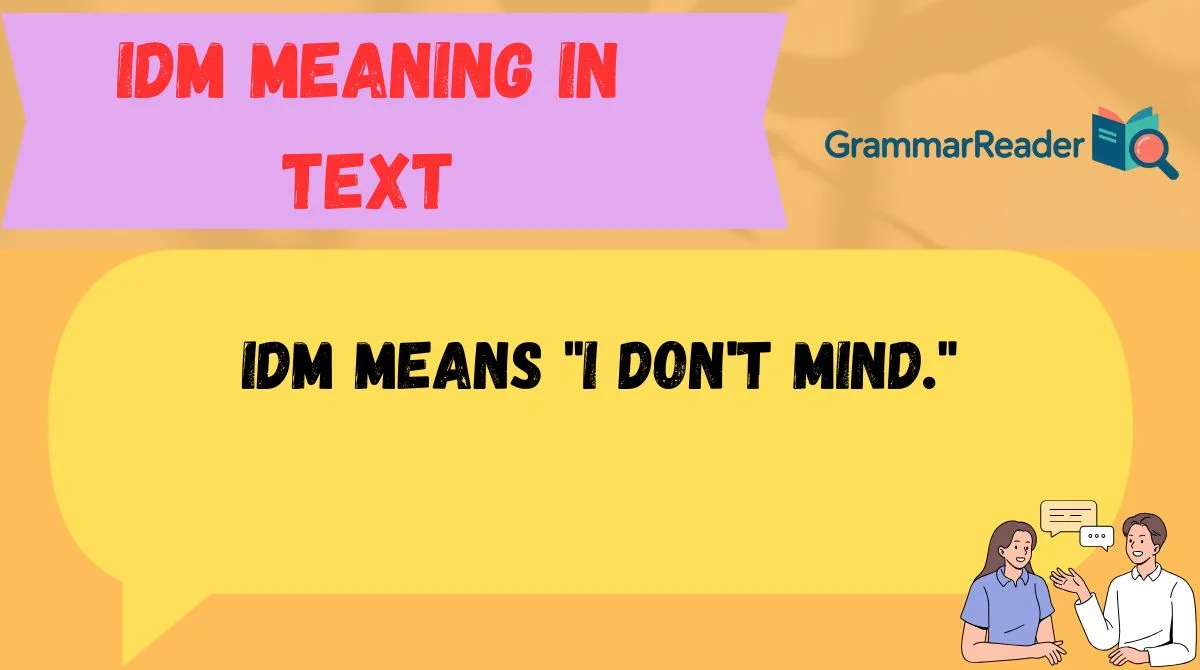
In texting and online conversations, IDM usually means “I Don’t Mind.” People use it to show that they are okay with something and have no strong preference either way.
You’ll often see IDM in text messages, group chats, social media comments, and messaging apps like WhatsApp, Instagram, TikTok, and Snapchat.
In this guide, you’ll learn what IDM means, where it came from, how people use it, examples of real conversations, and other meanings of IDM in different fields.
What Does IDM Mean in Text & Chat?
IDM means “I Don’t Mind.”
It’s a casual abbreviation people use when they are happy with any option or decision.
Simple Definition
IDM = I Don’t Mind = I’m okay with it.
It shows:
- No strong preference
- Agreement with different choices
- Flexibility
- A relaxed attitude
Example
Friend: “Should we order pizza or burgers?”
You: “IDM. Either is fine.”
In this case, the person is comfortable with both options.
Full Form, Stands For & Short Meaning of IDM
| Term | Meaning |
|---|---|
| IDM | I Don’t Mind |
| Short Meaning | I’m okay with it |
| Tone | Friendly and casual |
| Purpose | Expressing flexibility |
There is no separate official full form in texting beyond “I Don’t Mind.”
Origin, History & First Known Use of IDM
IDM became popular as internet slang during the rise of:
- SMS texting
- Instant messaging platforms
- Chat rooms
- Social networking sites
As people started shortening common phrases to type faster, expressions like:
- LOL
- BRB
- IMO
- IDK
- IDM
became part of everyday online communication.
“I don’t mind” has existed in English for centuries. The abbreviation IDM gained popularity once texting and messaging apps became widely used.
How People Use IDM in Daily Conversations
People use IDM when they:
- Have no preference
- Want to sound easygoing
- Agree with someone else’s suggestion
- Avoid making the decision themselves
Texting Examples
Person A: “Want to watch a movie or play games?”
Person B: “IDM.”
Person A: “Should we meet at 6 or 7?”
Person B: “IDM, whatever works.”
Social Media Usage
Someone posts:
“Should I cut my hair short?”
Comment:
“IDM, both styles look great.”
Casual Situations
Friend: “Window seat or aisle?”
You: “IDM.”
The phrase is short, friendly, and convenient.
IDM Meaning Across WhatsApp, Instagram, TikTok & Snapchat
On WhatsApp, IDM almost always means:
“I Don’t Mind.”
Example:
“We can talk tomorrow if you’re busy.”
“IDM 😊”
On Instagram, IDM is often used in:
- Comments
- Direct messages
- Story replies
Example:
“Should I post this picture?”
“IDM, it looks nice.”
TikTok
TikTok users may write IDM in comments to show they are fine with different opinions or choices.
Example:
“Which song should I use?”
“IDM. Both fit the video.”
Snapchat
On Snapchat, IDM usually carries the same meaning.
Example:
“Should I send the snap?”
“IDM 😂”
Across these platforms, the meaning stays mostly the same.
Different Meanings of IDM in Other Fields
Although texting usually uses IDM for “I Don’t Mind,” the abbreviation can have other meanings.
| Field | Meaning |
|---|---|
| Texting | I Don’t Mind |
| Technology | Identity Management |
| Business | Integrated Data Management |
| Music | Intelligent Dance Music |
| Education | Instructional Decision Making |
Context helps determine the intended meaning.
For example:
“Our company upgraded its IDM system.”
Here, IDM refers to Identity Management, not “I Don’t Mind.”
Common Confusions, Mistakes & Wrong Interpretations
Many people misunderstand IDM because it has several meanings.
Common Mistakes
Assuming It Means “I Don’t Know”
No. That’s usually:
IDK = I Don’t Know
Thinking It’s Rude
IDM is generally polite and friendly.
Believing It Means Someone Doesn’t Care
Not exactly.
“I don’t mind” means:
“I’m fine with either choice.”
It doesn’t necessarily mean the person is uninterested.
Similar Terms, Alternatives & Related Slang
| Term | Meaning | Usage |
|---|---|---|
| IDM | I Don’t Mind | No preference |
| IDK | I Don’t Know | Lack of information |
| IDC | I Don’t Care | No interest or concern |
| IMO | In My Opinion | Giving an opinion |
| NVM | Never Mind | Ignore previous statement |
| Up to You | Your choice | Letting someone decide |
| Either Works | Both are okay | Showing flexibility |
Examples of IDM in Real Chat Situations
- “Pizza or pasta tonight?” – “IDM 😂”
- “Should we leave now?” – “IDM 😊”
- “Want to sit inside or outside?” – “IDM.”
- “Blue shirt or black shirt?” – “IDM 🤔”
- “Can we move the meeting to Friday?” – “IDM 👍”
- “Movie or bowling?” – “IDM, both sound fun 😄”
- “Should I text him first?” – “IDM, go for it 😊”
- “Can I borrow your charger?” – “IDM 😂”
- “Let’s start at 10 AM.” – “IDM.”
- “Do you want coffee?” – “IDM, tea works too 😄”
These examples show that IDM is usually positive and relaxed.
How to Reply When Someone Says IDM
Casual Replies
- “Cool, let’s do pizza then.”
- “Great, I’ll decide.”
Friendly Replies
- “Awesome, thanks for being flexible.”
- “Perfect. I’ll pick something.”
Funny Replies
- “Thanks for making my job harder 😂”
- “You really don’t make decisions, do you? 😄”
Formal Replies
- “Thank you. I’ll proceed with that option.”
- “Understood. I’ll make the arrangements.”
Is IDM Still Popular? Trends & Online Usage
Yes, IDM is still widely used.
Who Uses It Most?
- Teenagers
- Young adults
- Frequent texters
- Social media users
Where Is It Commonly Seen?
- WhatsApp chats
- Instagram DMs
- Snapchat conversations
- TikTok comments
- Group messages
- Online gaming chats
Although newer slang appears regularly, IDM remains useful because it expresses a simple idea quickly.
Quick Facts
| Factor | Details |
|---|---|
| Meaning | I Don’t Mind |
| Category | Text abbreviation |
| Tone | Casual and friendly |
| Usage Platform | Text messages, WhatsApp, Instagram, TikTok, Snapchat |
| Popularity | Moderately popular |
| Formal/Informal | Mostly informal |
FAQs
What does IDM mean on Snapchat?
On Snapchat, IDM usually means “I Don’t Mind.” People use it when they are okay with any choice or have no particular preference. It often appears in casual conversations between friends.
What does IDM mean on Instagram?
On Instagram, IDM generally means “I Don’t Mind.” Users may write it in comments, story replies, or direct messages to show flexibility or agreement.
What does IDM mean on WhatsApp?
On WhatsApp, IDM almost always means “I Don’t Mind.” It helps people respond quickly when they don’t have a strong opinion about a decision or suggestion.
Is IDM rude?
No. IDM is usually polite and easygoing. It simply means the person is fine with different options. However, depending on tone and context, it can occasionally sound indifferent.
What does IDM mean from a girl?
When a girl says IDM, it generally means she has no strong preference and is comfortable with either option. The phrase itself does not carry any hidden meaning.
What does IDM mean from a guy?
When a guy uses IDM, it usually means exactly what it says: “I Don’t Mind.” He’s indicating that any of the suggested choices work for him.
Does IDM mean the same as IDC?
No. IDM means “I Don’t Mind,” which sounds flexible and agreeable. IDC means “I Don’t Care,” which can sound more dismissive or uninterested.
Conclusion
The IDM meaning in text is usually “I Don’t Mind.” It’s a simple abbreviation that shows flexibility and a relaxed attitude toward a choice or suggestion.
People commonly use it in text messages, social media conversations, and messaging apps such as WhatsApp, Instagram, TikTok, and Snapchat.
While IDM can have other meanings in technology, business, and music, the context of the conversation usually makes the intended meaning clear.
If someone replies with “IDM,” they’re typically saying that either option works for them and they don’t have a strong preference.

Aiden Brooks is an educational writer dedicated to simplifying grammar for learners of all levels. He creates clear, practical explanations that help students read, write, and understand English with confidence.