Last updated on June 3rd, 2026 at 04:31 pm
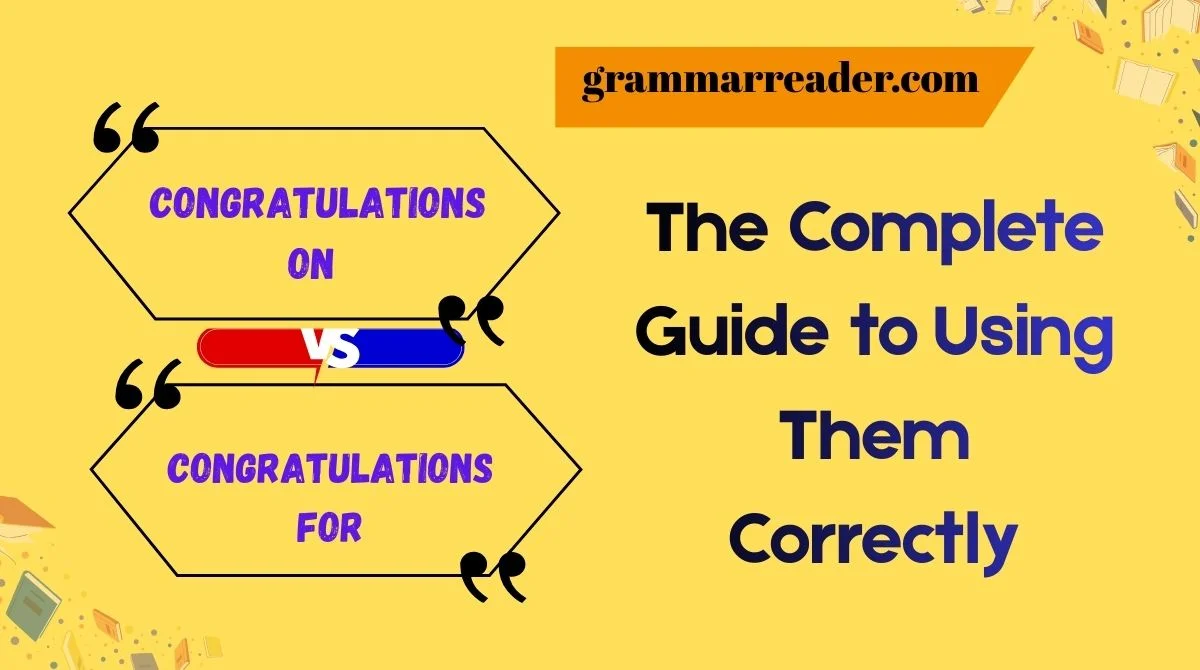
English gives you endless ways to praise someone, but few expressions confuse learners more than “Congratulations on” and “Congratulations for.”
Both sound right sometimes which makes things even trickier.
This guide breaks everything down in simple language. You’ll learn exactly when to use each phrase, why one is more common, and how meaning shifts with context so your congratulatory messages always sound natural.
Let’s dive in.
Most people don’t think about prepositions until one feels off.
Congratulatory phrases are a perfect example. You’ll hear:
- “Congratulations on your new job!”
- “Congratulations for helping the team!”
Both look similar. Both sound kind.
So why do native speakers prefer one over the other in certain situations?
Because “on” and “for” change the focus of the praise.
- “On” connects your congratulations to an achievement, milestone, or event.
- “For” connects your congratulations to an action, behavior, or reason that deserves praise.
Once you understand the difference, your English instantly sounds more natural.
Core Difference in Simple Terms

Here’s the difference in one line:
“Congratulations ON” = result or achievement
“Congratulations FOR” = reason or action
You use on when the outcome matters.
You use for when the behavior matters.
This one sentence will carry you through almost every example.
“Congratulations On”: Meaning and Correct Usage
What it means
“Congratulations on” celebrates a result, achievement, status, or important event.
This is why you hear it in formal settings like weddings, graduations, promotions, and awards.
When to use it
Use “congratulations on” when the subject achieved or reached something, such as:
- A life event
- A milestone
- A career achievement
- A status change
- A new possession
- A completed action
Examples
| Event / Achievement | Correct Phrase |
|---|---|
| Marriage | Congratulations on your wedding |
| Graduation | Congratulations on graduating |
| Job | Congratulations on your new job |
| Promotion | Congratulations on your promotion |
| Award | Congratulations on winning the award |
| New Home | Congratulations on your new house |
| Baby | Congratulations on the birth of your baby |
| Success | Congratulations on your success |
Notice that all of these focus on something achieved or completed.
Why “on” is standard
It links the praise to a specific point:
Congratulations on reaching this milestone.
The preposition “on” behaves like “on the occasion of,” which matches celebrations and achievements perfectly.
“Congratulations For”: Meaning and Correct Usage
What it means
“Congratulations for” praises a reason, action, or behavior that deserves recognition.
You’re appreciating what they did rather than what they achieved.
When to use it
Use it when you’re focusing on:
- Effort
- Good behavior
- Positive choices
- Courage
- Helping others
- Trying something difficult
Examples
| Action / Reason | Correct Phrase |
|---|---|
| Helping someone | Congratulations for helping your friend |
| Volunteering | Congratulations for volunteering this year |
| Good decision | Congratulations for making a brave choice |
| Hard work | Congratulations for working so hard |
| Dedication | Congratulations for your commitment |
| Leadership | Congratulations for leading the team well |
Notice how each example highlights behavior, not just the result.
Tone shift when using “for”
Using “for” feels more conversational, personal, and emotional because it highlights the person’s character.
Congratulations for being so dedicated.
That sentence praises who they are, not just what they achieved.
Side-by-Side Comparison
Here’s a quick table to remove any remaining confusion:
| Situation | Correct Choice | Why |
|---|---|---|
| Success or milestone | Congratulations on your success | Celebrates achievement |
| Graduation | Congratulations on graduating | Celebrates completed event |
| Good behavior | Congratulations for helping others | Praises action |
| Winning something | Congratulations on winning | Focus on achievement |
| Trying hard | Congratulations for working hard | Praise for behavior |
| Wedding | Congratulations on your wedding | Event or milestone |
| New baby | Congratulations on the baby | Milestone |
| Choosing well | Congratulations for making a wise decision | Represents action |
Nuances You Should Know
Sometimes both forms work, but they express slightly different feelings.
Nuance 1: Action vs Achievement
- Congratulations on finishing the marathon
- Congratulations for training so hard for the marathon
See the difference?
“On” praises the finish.
“For” praises the effort.
Nuance 2: Formal vs informal tone
- “On” feels formal and widely accepted.
- “For” feels emotional and personal.
Nuance 3: When both sound okay but aren’t identical
- On: Congratulations on winning the contest → Focus on result
- For: Congratulations for winning the contest → Sounds like you’re praising the act of winning
Native speakers prefer “on” in this case.
Nuance 4: Cultural perception
In most English-speaking countries:
- “Congratulations on” = Standard, safe, widely used
- “Congratulations for” = Used but less common
Always choose “on” if you’re not sure.
Sentence Structure That Sounds Natural
Many learners make congratulatory sentences sound stiff.
These patterns help you write naturally.
Common patterns with “on”
- Congratulations on your ___
- Congratulations on the ___
- Congratulations on winning / graduating / achieving ___
Examples:
- Congratulations on your big achievement
- Congratulations on the successful launch
- Congratulations on completing the course
Common patterns with “for”
- Congratulations for being ___
- Congratulations for doing ___
- Congratulations for your efforts / hard work
Examples:
- Congratulations for being so patient
- Congratulations for doing great work
- Congratulations for your dedication
Avoid awkward phrasing
❌ Congratulations for your wedding
✔️ Congratulations on your wedding
❌ Congratulations for your job
✔️ Congratulations on the new job
These mistakes happen when you apply “for” to events.
Usage Trends: Which One Is More Common?
Even without data, you’ll easily notice:
“Congratulations on” is far more common.
It dominates:
- Formal writing
- Emails
- Social media
- Greetings cards
- Speeches
- Workplace communication
Why?
Because people celebrate events, results, and achievements more often than behaviors in congratulatory messages.
But “congratulations for” remains useful when you want to praise effort or character.
Real-life examples
- LinkedIn posts: almost always use “Congratulations on”
- Wedding invitations: “Congratulations on your marriage”
- Graduation cards: “Congratulations on graduating”
- Parenting: “Congratulations for being such a patient mom”
Are They Interchangeable? Honest Breakdown
Sometimes yes. Usually no.
When they are NOT interchangeable
- Congratulations on your wedding
- Congratulations on your success
- Congratulations on your promotion
- Congratulations on the new home
Using “for” here feels unnatural or incorrect.
When meaning changes depending on the preposition
- Congratulations on finishing the project → Result
- Congratulations for finishing the project → Praise for completing the task (effort emphasized)
When both can work (rare)
- Congratulations on/for winning the competition
Both work but “on” is the safer choice.
Practical Examples You Can Copy
Life Events
- Congratulations on your marriage
- Congratulations on the baby
- Congratulations on your anniversary
Career Achievements
- Congratulations on your promotion
- Congratulations on starting your business
- Congratulations on the successful interview
Personal Traits or Behavior
- Congratulations for being such a supportive friend
- Congratulations for your honesty
- Congratulations for taking responsibility
Academic Wins
- Congratulations on your scholarship
- Congratulations on graduating
- Congratulations for your hard work during exams
General Compliments
- Congratulations on your success
- Congratulations for staying committed
- Congratulations on achieving your goals
Understanding the Word “Congratulations”
Many learners wonder why the word has an s.
Why it’s plural
Historically, “congratulations” meant “expressions of joy.”
You were sending multiple good wishes, not just one.
When singular “congratulation” appears
It’s rare in modern English but you might see it in:
- Historical writing
- Highly formal documents
- Academic papers
You almost never use it in conversation.
So stick to “congratulations.”
Advanced Examples: Using “On” in Complex Sentences
Professional examples
- Congratulations on presenting such a strong report that convinced the entire board.
- Congratulations on leading the team through a difficult quarter.
- Congratulations on launching a project that exceeded expectations.
Academic examples
- Congratulations on conducting research that contributed valuable insight to your department.
- Congratulations on submitting a thesis that demonstrates originality and depth.
Creative examples
- Congratulations on producing a film that resonated with audiences.
- Congratulations on writing a book that blends emotion and storytelling beautifully.
These showcase how “on” fits naturally with achievements of any scale.
Sounding Natural: Tips You’ll Actually Use
1. Focus on results for “on”
If something happened or was achieved, use “on.”
2. Focus on actions for “for”
If someone did something meaningful, use “for.”
3. Keep sentences short
Long congratulatory messages feel stiff.
4. Use emotion
Congratulating someone should feel personal:
“I’m thrilled for you. Congratulations on the promotion!”
5. Match tone to context
- Formal email: “Congratulations on your success.”
- Friendly text: “Congrats on the win!”
- Personal praise: “Congratulations for always giving your best.”
Responding to Congratulations
Your reply should be warm and grateful.
Examples of natural responses
- Thank you so much!
- I really appreciate it.
- Thanks! That means a lot.
- Thank you for your kind words.
- I’m grateful for your support.
Don’t do this
❌ “It was nothing.”
This dismisses the compliment.
❌ “Yeah, I know.”
Sounds arrogant.
Simple and sincere works best.
Alternatives to “Congratulations”
Sometimes you want variety.
Here are natural alternatives categorized by tone.
Formal
- Well done
- My compliments
- Kudos
- I applaud your achievement
Casual
- Congrats!
- You nailed it
- Awesome job
- Proud of you
Emotional or personal
- You deserve this
- I’m so happy for you
- This is well-earned
Creative
- You knocked it out of the park
- You crushed it
- You made it happen
FAQs
What’s the difference between “Congratulations on” and “Congratulations for”?
“On” praises achievements or events. “For” praises actions or behavior. “On” is more common.
Is “Congratulations for your success” correct?
Yes, but “Congratulations on your success” sounds more natural and is the standard form.
Why do we say “Congratulations on your wedding”?
Because a wedding is an event or milestone, not a behavior. Events pair with on.
Can I use “Congratulations for winning the award”?
You can, but “Congratulations on winning the award” is preferred and sounds more natural.
Which phrase is more common overall?
“Congratulations on” is significantly more common in both spoken and written English.
Conclusion
When you’re unsure which phrase to use, follow this simple rule:
Use “Congratulations ON” for results, achievements, and events.
Use “Congratulations FOR” for actions, behavior, and reasons.
Once you see the difference, choosing the right phrase becomes effortless.
Your messages sound more natural, polished, and human—exactly what good English should feel like.

Aiden Brooks is an educational writer dedicated to simplifying grammar for learners of all levels. He creates clear, practical explanations that help students read, write, and understand English with confidence.