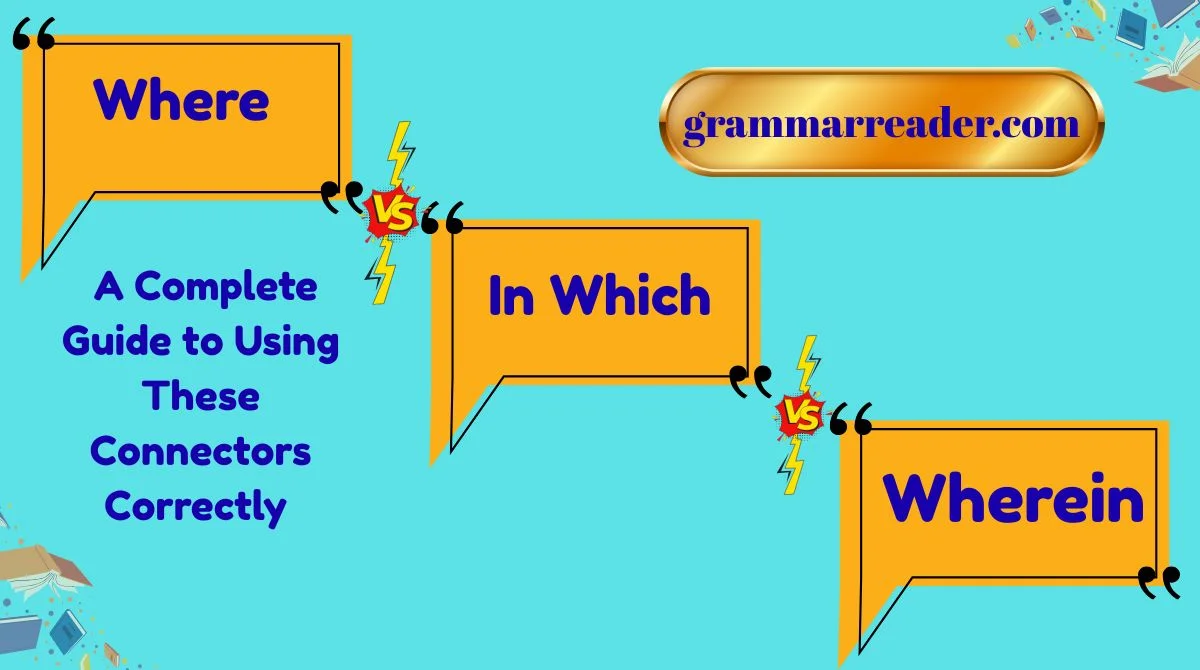
When you write, you want your sentences to feel smooth, clear, and easy to understand. That’s why choosing the right connector—where, in which, or wherein—matters more than most writers realize.
These three expressions look similar on the surface but behave very differently in your sentences. Once you learn how each one works, you’ll write with more confidence and avoid confusing your readers.
This in-depth guide breaks everything down in plain English. You’ll see examples, comparisons, tables, and even case studies. You’ll also pick up simple rules you can use every day to choose the right term.
Understanding “Where”
Definition and Core Function of “Where”
The word where works primarily as an adverb of place. You normally use it to talk about a physical location:
- The café where we met is closing.
- I don’t know where she is.
But English is flexible. You can also use where to talk about abstract places such as:
- a stage in a process
- a point in time
- a condition
- a situation
For example:
- This is the point where everything changed.
- He reached a stage where the project became unmanageable.
Here, “where” acts like a bridge between an idea and the situation surrounding it.
“Where” as a Clause Connector
You also use where to connect a main clause with a dependent clause.
Example:
- He showed me the folder where all the files were kept.
Notice there’s no preposition needed. “Where” replaces “in which”, “at which”, or “on which” when referring to a place or abstract scenario that acts like a location.
When “Where” Works for Abstract Contexts
Using “where” for non-physical places works when the noun suggests a kind of “location,” even if imaginary.
| Correct Abstract Use | Meaning |
|---|---|
| A moment where I felt proud | moment = metaphorical point |
| A condition where he couldn’t speak | condition = situation |
| A chapter where the hero returns | chapter = location inside a book |
But be careful.
Some nouns cannot act like locations. For those, “where” becomes incorrect.
Incorrect:
❌ The method where he solved the issue
Correct:
✔️ The method in which he solved the issue
Why?
Because a method is not a place—it’s a way, not a location.
Understanding “In Which”
What “In Which” Actually Means
The phrase “in which” is a prepositional relative pronoun. It connects a noun to extra information about it.
It’s more precise than “where” because it tells you the exact relationship:
- in = position inside something
- which = refers back to the noun
Example:
The box in which the books are stored is locked.
This is more formal and more structurally correct than:
The box where the books are stored.
Both work, but “in which” sounds tighter and more professional.
How “In Which” Adds Precision
You should use “in which” when:
- the noun is not a location
- the noun is abstract and not metaphorically a place
- the sentence needs formal clarity
- the grammar requires a preposition
Examples:
✔️ The report in which the results were published
✔️ A system in which data is stored
✔️ A rule in which exceptions are defined
These nouns—report, system, rule—aren’t “places,” so “where” would feel sloppy.
Choosing “In Which” for Formal or Technical Writing
You’ll often see “in which” in:
- legal writing
- academic papers
- technical documentation
- business reports
It signals precision and clarity, and sometimes you need that sharper tone.
Understanding “Wherein”
What “Wherein” Really Means
The word wherein literally means “in which.”
It’s a single-word version of the prepositional phrase.
Example:
A contract wherein all rights are transferred.
It sounds formal—sometimes too formal for modern everyday writing.
Evolution and Modern Standing
Centuries ago, English used many compound words like:
- wherein
- whereby
- whereof
- whereupon
They appear in older texts, religious writing, and classic literature.
Today “wherein” survives mainly because law, academia, and religious writing prefer very precise language.
When “Wherein” Is Still Acceptable
You can still safely use “wherein” in:
- legal definitions
- contracts
- academic papers
- religious texts
- historical or traditional-style writing
Example:
A clause wherein the tenant waives liability.
For everyday writing, however, it often sounds outdated.
Quote professionals often follow:
“Use ‘wherein’ only when precision matters more than tone.”
Direct Comparison: Where vs In Which vs Wherein
Here’s a quick table to help you understand the differences:
| Term | Meaning | Tone | Best Use |
|---|---|---|---|
| Where | A place (literal or abstract) | Neutral | Everyday writing |
| In which | Inside/involved with something | Formal | Precision, non-locations |
| Wherein | In which (compressed) | Very formal/archaic | Law, contracts, academia |
Structural Differences
Where
- Functions as a relative adverb
- Replaces preposition + which
- Works for places or “place-like” concepts
In Which
- Prepositional phrase
- Works even when the noun is not a place
Wherein
- Formal substitute for “in which”
- Rare in casual use
Functional Differences
The right choice impacts:
- clarity
- tone
- formality
- precision
Example differences:
- The meeting where we discussed it (casual, okay)
- The meeting in which we discussed it (more exact)
- The meeting wherein we discussed it (formal/old-school)
Situational Comparisons
When all three could work
The chapter ___ he appears.
- where
- in which
- wherein
All can work because a chapter is a location in a book.
When only one works
Nouns that are not “places” require “in which.”
❌ The belief where people come together
✔️ The belief in which people come together
Real Examples and Corrections
Examples of “Where”
✔️ The café where we had lunch has reopened.
✔️ A moment where everything makes sense.
✔️ The folder where I saved the drafts.
Common misuse:
❌ The idea where he started changing his business.
✔️ The idea from which he started changing his business.
Examples of “In Which”
✔️ The model in which the data is analyzed.
✔️ The platform in which users store files.
✔️ The scenario in which she discovered the error.
“In which” also helps avoid ending sentences with prepositions.
The environment in which they operate.
vs
The environment which they operate in.
The first feels more polished.
Examples of “Wherein”
✔️ The contract wherein all financial terms are defined.
✔️ A framework wherein creativity is encouraged.
✔️ A chapter wherein the villain reveals his motive.
These examples fit academic or legal contexts.
Choosing the Right Connector
Practical Selection Guidelines
Use this simple logic:
| If the noun describes… | Use… |
|---|---|
| a physical location | Where |
| an abstract “place-like” idea | Where |
| something that is not a place | In which |
| formal or legal relationships | Wherein |
Clarity and Readability Considerations
Your writing becomes easier to read when you choose a connector that matches the reader’s expectations.
- Use where when you want smooth, conversational flow.
- Use in which when accuracy matters.
- Use wherein when precision + formality are the top priority.
Examples Showing Improved Sentences
Before:
❌ The situation where he got promoted is unclear.
After:
✔️ The situation in which he was promoted is unclear.
Before:
❌ The method where you boil the water first is better.
After:
✔️ The method in which you boil the water first is better.
Before (formal writing):
❌ The agreement in which both parties share responsibility.
After:
✔️ The agreement wherein both parties share responsibility.
Common Mistakes and How to Fix Them
Frequent Misconceptions
- Misconception 1: You can use “where” for any abstract noun.
✘ False. Only when it behaves like a location. - Misconception 2: “Wherein” is fancy so you should use it to sound smart.
✘ It often sounds outdated and distracts readers. - Misconception 3: “In which” is always formal.
✔ It can be formal but it’s essential for clarity in many cases.
Strategies for Proofreading
Ask yourself:
- Does this noun function like a place?
- Am I writing casually or formally?
- Would “in which” make the sentence clearer?
- Would “wherein” feel forced?
If a sentence feels stiff, switch back to where.
Short Practice Exercises
Choose the correct connector:
- The stage ___ the actor forgets his lines.
- A system ___ users manage their accounts.
- A treaty ___ both countries agree to cooperate.
- The hotel ___ they filmed the movie.
- A document ___ the details are outlined.
Answers:
- where
- in which
- wherein
- where
- in which
“Wherein”: When It Actually Makes Sense
Situations That Justify “Wherein”
You should only use “wherein” when:
- the writing is legal or contractual
- the tone needs to be strictly formal
- the noun contains something being defined
Examples:
✔️ A clause wherein payment terms are set
✔️ A definition wherein multiple factors are included
Balancing Tone and Readability
Ask yourself:
Will “wherein” help my sentence or make me sound like I’m stuck in the 1800s?
If the answer leans toward “old-fashioned,” stick with in which.
Final Guidance
Use “wherein” sparingly. It’s like a strong spice—you only need a pinch in the right dish.
FAQs
What is the difference between “where” and “in which”?
“Where” refers to a location (physical or abstract). “In which” is used when the noun is not a location and requires a preposition.
When should I use “wherein”?
Use “wherein” only in formal, legal, academic, or traditional contexts. Avoid it in daily writing.
Can “where” and “in which” be used interchangeably?
Sometimes, yes—but only when the noun represents a place. Otherwise, “in which” is required.
Is “wherein” outdated?
It’s uncommon in everyday writing but still valid in legal and academic contexts.
Which is correct: “the situation where” or “the situation in which”?
Use “the situation in which” because a situation is not a place.
Conclusion
Choosing between where, in which, and wherein can significantly change your writing’s clarity and tone. “Where” works for places and place-like ideas.
“In which” provides precision when the noun isn’t a place. “Wherein” adds heavy formality and should be reserved for specific contexts like law or academia.
When you match the right connector with the right situation, your sentences flow smoother, your ideas land stronger, and your writing feels more natural.

Aiden Brooks is an educational writer dedicated to simplifying grammar for learners of all levels. He creates clear, practical explanations that help students read, write, and understand English with confidence.