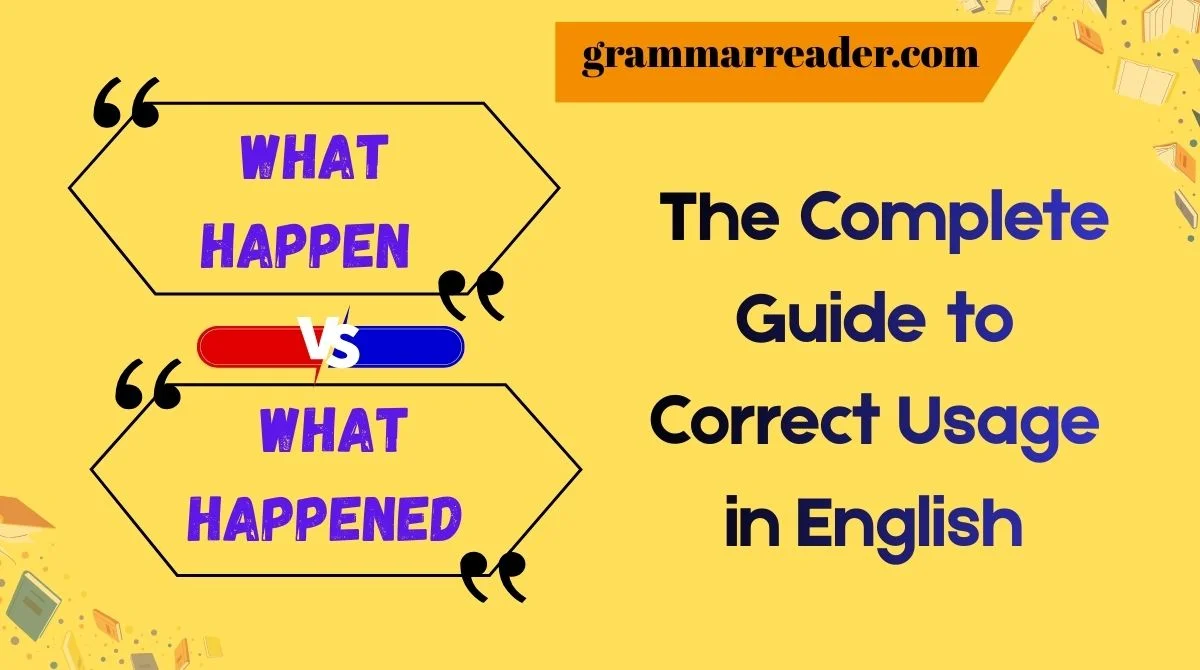
Many English learners get confused between “what happen” and “what happened.” Both sound similar, especially in casual speech, but only one is grammatically correct.
Using the wrong form can make your sentences confusing or even incorrect in exams, writing, and professional contexts.
In this guide, you’ll learn the real difference between “what happen” and “what happened,” why mistakes occur, and how to avoid them forever.
By the end, you’ll understand exactly when to use each form, and your English will sound confident and natural.
Understanding Why “What Happen” Feels Right
It’s easy to see why learners say “what happen.” Spoken English often drops endings or shortens words for speed. When you hear someone quickly say, “What happen yesterday?” it can seem normal.
However, in standard English, this is wrong. Every verb in English signals time through tense. Missing or misplacing tense changes the meaning entirely.
For example:
- ❌ “What happen at the party last night?”
- ✅ “What happened at the party last night?”
Even though casual speech might tolerate the first, writing and formal communication do not.
How Verb Tenses Communicate Time
English uses tense to indicate when an action occurs. Using the wrong tense can confuse your reader or listener.
- Present tense → happening now or general truths
- Past tense → actions completed in the past
- Future tense → actions that will occur
In questions like “What happened?” the past tense is mandatory because the speaker is asking about completed events.
Understanding the Verb Happen
Happen is a regular verb. Its forms are simple:
| Form | Tense | Example |
|---|---|---|
| happen | Base/Present | Accidents often happen unexpectedly. |
| happened | Past | Something happened yesterday. |
| happening | Present Participle | What is happening right now? |
| has/have happened | Present Perfect | A lot has happened this week. |
Notice that “happen” is never irregular. This means there is no form like “hapened” or “happeneded.” The past tense always adds -ed.
Why “What Happen” Is Grammatically Incorrect
The main reason “what happen” is wrong is missing the past tense marker. In English, a question about a past event requires the past form of the verb: happened.
Think of it like this:
- Present question: “What happens every Monday?” ✅
- Past question: “What happened yesterday?” ✅
- ❌ “What happen yesterday?”
English does not allow the base verb alone for a completed past event. Even if the sentence sounds okay, it is not standard grammar.
Why “What Happened” Works
“What happened” is the correct form for asking about completed events. The verb happened signals that the action or event occurred in the past.
- Example: “What happened at the meeting yesterday?”
- Example: “Do you know what happened to John?”
Notice that in subject questions like these, we don’t need an auxiliary verb such as “did.” Adding “did” would make it redundant:
- ❌ “What did happened?”
- ✅ “What happened?”
The past tense is already included in the verb itself.
Subject Questions vs Object Questions
English question forms differ depending on whether the question targets the subject or the object.
- Subject question: Asks about the doer of the action
- “Who arrived late?” ✅
- “Who did arrive late?” ❌ (incorrect, because “who” is the subject)
- Object question: Asks about the object of the action
- “What did you see?” ✅
“What happened” is a subject question. It asks about an event rather than asking about someone performing an action. That is why no auxiliary verb is needed.
When to Use “What Happened”
Use “what happened” whenever you are inquiring about a completed event. This includes:
- Asking about news: “What happened at the conference?”
- Responding to unexpected events: “I heard a loud noise. What happened?”
- Clarifying mistakes or accidents: “The vase is broken. What happened?”
It works in both formal and informal contexts and is universally correct.
Why “What Happen” Should Be Avoided
Even though you might hear “what happen” in movies, casual conversations, or text messages, it is never correct in standard English.
- Exams and academic writing will mark it wrong.
- Professional emails and reports require accuracy.
- It often indicates incomplete understanding of verb tense.
Remember: If you are writing or speaking clearly, always use what happened for past events.
Spoken English vs Written English
Many learners confuse casual spoken English with standard written English.
- Fast speech often drops endings: “What happen?”
- Slang or informal texting might accept it: “Yo, what happen?”
- Writing requires full verbs to convey correct tense: “What happened?”
Being aware of the difference ensures your writing is professional, clear, and correct.
Common Mistakes Related to “What Happened”
- Mixing present and past tenses in one sentence
- ❌ “What happen yesterday?”
- ✅ “What happened yesterday?”
- Overcorrecting by adding unnecessary auxiliary verbs
- ❌ “What did happened?”
- ✅ “What happened?”
- Confusing it with object questions
- ❌ “What did happen?” (for subject questions)
- ✅ “What happened?”
- Using it in informal speech but writing it incorrectly
- Always check the tense when writing.
Real-Life Examples: Correct vs Incorrect Usage
| Situation | Incorrect | Correct |
|---|---|---|
| Conversation | What happen at the party? | What happened at the party? |
| Texting | Yo, what happen bro? | Yo, what happened, bro? |
| Academic | What happen during the experiment? | What happened during the experiment? |
| Workplace | What happen in the meeting? | What happened in the meeting? |
These examples show that even if casual English tolerates “what happen,” proper usage always requires happened for past events.
Quick Rule to Remember
For any past event, always use “what happened.”
It’s simple, memorable, and eliminates confusion entirely.
FAQs About “What Happen” vs “What Happened”
What is the difference between “what happen” and “what happened”?
“What happened” is correct for past events; “what happen” is grammatically incorrect.
Why is “what happen” incorrect in English?
It lacks the past tense marker -ed that signals a completed action.
When should I use “what happened”?
Use it whenever asking about events that have already occurred.
Can “what happen” ever be correct in any context?
Only in informal speech or text, never in standard English writing or formal communication.
How can I stop making this mistake in speaking and writing?
Always link the verb tense to the time of the event. For past events, memorize: use “happened.”
Final Takeaway
The single most important rule is this:
Present or ongoing events → what happens / is happening
Completed past events → what happened
Following this rule ensures your English is clear, correct, and professional.
Mastering this small but important detail improves your writing, your speaking, and your confidence with English grammar.

Aiden Brooks is an educational writer dedicated to simplifying grammar for learners of all levels. He creates clear, practical explanations that help students read, write, and understand English with confidence.