English looks simple on the surface. Then a word like unaccessible shows up and everything feels shaky.
You pause.
You hesitate.
You wonder which one sounds right.
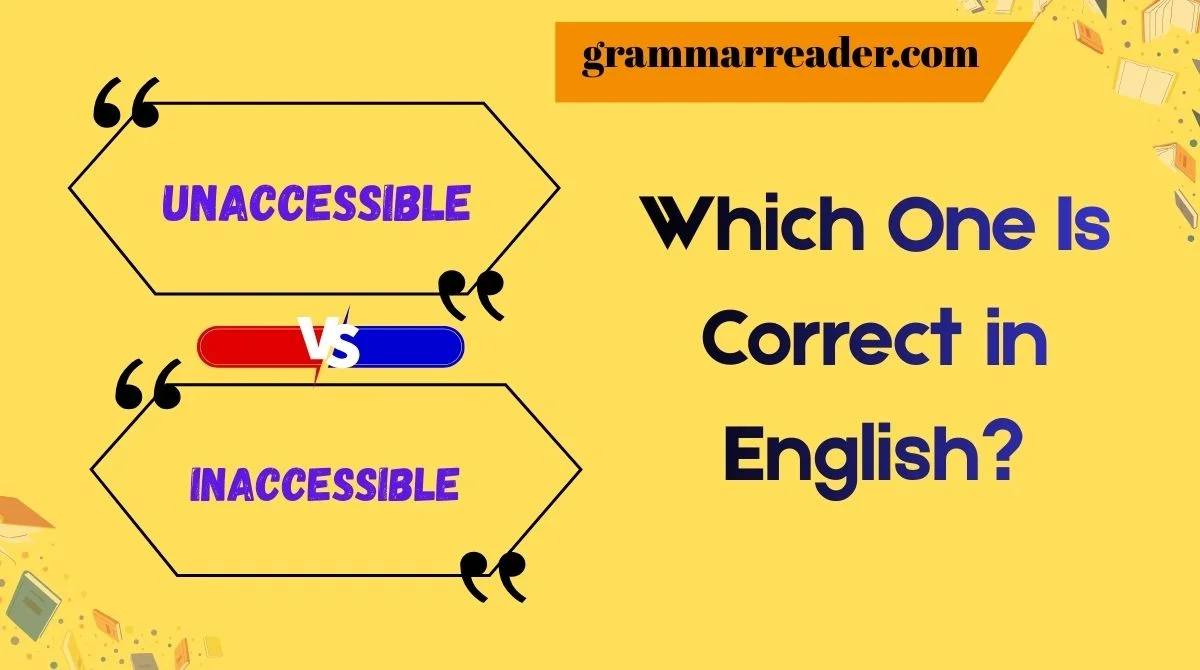
Is it unaccessible or inaccessible?
Both appear in writing. Both seem logical. Yet only one is truly accepted in standard English. This guide clears up the confusion completely. You’ll learn which word is correct, why it’s correct, and how to use it confidently in real writing without second-guessing yourself.
By the end, you’ll know exactly which word belongs on the page and which one should stay out.
Why Unaccessible vs Inaccessible Confuses So Many Writers
This confusion doesn’t come from carelessness. It comes from logic.
English uses prefixes like un-, in-, im-, and non- to form negatives. Writers see words like unhappy, unfair, and unknown and assume the same rule applies everywhere. So un + accessible feels natural.
But English doesn’t always reward logic.
Sometimes history decides instead.
That’s exactly what happened with inaccessible.
The Core Difference Between Unaccessible and Inaccessible
Let’s get straight to the point.
- Inaccessible is the standard, correct, and preferred form.
- Unaccessible is considered nonstandard, rare, and discouraged in modern English.
Both words aim to express the same idea. Only one does it correctly.
Quick Verdict Table
| Word | Status | Recommended Use |
|---|---|---|
| inaccessible | Standard English | Always use |
| unaccessible | Nonstandard / rare | Avoid |
If clarity and credibility matter, inaccessible is the only safe choice.
Understanding English Prefixes: Un- vs In-
To understand why inaccessible wins, you need to understand how English prefixes actually work.
The un- prefix
The prefix un- usually attaches to:
- Germanic-origin words
- Adjectives formed later in English
- Words describing personal states or qualities
Examples:
- unhappy
- unclear
- unfair
- unknown
The in- prefix
The prefix in- usually attaches to:
- Latin-based words
- Abstract or technical adjectives
- Words already borrowed fully formed
Examples:
- invisible
- inaccurate
- incomplete
- inaccessible
Accessible comes from Latin roots.
That automatically pushes it toward in-, not un-.
Prefixes aren’t interchangeable. English locks them in place.
Why Inaccessible Is the Standard Form
This isn’t opinion. It’s convention shaped by centuries of usage.
Historical consistency matters
English borrowed accessible from Latin accessibilis. When English forms negatives from Latin-based adjectives, it typically keeps the Latin negative prefix.
That’s why we have:
- accessible → inaccessible
- complete → incomplete
- accurate → inaccurate
- visible → invisible
Using unaccessible breaks that pattern.
Consistency creates clarity
Writers trust patterns. Readers expect them. When a word breaks the pattern, it slows reading and raises doubt.
That’s why inaccessible dominates formal writing, academic texts, legal language, journalism, and professional communication.
Why Unaccessible Still Appears in Writing
If unaccessible is discouraged, why does it still show up?
There are several real reasons.
Spoken English influence
People say what feels natural. Un- feels familiar. Speech doesn’t always respect formal rules.
Overgeneralization
Learners apply un- to everything because it works most of the time. Unfortunately, accessible isn’t one of those times.
Editing oversights
Spellcheck doesn’t always flag unaccessible. That lets it slip into drafts unnoticed.
Non-native patterns
English learners often build words logically instead of historically. That’s understandable. It’s also why mistakes happen.
Is Unaccessible Ever Correct?
This question comes up a lot.
The honest answer
Unaccessible is not recommended in standard modern English.
Some older dictionaries list it as “rare” or “nonstandard.” That label matters. It means the word exists, but educated usage avoids it.
Should you ever use it?
No.
There is no context where unaccessible communicates better than inaccessible. Choosing the standard form always strengthens your writing.
What Inaccessible Really Means
Understanding meaning helps lock in correct usage.
Core definition
Inaccessible means:
- Not able to be reached
- Difficult or impossible to enter
- Hard to obtain, understand, or interact with
Literal meaning
- A road blocked by snow
- A building without an entrance
- A location cut off by terrain
Figurative meaning
- A person who is emotionally distant
- Information hidden behind restrictions
- Ideas that are hard to understand
The word works both physically and abstractly.
Common Contexts Where Inaccessible Is Correct
Physical locations
- The village became inaccessible after the flood.
- The mountain trail is inaccessible during winter.
Digital and technical use
- The website is inaccessible due to server failure.
- The file is inaccessible without permission.
Social and emotional contexts
- He appears friendly but emotionally inaccessible.
- The leader became inaccessible to the public.
Legal and professional writing
- Records remain inaccessible to unauthorized users.
- Certain areas are legally inaccessible to civilians.
Real-World Examples: Correct vs Incorrect Usage
Correct usage of inaccessible
- The island is inaccessible by road.
- Medical care was inaccessible in remote regions.
- The data became inaccessible after encryption.
Incorrect usage of unaccessible
- ❌ The island is unaccessible by road.
- ❌ The website is unaccessible right now.
- ❌ The files are unaccessible to staff.
Each incorrect example becomes correct by replacing unaccessible with inaccessible.
Formal vs Informal Writing: What Should You Use?
Formal writing
Academic papers, legal documents, business reports, and journalism always require inaccessible.
Using unaccessible in these settings signals weak editing and reduces credibility.
Informal writing
Even in casual blogs or emails, inaccessible remains the better choice. Informal doesn’t mean incorrect.
Consistency builds trust with readers.
Style and Grammar Guidelines That Matter
Professional style values:
- clarity
- predictability
- established usage
Writers who rely on “what sounds right” often drift into error. Good writing follows patterns readers already know.
That’s why inaccessible continues to dominate edited English.
Synonyms for Inaccessible (With Context)
Choosing the right synonym can sharpen meaning.
Common alternatives
| Synonym | Best Used When |
|---|---|
| unreachable | physical or digital distance |
| impassable | blocked paths or roads |
| restricted | controlled access |
| obscure | difficult to understand |
| unattainable | goals or outcomes |
Example comparisons
- The road is impassable after the storm.
- The document remains restricted.
- His writing style is obscure.
- That level of success feels unattainable.
Each word serves a specific purpose.
Choosing the Right Word Based on Context
Ask one simple question:
Are you describing access?
If yes, inaccessible is your word.
If not, a synonym may fit better.
Precision improves clarity. Clarity improves writing.
Common Mistakes Writers Make With Unaccessible
- Assuming un- works universally
- Ignoring word origin
- Trusting spellcheck blindly
- Confusing spoken habits with written standards
Avoiding these mistakes instantly raises writing quality.
Quick Decision Rule You Can Always Trust
Here’s the rule that never fails:
If you want the opposite of accessible, use inaccessible. Always.
No exceptions worth worrying about.
FAQs About Unaccessible vs Inaccessible
What is the difference between unaccessible and inaccessible?
Inaccessible is standard English. Unaccessible is nonstandard and discouraged.
Why is inaccessible preferred over unaccessible?
Because accessible comes from Latin and follows established prefix rules.
Is unaccessible ever grammatically correct?
It exists historically but is not recommended in modern writing.
What does inaccessible mean?
It means something cannot be reached, entered, or easily understood.
What are good synonyms for inaccessible?
Unreachable, impassable, restricted, obscure, and unattainable.
Final Takeaway
This choice doesn’t need debate.
If you want clear, professional, and correct English, inaccessible is the word you use. Every time.
Skipping unaccessible avoids confusion, improves credibility, and keeps your writing aligned with modern standards. One decision. Zero doubt.

Aiden Brooks is an educational writer dedicated to simplifying grammar for learners of all levels. He creates clear, practical explanations that help students read, write, and understand English with confidence.