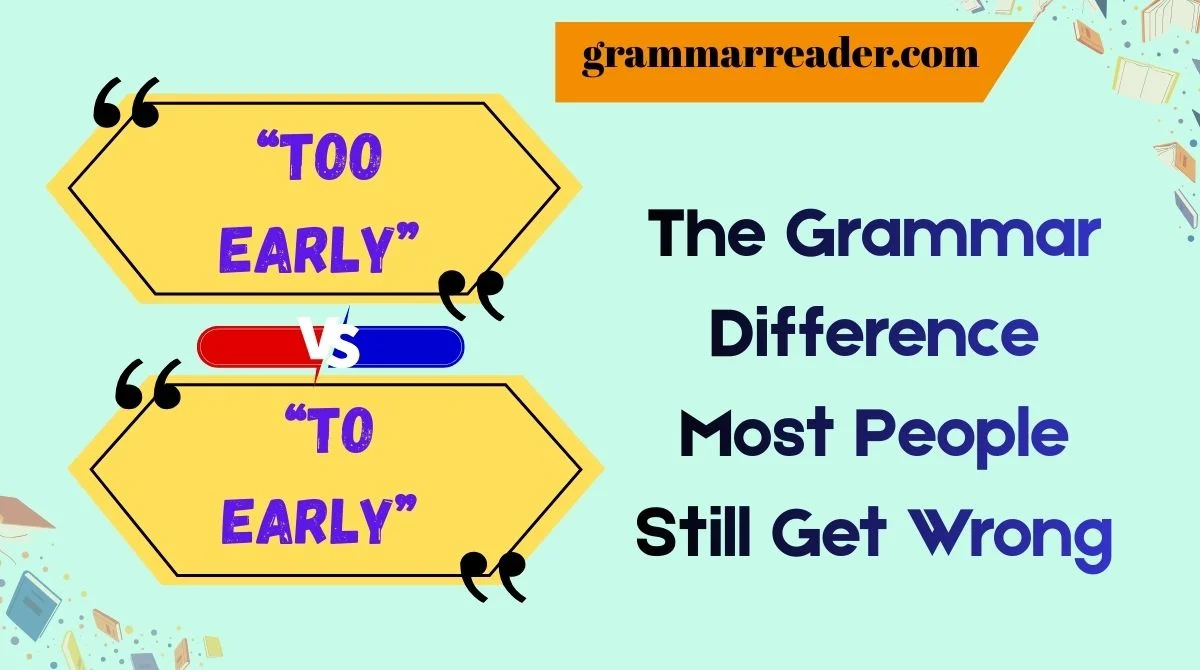
If you’ve ever paused mid-sentence and wondered whether to write “too early” or “to early”, you’re not alone.
This tiny spelling choice trips up students, bloggers, professionals, and even fluent English speakers every day.
It looks harmless. It sounds the same.
But one version is always correct, and the other is always wrong in standard English.
This guide clears the confusion completely. You’ll learn why the mistake happens, how English grammar actually works here, and how to avoid the error forever—without memorizing boring rules.
Let’s settle it once and for all.
Why “To” vs “Too” Causes So Much Confusion
English loves homophones. Words that sound identical but behave very differently cause endless trouble, especially in writing.
“To” and “too” sound exactly alike. Spoken English gives you no clues. Writing demands precision.
Here’s why this specific confusion sticks around:
- Both words appear everywhere in daily writing
- Autocorrect often ignores the mistake
- Social media normalizes informal errors
- People rely on sound instead of sentence structure
Once this habit forms, it sneaks into emails, exams, blog posts, and even professional documents.
And yes, readers notice.
What “To” Really Means in English Grammar
Before judging any phrase, you need to understand what “to” actually does.
“To” as a Preposition
As a preposition, “to” shows direction, movement, or relationship.
Examples:
- She walked to the office.
- Send the file to your manager.
- The answer belongs to you.
In every case, “to” connects two things. It never shows degree or intensity.
“To” as Part of an Infinitive Verb
This is where most confusion begins.
“To” often appears before a base verb to form an infinitive.
Structure:
to + base verb
Examples:
- to start
- to explain
- to decide
- to leave
Key rule:
“To” must be followed by a verb.
“Early” is not a verb. That alone explains why “to early” fails.
What “Too” Really Means (And Why It Changes Everything)
Now meet “too”, the misunderstood sibling.
“Too” as an Adverb of Degree
“Too” shows excess, intensity, or more than necessary.
Examples:
- The coffee is too hot.
- This bag is too heavy.
- He talks too fast.
If something goes beyond the ideal limit, “too” steps in.
“Too” to Show Agreement
“Too” can also mean also.
Examples:
- I agree too.
- She’s coming too.
Same spelling. Different role. Same logic.
The Core Idea
If you’re talking about excess, intensity, or something happening before the right time, you need “too.”
That rule alone solves 90% of cases.
Breaking Down the Phrase “Too Early”
The phrase “too early” appears constantly in real English. Let’s break it apart.
Literal Meaning of “Too Early”
Literally, “too early” means earlier than necessary, acceptable, or expected.
Examples:
- We arrived too early for the meeting.
- The store opened too early for customers.
- He woke up too early today.
In each case, timing exceeds what’s reasonable.
Figurative Meaning of “Too Early”
English also uses “too early” in abstract ways.
Examples:
- It’s too early to judge the results.
- She felt it was too early to commit.
- The discussion started too early emotionally.
Here, “early” doesn’t refer to the clock. It refers to readiness, information, or maturity.
Same grammar. Same rule.
Why “To Early” Is Incorrect in Standard Grammar
Now let’s address the problem phrase directly.
Why “To Early” Fails Grammatically
The phrase “to early” breaks English grammar for one simple reason:
“Early” is not a verb.
“To” requires a verb after it.
“Early” functions as an adverb or adjective, never a verb.
That makes “to early” structurally impossible.
Sentence Breakdown Example
❌ It’s to early to decide.
Let’s analyze it:
- “to” → expects a verb
- “early” → not a verb
The sentence collapses.
Correct version:
✅ It’s too early to decide.
Now “too” modifies “early,” which works perfectly.
Common Slip-Ups Writers Actually Make
These mistakes don’t come from ignorance. They come from habit.
Here’s what usually goes wrong:
- Writing by sound instead of structure
- Typing too fast and trusting autocorrect
- Copying informal text language
- Forgetting that grammar still matters online
Even experienced writers slip when they rush.
Practical Examples: “Too Early” vs “To Early”
Let’s ground this in real usage.
Correct Uses of “Too Early”
- It’s too early to tell the outcome.
- We left too early and waited outside.
- Calling now would be too early.
Every example shows excess timing.
When “To” Appears Near “Early” (Correctly)
“To” can appear in the same sentence. It just doesn’t modify “early.”
Examples:
- It’s too early to decide.
- She woke up early to study.
- He arrived early to avoid traffic.
See the difference?
“Too” modifies early.
“To” introduces a verb.
Advanced Cases: When “Too” and “To” Appear Together
This structure confuses many writers.
“Too Early to + Verb” Explained
This pattern is extremely common:
too + adjective/adverb + to + verb
Examples:
- too tired to continue
- too late to apologize
- too early to decide
Each word has a clear job:
- “too” shows excess
- “early” describes timing
- “to decide” names the action
Nothing overlaps. Nothing breaks.
Insights from Grammar Experts and Style Guides
Across modern English references, there’s complete agreement:
- “Too early” is correct
- “To early” does not exist in edited English
Style guides, academic writing, journalism, and professional publishing all follow this rule without exception.
If you ever see “to early” in print, it slipped past editing.
Quick Reference Table: “To” vs “Too” with “Early”
| Phrase | Correct | Why |
|---|---|---|
| too early | ✅ | Shows excess timing |
| to early | ❌ | “Early” isn’t a verb |
| too early to say | ✅ | Correct structure |
| early to bed | ❌ | Missing verb |
| early to arrive | ❌ | Incorrect infinitive |
Save this table. It’s a fast check.
Memory Tricks That Actually Work
Forget memorization drills. Use logic.
The “Extra O” Rule
- Too has an extra “O”
- Extra letter = extra meaning
If something is excessive, choose too.
The Verb Test
Ask one question:
Can I put a verb after “to”?
If not, “to” doesn’t belong there.
Replace Test
Try replacing “too” with “excessively.”
If the sentence still works, you chose correctly.
Common Errors and How to Avoid Them
Here’s how professional writers dodge this mistake:
- Pause before homophones
- Read sentences out loud
- Look for the verb immediately
- Edit with intention, not speed
Small habits prevent big errors.
Frequently Asked Questions About “Too Early” vs “To Early”
What is the correct phrase: “to early” or “too early”?
“Too early” is always correct. “To early” is grammatically wrong.
Why is “too early” correct in English grammar?
Because “too” acts as an adverb showing excess, and “early” is an adverb or adjective it modifies.
Can “to” ever be used before “early”?
Only when “early” is separate from the infinitive, such as early to bed, which still requires a verb context.
Are “to” and “too” homophones?
Yes. They sound identical but have completely different grammatical roles.
Is it “too early to tell” or “to early to tell”?
The correct phrase is “too early to tell.”
Final Thoughts
If there’s one takeaway, it’s this:
If “early” describes timing and sounds excessive, you need “too.”
English rewards structure over sound.
Once you stop guessing and start checking function, this mistake disappears for good.
Write with confidence.
Edit with intention.
And never let two tiny letters weaken your message again.

Aiden Brooks is an educational writer dedicated to simplifying grammar for learners of all levels. He creates clear, practical explanations that help students read, write, and understand English with confidence.