Language can feel slippery sometimes. One tiny spelling change can shift meaning like sand under your feet.
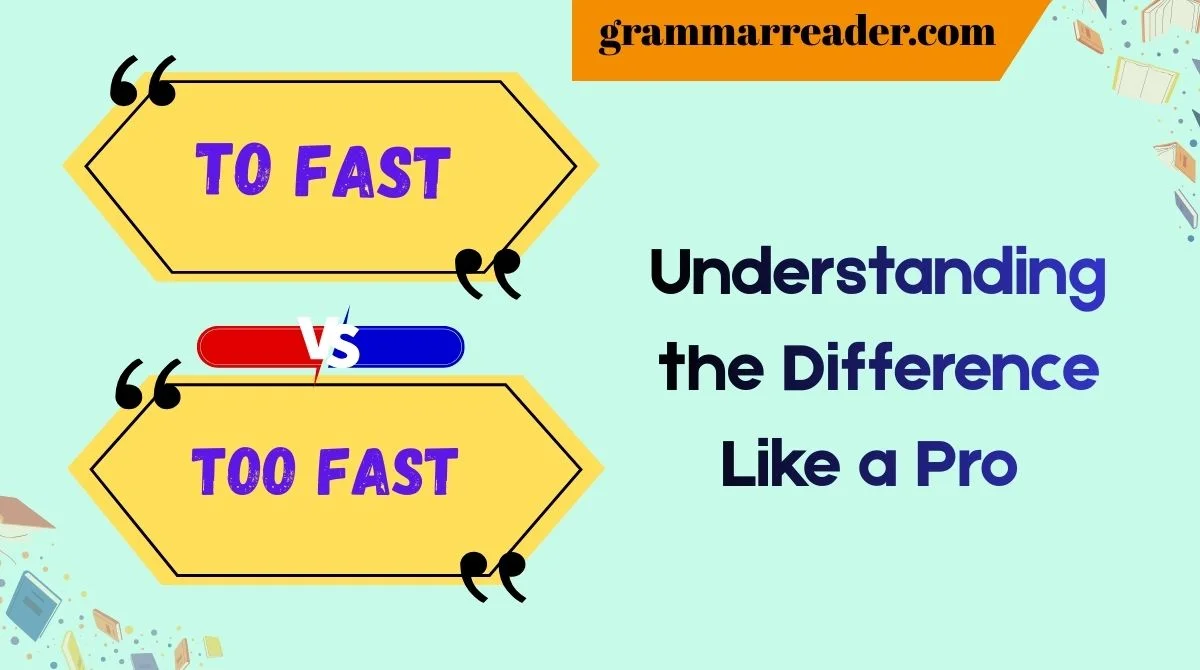
Many learners mix up to fast and too fast. The confusion happens because these words sound alike but behave differently in grammar.
Think of it this way.
- To points toward purpose or action.
- Too means more than needed or also.
- Fast talks about speed or the act of not eating.
Once you see the logic, mistakes start disappearing.
Let’s dig deeper. You’ll learn real meaning, real usage, and practical tricks.
The Real Difference Between “To” and “Too”
English uses to and too in very different ways.
Even native speakers sometimes slip when typing quickly.
The difference is simple but powerful.
What “To” Means
The word to works as a connector.
It links verbs and shows direction or intention.
You can treat it like a small bridge inside a sentence.
Use “to” when:
- Showing movement toward something
- Connecting verbs
- Expressing purpose
Examples:
- I want to learn English.
- She walked to the market.
- We plan to travel tomorrow.
Here, “to” never means excess.
It simply shows direction or intention.
What “Too” Means
Now let’s talk about too.
This word carries two main meanings.
First, it means also.
Second, it means more than necessary.
Think of “too” as a signal that something crossed a comfort line.
Examples:
- I want coffee too. (also)
- The room is too hot. (excess)
When you hear “too”, imagine something stretching beyond normal limits.
What Does “Fast” Mean in Grammar?
The word fast plays multiple roles in English.
It works as:
- An adjective
- An adverb
- A verb in special contexts
Fast as an Adjective
When describing nouns, fast means quick.
- The fast car won the race.
- He rides a fast bicycle.
Here, fast explains the quality of the object.
Fast as an Adverb
Fast can also describe actions.
- She runs fast.
- The train moves fast.
Notice something interesting.
Unlike many English adverbs, fast does not always need “-ly”.
You say:
- Drive fast (not drive fastly).
Fast as a Verb
Fast becomes a verb when talking about abstaining from food.
This usage appears in religious and health contexts.
The global fasting population is growing.
Studies show around 1.9 billion Muslims worldwide practice fasting during Ramadan every year.
Fasting also appears in modern diet systems.
When “To Fast” is Correct
You use to fast when describing the action of not eating.
Structure follows this pattern:
👉 verb + to fast
Examples:
- I want to fast tomorrow.
- Doctors may advise patients to fast before blood tests.
Religious and Health Contexts
Fasting appears across cultures.
Many traditions promote fasting for discipline and spiritual focus.
Medical fasting usually happens before surgery or laboratory testing.
For example:
| Situation | Reason |
|---|---|
| Blood sugar test | Avoid food interference |
| Surgery | Reduce anesthesia risk |
| Religious observance | Spiritual purification |
Fasting periods vary.
Some people fast for 12 hours.
Others fast for 24 hours or more.
Always check medical guidance before long fasting sessions.
Case Study: Intermittent Fasting
Intermittent fasting has gained popularity in recent years.
People follow eating windows instead of constant eating.
Typical patterns include:
| Method | Eating Window | Fasting Window |
|---|---|---|
| 16:8 method | 8 hours | 16 hours |
| 14:10 method | 10 hours | 14 hours |
| 24-hour fast | Once per day | Full day |
Research suggests intermittent fasting may help:
- Weight management
- Blood sugar control
- Metabolic balance
However, results depend on lifestyle and health condition.
Always listen to your body.
When “Too Fast” is Correct
Use too fast when speed becomes excessive.
It means something moves faster than desired.
Examples:
- The car is going too fast.
- You are talking too fast.
- The processor runs too fast for the program.
Imagine riding a bicycle downhill.
If you cannot control the speed, it is too fast.
Safety becomes the main concern.
Real-World Application: Traffic Safety
Traffic authorities enforce speed limits.
They do this to prevent accidents.
Driving too fast increases stopping distance.
Here is a simple physics idea:
| Speed | Stopping Distance |
|---|---|
| 30 km/h | Short |
| 60 km/h | Medium |
| 100 km/h | Very long |
Higher speed means more risk.
Road safety campaigns worldwide encourage controlled driving.
Some countries report thousands of deaths annually due to speeding.
Speed discipline saves lives.
Common Mistakes and How to Avoid Them
Common Errors
| Wrong Sentence | Correct Version |
|---|---|
| I love you to | I love you too |
| Drive to fast | Drive too fast |
| Eat too much fast | Fast too much (if meaning excess fasting) |
Why Confusion Happens
Three reasons cause trouble.
- Sound similarity.
- Typing speed on phones.
- Lack of grammar awareness.
English has many homophones.
Practice helps you avoid traps.
Tips to Catch Mistakes
Try these quick checks.
- Replace too with also.
If the sentence still works, you used “too” correctly.
Example:
- I want pizza too → I want pizza also.
- Ask yourself:
- Is the sentence about speed? → Use fast.
- Is it about purpose? → Use to.
- Is it about excess or also? → Use too.
Quick Reference Tools
| Situation | Use |
|---|---|
| Direction | To |
| Verb infinitive | To |
| Also | Too |
| Excess amount | Too |
| Speed | Fast |
| Fasting | To fast |
Simple Trick to Remember
Use this memory hook:
👉 To = Toward
👉 Too = Also or Over
👉 Fast = Speed or Food abstinence
Picture a road.
- “To” points the car forward.
- “Too” warns the car is speeding.
- “Fast” tells how quickly it moves.
Comparison Table: To vs Too vs Fast
| Word | Meaning | Example |
|---|---|---|
| To | Direction or purpose | Go to school |
| Too | Also or excess | Too fast |
| Fast | Speed or fasting | Drive fast |
Mini Quiz
- Which is correct?
A. Move to fast
B. Move too fast
Answer: B
- Fill blank:
I want ___ eat now.
Answer: to - Choose correct:
She talks ___ much.
Answer: too
Advanced Usage: When Both Appear in Same Sentence
You may see complex structures.
Examples:
- He wanted to run too fast.
- I need to eat to fast tomorrow.
Here, each word plays a different grammatical role.
Related Confusing Word Pairs
- There / Their / They’re
- Your / You’re
- Then / Than
- Its / It’s
English loves confusing learners like a puzzle box.
Frequently Asked Questions
When should I use “to fast”?
Use it when talking about abstaining from eating.
What does “fast” mean in grammar?
Fast means quick movement or voluntary food abstinence.
Is “to fast” ever wrong?
No. It is correct when used as a verb phrase.
Which is correct: “I love you to” or “I love you too”?
“I love you too” is correct.
Can I use “fast” to describe not eating?
Yes. Fast can mean abstaining from food.
Conclusion
The difference between to fast and too fast feels small but matters.
Remember this simple rule.
Use to fast when speaking about food abstinence.
Use too fast when speed becomes excessive.
English becomes easy once you see the logic behind words.
Practice daily. Read sentences aloud. Check your writing.
Soon, you’ll use these words naturally and confidently.

Aiden Brooks is an educational writer dedicated to simplifying grammar for learners of all levels. He creates clear, practical explanations that help students read, write, and understand English with confidence.