
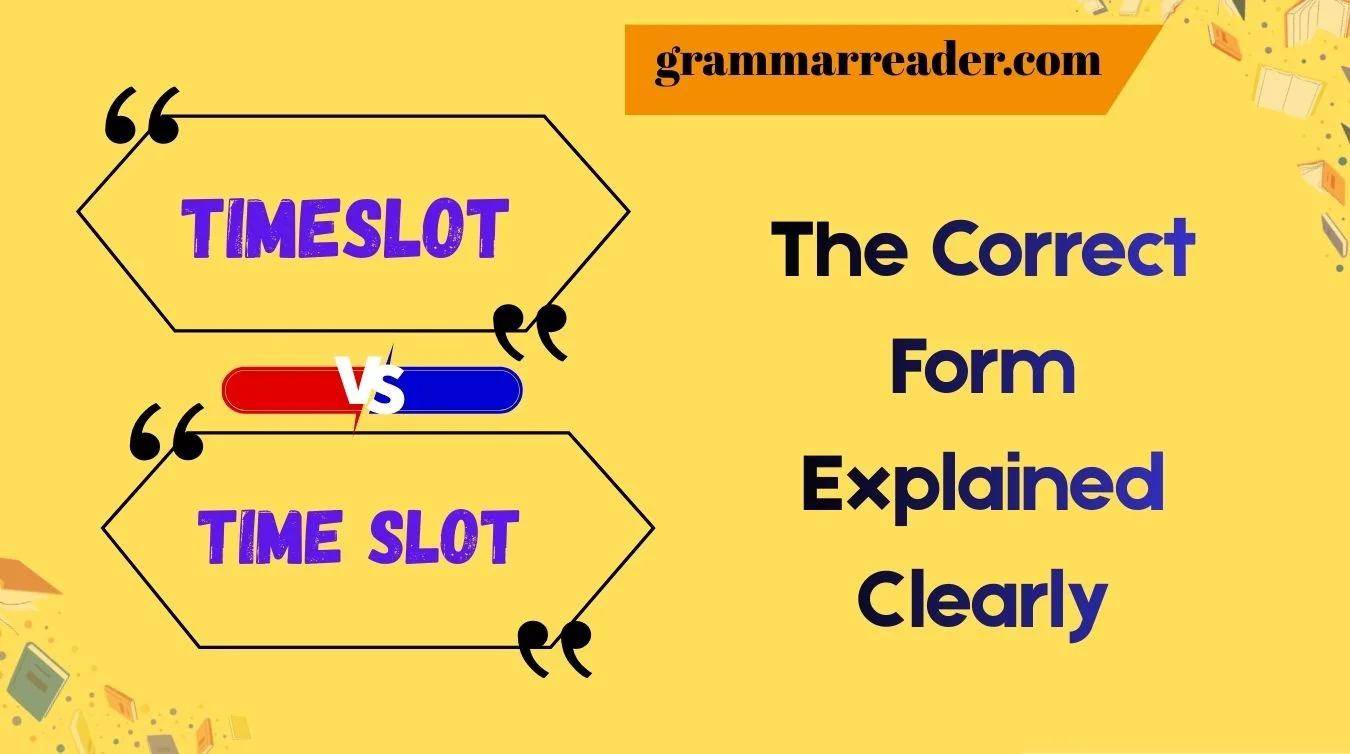
If you’ve ever paused while writing timeslot vs time slot, you’re not alone. This small spacing issue causes big confusion.
It appears in booking apps, emails, blogs, schedules, and professional documents. Both versions look reasonable at first glance. However, only one stands firm in standard English.
This guide explains everything in simple language. You’ll learn which form is correct, when a hyphen makes sense, and why “timeslot” keeps showing up even though it’s usually wrong. By the end, you’ll write with confidence and clarity.
Timeslot vs Time Slot: The Quick Answer
Let’s get straight to the point.
Time slot is the correct and widely accepted form.
Time-slot is correct only in specific grammatical situations.
Timeslot is informal and nonstandard in formal writing.
Remember this one rule:
Use “time slot” as two words unless it directly modifies a noun.
What Does “Time Slot” Mean?
A time slot is a fixed or assigned period during which something happens. It answers one simple question: When?
You’ll see this term used in many real-life situations:
- Doctor appointments
- Online booking systems
- Television and radio schedules
- Exams and interviews
- Meetings and deliveries
Examples in real sentences
- You booked a time slot for tomorrow morning.
- Each speaker receives a 20-minute time slot.
- Prime-time time slots attract larger audiences.
From a grammar point of view, time slot is an open compound noun, which means the words work together but stay separate.
Why “Timeslot” Looks Right but Isn’t
Many people trust timeslot because they see it everywhere. Apps use it. Software dashboards use it. Marketing text uses it.
Familiar doesn’t mean correct.
Here’s why timeslot usually fails grammar standards:
- It isn’t fully accepted in formal English
- It lacks consistency across professional writing
- It hasn’t completed the natural evolution of English compounds
English only closes compound words when they become stable across formal usage. Timeslot hasn’t reached that stage yet.
Understanding Compound Nouns in Simple Terms
English forms compound nouns in three main ways:
| Form | Example | Status |
|---|---|---|
| Open compound | time slot | Correct |
| Hyphenated compound | time-slot | Conditionally correct |
| Closed compound | timeslot | Informal or nonstandard |
Why “time slot” stays open
- The meaning stays clear
- Readers naturally pause between the words
- Formal writing values clarity over compression
Compare it with words like website or notebook. Those became closed compounds after decades of consistent formal use. Time slot hasn’t followed that path.
When “Time-Slot” Is Correct
This is where many writers get confused.
Use time-slot only when the phrase acts as a compound modifier before another noun.
Correct usage
- time-slot booking system
- time-slot allocation policy
- time-slot conflicts
Incorrect usage
- Your time-slot is confirmed ❌
- Choose a convenient time-slot ❌
Why does this rule exist?
English uses hyphens to prevent confusion before nouns, not after them. Once the phrase stands alone, the hyphen disappears.
Think of the hyphen as temporary glue. It sticks words together only when grammar demands it.
Timeslot vs Time Slot in Formal Writing
Formal writing demands accuracy and consistency. This includes:
- Academic papers
- Business reports
- Legal documents
- Professional blogs
- Editorial articles
In all these contexts, time slot is the safest and most correct choice.
Editors avoid timeslot because:
- It lacks dictionary agreement
- It appears careless
- It weakens professional tone
Small errors like spacing can quietly reduce trust.
Why Informal Writing Uses “Timeslot”
Informal environments follow looser rules. That’s where timeslot survives.
You’ll often see it in:
- App interfaces
- Internal tools
- Marketing headlines
- Casual messages
Example:
“Select your preferred timeslot.”
This choice favors shorter text and design convenience, not grammatical precision. It works for buttons. It doesn’t belong in polished writing.
How English Compound Words Evolve
Most English compounds follow this pattern:
- Open form: time slot
- Hyphenated form: time-slot
- Closed form: timeslot
Only a small number complete the final step.
Why time slot hasn’t closed:
- The open form remains clear
- Formal writers still prefer separation
- No universal acceptance exists
Many compound words never fully merge, and that’s normal.
Common Mistakes Writers Make
Using “timeslot” in professional content
Fix: Replace it with time slot
Hyphenating in every situation
Fix: Use time-slot only before nouns
Mixing forms in the same article
Fix: Choose time slot and stay consistent
Copying app language into formal writing
Fix: Rewrite UI terms using proper English
Why Choosing the Right Form Matters
This isn’t just about grammar rules.
Correct usage:
- Builds reader trust
- Signals professionalism
- Improves clarity
- Supports strong SEO structure
Readers may not point out small mistakes, but they notice them.
Quick Decision Guide
Use this checklist when writing:
- Academic writing → time slot
- Blog posts → time slot
- Business emails → time slot
- User interfaces → time slot preferred
- Modifier before noun → time-slot
When in doubt, choose time slot. It’s always correct.
Frequently Asked Questions
Is “timeslot” ever correct?
It’s acceptable in informal or design-focused contexts, but not recommended for formal writing.
Should I hyphenate “time slot”?
Only when it modifies another noun, such as time-slot booking.
Can “time slot” and “time-slot” be used interchangeably?
No. The hyphen depends on sentence structure, not personal preference.
Why do apps prefer “timeslot”?
Shorter words fit better in interfaces, even if they aren’t grammatically ideal.
Will “timeslot” become standard English?
It may evolve over time, but current formal usage still favors time slot.
Conclusion
The answer is clear.
Time slot is the correct and professional form.
Time-slot works only as a modifier.
Timeslot remains informal and nonstandard.
If clarity and credibility matter, use time slot every time.

Aiden Brooks is an educational writer dedicated to simplifying grammar for learners of all levels. He creates clear, practical explanations that help students read, write, and understand English with confidence.