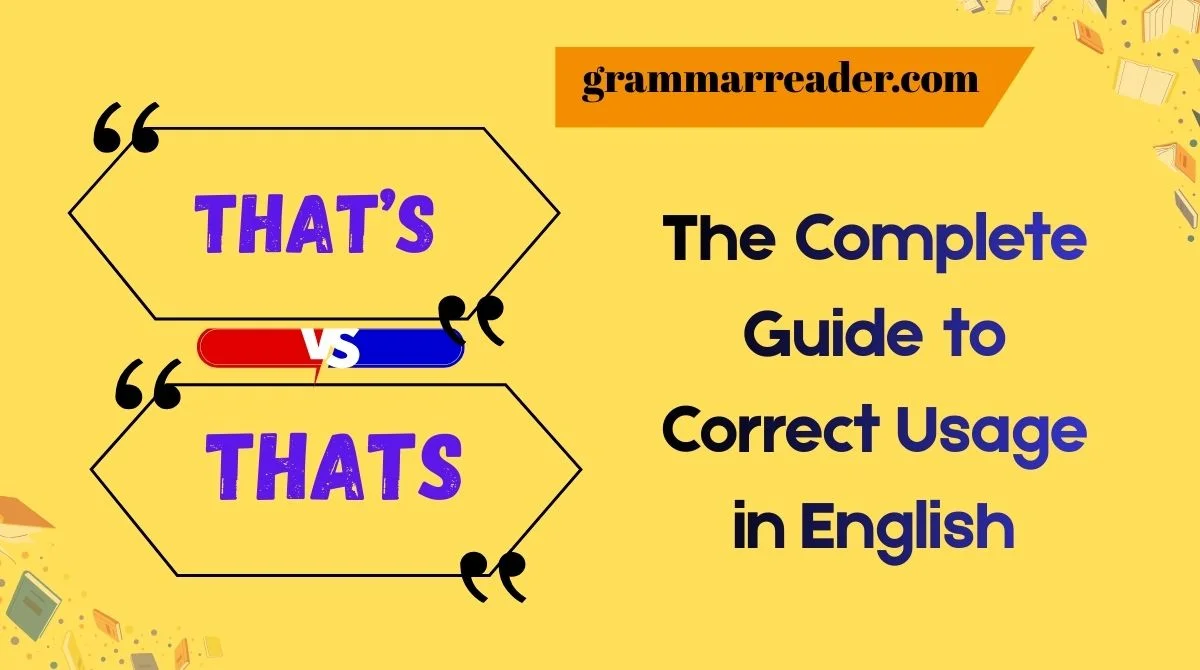
Few grammar mistakes appear as often as that’s vs thats.
You see it in emails, blog posts, captions, comments, and even professional documents. One tiny apostrophe disappears, and suddenly the sentence looks careless.
What makes this error tricky is how normal it feels. People read thats every day, especially in texts and social media. Over time, the wrong form starts to feel right.
This guide fixes that problem completely.
You’ll learn the real grammatical difference between that’s and thats, when each form is correct, why people confuse them, and how to choose the right one every time. By the end, this mistake won’t survive your proofreading.
Understanding the Basics: That’s vs Thats
The difference between that’s and thats comes down to one thing:
the apostrophe.
- That’s is a contraction
- Thats is not a standard English word in normal writing
That apostrophe isn’t decoration. It carries meaning.
Quick comparison
| Form | Is it correct? | Meaning |
|---|---|---|
| that’s | Yes | that is / that has |
| thats | No (usually) | Missing apostrophe |
If the apostrophe disappears, the grammar collapses with it.
What That’s Really Means in Grammar
That’s is a contraction.
A contraction shortens two words into one.
In English, that’s can stand for only two phrases:
- that is
- that has
Nothing else.
If neither phrase fits your sentence, that’s does not belong there.
When That’s Means “That Is”
This is the most common use of that’s.
How it works
If you can replace that’s with that is and the sentence still makes sense, the usage is correct.
Examples
- That’s my phone.
→ That is my phone. - That’s the reason we left early.
→ That is the reason we left early. - That’s exactly what I meant.
→ That is exactly what I meant.
The meaning stays intact. The sentence flows naturally. That’s how you know it’s right.
Spoken vs written English
In speech, that’s feels natural and effortless.
In writing, it keeps the tone conversational but still correct.
When That’s Means “That Has”
This usage confuses many writers because it hides quietly in sentences.
Here, that’s replaces that has, usually in the present perfect tense.
Structure
that’s + past participle
Examples
- That’s been a long day.
→ That has been a long day. - That’s caused a lot of confusion.
→ That has caused a lot of confusion. - That’s changed my opinion.
→ That has changed my opinion.
If you replace that’s with that has and the sentence still works, the grammar is correct.
Why Thats Is Usually Wrong
In standard English, thats without an apostrophe is almost always incorrect.
Why?
Because English requires apostrophes to show missing letters in contractions.
When you write thats, you’re removing:
- the apostrophe
- the grammatical signal
- the meaning
The sentence loses clarity and correctness.
Why autocorrect doesn’t always fix it
Autocorrect often ignores thats because:
- It appears frequently in casual writing
- It’s not always flagged as a spelling error
- Context matters, and machines struggle with that
That means the responsibility falls on you.
The Only Real Case Where Thats Is Correct
There is one legitimate exception.
Proper nouns and brand names
Some brand names ignore grammar rules intentionally. When Thats appears as part of a registered name, it’s correct within that name only.
Example:
- Honda That’s (a model name)
This does not make thats correct in normal sentences.
Brand spelling follows branding rules, not grammar rules.
Common Misconceptions That Cause the Thats Mistake
Most people don’t make this error because they’re careless. They make it because of habits.
Misconception one: Apostrophes are optional
They are not. Apostrophes carry meaning.
Misconception two: Texting rules apply everywhere
Casual texting habits bleed into professional writing.
Misconception three: Possession confusion
Some writers mistakenly think that’s shows possession. It does not.
That’s never shows ownership.
That’s vs That Is vs That Has: How to Choose Correctly
Here’s a simple decision method you can use every time.
The replacement test
Ask yourself:
- Can I replace it with that is?
- Can I replace it with that has?
If the answer is yes to either, that’s is correct.
If the answer is no to both, rewrite the sentence.
Examples
- That’s finished already.
→ That has finished already ✔ - Thats my bag.
→ That is my bag ✔ → needs apostrophe - Thats ideas are outdated.
→ No correct replacement ✘ → rewrite sentence
Real-World Examples of That’s in Everyday Writing
Casual conversation
- That’s amazing news.
- That’s not what I expected.
- That’s been bothering me all day.
Emails and professional writing
- That’s attached for your review.
- That’s been approved by management.
- That’s the final version of the report.
Academic and formal contexts
In very formal writing, contractions may be avoided.
Still, that’s remains grammatically correct.
Why Using That’s Correctly Matters
Small grammar errors send big signals.
Correct usage shows:
- attention to detail
- language awareness
- professionalism
Incorrect usage suggests:
- rushed writing
- weak editing
- poor command of basics
As writer David Foster Wallace once said:
“Good writing is not just about ideas, it’s about respect for the reader.”
Grammar earns that respect.
Quick Checklist to Avoid the Thats Error
Before you hit publish or send, ask:
- Did I mean that is or that has?
- Did I include the apostrophe?
- Does the sentence still make sense when expanded?
If yes, you’re safe.
Frequently Asked Questions About That’s vs Thats
What is the difference between that’s and thats?
That’s is a contraction for that is or that has. Thats is usually incorrect.
Is thats ever correct in English?
Only in proper names or brand titles. Not in normal sentences.
How do I know if that’s means that is or that has?
Replace it with that is or that has. Whichever works reveals the meaning.
Why do people confuse that’s with thats?
Texting habits and missing apostrophes cause the confusion.
How can I permanently stop writing “thats”?
Use the replacement test every time you write it.
Final Summary
Here’s the rule that ends the confusion:
If you mean “that is” or “that has,” use that’s.
If not, rewrite the sentence.
There are no shortcuts.
There are no hidden meanings.
Just one apostrophe doing important work.
Once you respect it, your writing instantly looks sharper and more professional.

Aiden Brooks is an educational writer dedicated to simplifying grammar for learners of all levels. He creates clear, practical explanations that help students read, write, and understand English with confidence.