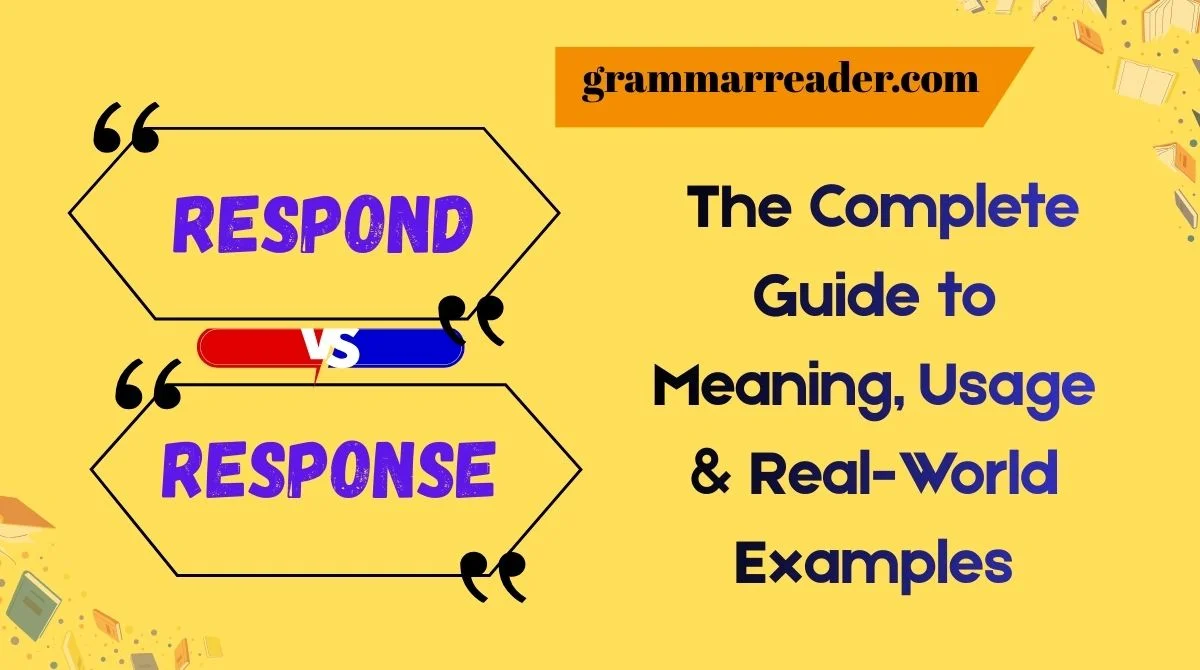
Understanding the difference between respond and response seems simple at first, yet these two words confuse millions of people every day.
They look and sound similar, but each plays a very different role in grammar, communication, psychology, medicine, and everyday life.
Mastering them instantly improves clarity in writing and sharpens communication skills across every area of life.
This guide breaks everything down in a conversational, easy-to-read way—loaded with examples, diagrams, tables, and practical insights.
Introduction: Why People Mix Up “Respond” and “Response”
You’ve probably seen sentences like:
- “I didn’t get a respond.”
- “Please response to this email.”
Both sound slightly “off,” right? But mistakes like these show up everywhere—texts, emails, social media, even business reports.
Why the confusion?
Because respond and response are incredibly close, but one is an action and the other is a result. They operate differently in grammar and carry different meanings depending on the situation—especially in medicine, psychology, behavioral science, and crisis communication.
This article makes everything crystal clear so you’ll never mix them up again.
What “Response” Actually Means (Noun)
Response is a noun, meaning it names a thing.
A response is the result, outcome, or reaction to something.
Here’s the simplest way to remember it:
A response is what you give. Respond is what you do.
Core Characteristics of “Response”
- It describes an outcome, not an action
- It often appears after determiners like a, the, my, his
- It can describe physical, emotional, medical, or behavioral results
- It’s used heavily in scientific and professional fields
Examples of Correct Usage
- “I appreciated your response to my message.”
- “The immune system’s response was strong.”
- “Her response showed confidence.”
Quick Table: When “Response” Fits
| Situation | Does it describe an action? | Correct choice |
|---|---|---|
| Naming a result | No | Response |
| Talking about a reaction | No | Response |
| Describing the outcome of a process | No | Response |
| Used with adjectives (quick, emotional, dramatic) | No | Response |
If you’re pointing to a thing—a reply, a reaction, an outcome—you’re almost always talking about a response.
What “Respond” Actually Means (Verb)
Respond is a verb, meaning it expresses an action.
If someone responds, they do something: they reply, react, or take action.
Core Characteristics of “Respond”
- It’s an action word
- It often follows pronouns or nouns (I, you, they, employees, doctors)
- You can modify it with adverbs (quickly, calmly, professionally)
- It describes engagement, participation, or reaction
Examples of Correct Usage
- “Please respond by Monday.”
- “He didn’t respond to treatment.”
- “They responded emotionally.”
Quick Table: When “Respond” Fits
| Sentence Type | Example | Correct Choice |
|---|---|---|
| Someone performing an action | “I will respond soon.” | Respond |
| Asking someone to take action | “Can you respond?” | Respond |
| Behavioral reactions | “She didn’t respond to the cue.” | Respond |
| Medical reactions | “The patient didn’t respond to medication.” | Respond |
When an action is happening, you need respond.
Grammar Essentials: How to Choose the Right One
When you’re stuck between response and respond, here’s the fastest rule:
If the sentence needs an action, use respond. If it needs a thing, use response.
Let’s break it down.
Quick Rule: Action vs. Result
Ask yourself:
- Is the person doing something? → Use respond
- Is the sentence naming the result? → Use response
Examples
- “I didn’t respond to the email.” → Action
- “I didn’t get a response.” → Result
Notice how swapping them creates errors.
Sentence Patterns That Require “Respond”
You need respond when:
- the subject performs an action
- the verb answers the question “What did they do?”
- the sentence uses “to” after the verb
Correct Structures
- “They didn’t respond to the request.”
- “Can you respond right away?”
- “She refused to respond.”
Common Mistake
🚫 “They didn’t response.”
✔️ “They didn’t respond.”
Sentence Patterns That Require “Response”
You need response when:
- you mention the reaction itself
- the word has modifiers like a, the, immediate, strong
- it’s the object of a preposition
Correct Structures
- “Her response was surprising.”
- “Thank you for your quick response.”
- “The response to the campaign was huge.”
Common Mistake
🚫 “Please give me a respond.”
✔️ “Please give me a response.”
“Response” in Real Life: How the Noun Works
Everyday Communication
You use response every day without noticing it:
- Texting: “I got no response.”
- Business email: “Your response time matters.”
- Customer service: “The response from clients was positive.”
A response always refers to something produced, not something performed.
Visual Guide: How “Response” Works in a Sentence
[Subject] + [verb] + the response
Example:
The manager appreciated the quick response.
[The response] + [verb]
Example:
The response impressed the audience.
Response Placement Table
| Sentence Position | Example |
|---|---|
| Subject | “The response shocked everyone.” |
| Object | “We got a fast response.” |
| After adjectives | “Her emotional response…” |
| After prepositions | “In response to your message…” |
Results & Reactions: Why “Response” Captures Outcomes
A response is perfect for:
- feedback
- survey answers
- emotional reactions
- physical or biological results
- customer behavior
Examples:
- “The product received a huge response.”
- “Her response showed maturity.”
- “The immune response increased.”
Medical, Scientific & Emergency Usage of “Response”
Medical fields rely on response because they focus on outcomes.
Why “Response” Matters in Medicine
Doctors measure:
- treatment response
- immune response
- pain response
- reflex response
Examples
- “The patient had a delayed response to stimuli.”
- “Chemotherapy shows positive response rates.”
Case Study: Medical Scenario
Case:
A 47-year-old patient receives a new medication for chronic pain.
Observations:
- First 24 hours: no response
- Day three: partial response
- Day seven: strong response to lower doses
What this shows:
“Response” describes the progress, outcome, and effectiveness of a treatment—not the action taken by the patient.
“Respond” as a Verb: When Action Matters
Everyday Usage
You use respond whenever someone acts.
Examples:
- “Please respond soon.”
- “They didn’t respond to the announcement.”
- “He finally responded after three days.”
Nuanced Meanings of “Respond”
“Respond” isn’t just about replying. It can describe:
Emotional Responding
- “She didn’t respond well to criticism.”
Intellectual Responding
- “Students responded to the lecture with smart questions.”
Behavioral Responding
- “The dog responded to training immediately.”
Environmental Responding
- “Plants respond to sunlight.”
These subtleties show how powerful the verb can be.
Interactive Scenarios: When Respond Shows Engagement
You’ll hear it in:
- customer service (“We respond within 24 hours”)
- therapy and counseling
- negotiations
- medical care
- crisis communication
In all these cases, respond measures performance and action.
Examples from Literature, Media & News
Writers use these words deliberately:
Literature
- “Her response revealed more than her words.”
- “He didn’t respond to the insult.”
News & Journalism
- “The government issued a swift response.”
- “Officials refused to respond to allegations.”
These choices shape tone, urgency, and clarity.
Psychology & Human Behavior
Understanding these words is essential in psychology.
Behavioral Responses
In behavioral science:
Stimulus → Response
Examples:
- A loud sound triggers a startle response.
- Rewards create positive responses.
Here, “response” names the reaction, not the action.
Physical Responding
Humans physically respond to:
- touch
- light
- heat
- sound
Examples:
- “Pupils respond to changes in light.”
- “Muscles respond during exercise.”
Emotional Contagion: How We Respond to Feelings
Humans automatically respond to others’ emotions.
Examples:
- “People respond to anxiety with tension.”
- “Children respond emotionally to their parents’ tone.”
This shows emotional responding is an action, not a thing.
Cognitive Responses in Decision Making
Cognitive responses involve:
- analyzing
- processing
- evaluating
- deciding
Examples:
- “The response to the risk was cautious.”
- “He didn’t respond immediately; he took time to think.”
Quick Comparison Table: Respond vs. Response
| Feature | Respond | Response |
|---|---|---|
| Word Type | Verb (action) | Noun (thing) |
| Meaning | To act, reply, react | The reaction, reply, or outcome |
| Example | “I will respond.” | “I got a response.” |
| Used After | Subjects | Determiners/adjectives |
| In Medicine | “Respond to treatment” | “Treatment response” |
| In Psychology | Actors respond | Responses are measured |
Common Errors and How to Fix Them
| Wrong | Right |
|---|---|
| “Please response soon.” | “Please respond soon.” |
| “He gave a quick respond.” | “He gave a quick response.” |
| “Did they response?” | “Did they respond?” |
| “I didn’t get a respond.” | “I didn’t get a response.” |
Practice Section: Test Yourself
Rewrite the incorrect sentences:
- “She didn’t response to my message.”
- “We need a respond quickly.”
- “They won’t response until tomorrow.”
- “His respond wasn’t helpful.”
- “Please send your response back when you respond.”
FAQs
How do I quickly tell the difference between respond and response?
Use respond for actions and response for outcomes or results.
Can “response” be plural?
Yes — “responses.” Example: “The survey received 1,200 responses.”
Is “respond back” correct?
It’s redundant. Just use “respond.”
What verb goes with “response”?
Common verbs: give, receive, offer, provide.
Is “responding” always verbal?
No. You can respond physically, emotionally, behaviorally, or intellectually.
Conclusion
The difference between respond and response becomes easy once you understand one simple rule: one is an action, the other is a result.
Learning when to use each helps you write clearly, communicate professionally, understand medical and psychological terminology, and express your thoughts with confidence.
Whether you’re writing an email, analyzing human behavior, reading scientific studies, or communicating in a crisis, choosing the right word strengthens your message and reflects your intentionality.

Aiden Brooks is an educational writer dedicated to simplifying grammar for learners of all levels. He creates clear, practical explanations that help students read, write, and understand English with confidence.