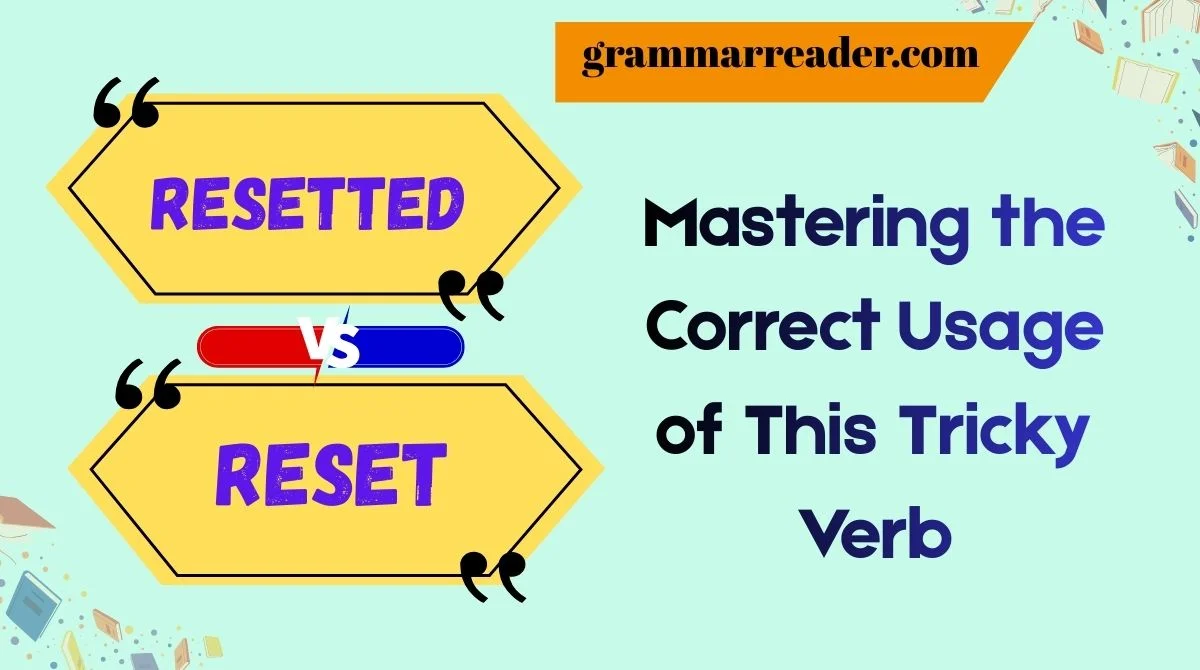
English learners and even native speakers often stumble when using the verb “reset.” Is it “reset” or “resetted”?
Understanding this simple yet tricky verb can save you from common mistakes in writing, emails, technical instructions, or casual conversations.
This guide will break down everything you need to know, from grammar rules to practical examples, so you can confidently use reset in any tense.
Understanding the Verb “Reset”
The verb reset means to set something again or return it to its original state. You might hear it in technology, routines, habits, or even metaphorical situations: “I need to reset my goals for the year.”
What makes reset unusual is that it’s irregular. Unlike most English verbs, its past tense and past participle forms do not change. This simplicity can trick learners into overcomplicating it.
For comparison:
| Verb | Past Tense | Past Participle | Example Sentence |
|---|---|---|---|
| Walk | Walked | Walked | I walked to the store yesterday. |
| Reset | Reset | Reset | She reset the timer after it ran out. |
Notice that reset stays the same, unlike regular verbs where you add -ed.
Past Tense of “Reset”
Many learners instinctively try to write “resetted” for the past tense. This is incorrect. The past tense of reset is reset, no extra letters or changes.
You use it just like any other past tense verb:
- Technical: “I reset the router last night to fix the connection.”
- Routine: “He reset his alarm clock after missing the bus.”
- Figurative: “After a tough week, I reset my mindset for a fresh start.”
It’s simple once you internalize that reset never changes.
“Resetted”: Myth vs. Reality
So, where does resetted come from?
Many English learners assume all verbs need -ed in the past tense. This misunderstanding leads to “resetted.” In standard English, it’s wrong in both formal and informal contexts. You might occasionally see it in very old texts or nonstandard usage, but it’s not recognized in modern English dictionaries.
Here’s a quick table to make it crystal clear:
| Incorrect Usage | Correct Usage | Example |
|---|---|---|
| I resetted the game | I reset the game | ✅ “I reset the game to start over.” |
| She has resetted the timer | She has reset the timer | ✅ “She has reset the timer twice today.” |
Remember: avoiding resetted makes your writing sound polished and professional.
Pronunciation and Tense Usage
Reset is pronounced the same way in present, past, and future tenses: /ri-ˈset/.
It’s also important to use it correctly with auxiliary verbs:
- Present perfect: “I have reset my password.”
- Past perfect: “She had reset the thermostat before leaving.”
- Future: “We will reset the schedule tomorrow.”
Tips for clarity:
- Don’t overthink the tense—reset never changes.
- When speaking, stress the second syllable slightly: “re-SET.”
Common Mistakes and How to Avoid Them
Even experienced writers stumble with reset. Here’s how to steer clear of errors:
Mistake 1: Using “resetted” as the past tense
- Tip: Always default to reset, even in past narratives.
Mistake 2: Thinking all verbs need -ed in past tense
- Tip: Keep a mental list of irregular verbs that don’t change: reset, set, bet, cost.
Mistake 3: Confusing “reset” with similar verbs like “set”
- Tip: Remember set also doesn’t change: “I set the table yesterday” vs “I reset the alarm.”
Mistake 4: Overcomplicating in technical contexts
- Tip: Keep instructions concise. “Reset the router” is correct; “Resetted the router” is not.
Related Irregular Verbs
English has a handful of verbs that behave like reset, staying the same across tenses:
| Verb | Past | Past Participle | Example Sentence |
|---|---|---|---|
| Set | Set | Set | I set the alarm for 6 AM. |
| Bet | Bet | Bet | She bet $50 on the game. |
| Cost | Cost | Cost | The repair cost $200. |
| Hit | Hit | Hit | He hit the target perfectly. |
| Put | Put | Put | I put the book on the shelf. |
Learning these patterns makes reset easy to remember.
Usage Examples Across Contexts
Let’s break down reset in different situations with practical examples:
Technology:
- “I reset my smartphone to factory settings.”
- “After the update, the system reset automatically.”
Personal habits and routines:
- “She reset her workout schedule for better results.”
- “I reset my morning alarm to start waking up earlier.”
Figurative / Mental Reset:
- “After a stressful day, I reset my mindset with meditation.”
- “He decided to reset his career and learn new skills.”
These examples show how versatile the verb is—you can use it in tech, life, or metaphorical contexts.
FAQs
What is the past tense of “reset”?
The past tense of reset is reset. It does not change.
Is “resetted” ever correct?
No. Resetted is incorrect in modern English. Always use reset.
Why doesn’t “reset” change in the past tense?
It’s an irregular verb. English has several verbs like this that remain unchanged.
How do I avoid confusing “reset” with “resetted”?
Remember: if it sounds like you’re adding unnecessary -ed, it’s probably wrong.
Can you give examples of “reset” in sentences?
Sure:
- “I reset my password yesterday.”
- “She has reset the thermostat three times.”
- “We will reset the schedule next week.”
Quick Reference Cheat Sheet
| Verb | Present | Past | Past Participle | Example |
|---|---|---|---|---|
| Reset | Reset | Reset | Reset | I reset my alarm yesterday. |
| Set | Set | Set | Set | She set the table for dinner. |
| Bet | Bet | Bet | Bet | He bet $20 on the race. |
| Cost | Cost | Cost | Cost | The service cost $150. |
| Hit | Hit | Hit | Hit | She hit the target perfectly. |
| Put | Put | Put | Put | I put my keys on the desk. |
This table helps you instantly see patterns and remember that reset stays the same in all tenses.
Conclusion
The verb reset is simple once you understand its irregularity: it never changes in past tense or past participle. Avoid resetted, practice examples in everyday and technical contexts, and notice patterns in similar verbs like set, bet, cost, hit, and put.
By internalizing these rules, you’ll write and speak confidently, avoiding common grammar mistakes. Remember, mastery comes with practice—so reset your approach to learning English and see the results immediately!

Aiden Brooks is an educational writer dedicated to simplifying grammar for learners of all levels. He creates clear, practical explanations that help students read, write, and understand English with confidence.