
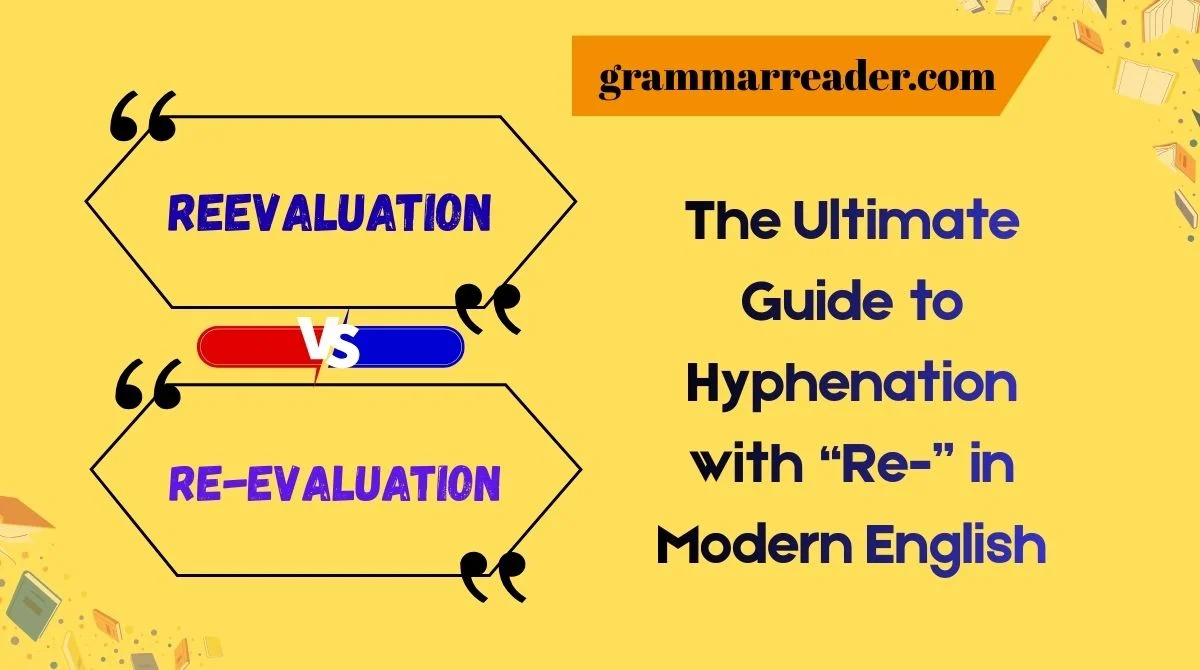
If you’ve ever paused while typing “reevaluation” and wondered whether you should add a hyphen—you’re not alone.
The debate around reevaluation vs. re-evaluation is one of the most common hyphenation questions writers struggle with. And it’s not just about spelling; it’s about clarity, meaning, and consistency.
In this guide, we’ll break down exactly when to hyphenate “re-” words, why American and British English differ, and how to decide the correct form every single time.
Understanding Hyphenation Trends in Modern American English
Hyphenation rules have changed a lot over the last century. Words that once used hyphens—email, cooperate, preorder—eventually evolved into closed forms.
Modern dictionaries and style guides now push toward simplicity and readability, which means:
- Hyphens are used less often
- Compound words are becoming shorter
- Closed forms are preferred unless the meaning becomes unclear
Why? Because the more people use a word, the quicker it becomes visually “normal,” and the hyphen falls away.
But “re-” words are special—they can change meaning entirely depending on whether you add a hyphen.
How the Prefix “Re-” Works
The prefix re- carries two primary meanings:
- Again (do something one more time)
- Back (return to a previous state)
Examples:
| Word | Meaning Without Hyphen | Meaning With Hyphen |
|---|---|---|
| reform | improve/change | re-form = form again |
| resign | quit | re-sign = sign again |
| recover | heal | re-cover = cover again |
A missing hyphen can completely shift the meaning. That’s why understanding when to hyphenate matters.
When to Hyphenate “Re-” Words
Writers often assume hyphens only matter for formality or style. In reality, they matter for meaning.
Here are the core rules.
Hyphenate When the Meaning Changes
Some “re-” words create two totally different meanings depending on hyphen usage. These MUST be hyphenated if you want to express the “again” meaning.
Examples:
- re-form (form again) vs. reform (improve)
- re-sign (sign again) vs. resign (quit)
- re-cover (cover again) vs. recover (heal)
- re-press (press again) vs. repress (control or suppress)
Whenever a closed word already exists, and the “re-” version changes meaning, the hyphen becomes essential.
Hyphenate for Readability with Double Vowels (Optional)
Words that create awkward double vowels often use a hyphen in British English, but not usually in American English.
Examples:
- re-enter
- re-express
- re-emerge
- re-enact
These are readable with or without the hyphen, but readability varies by region.
The “E-E Rule” and Why “Reevaluation” Usually Wins in American English
Historically, “re-evaluation” was the standard because of the double e-e.
But American English now overwhelmingly prefers:
reevaluation
reevaluate
reeducate
The trend is clear: remove the hyphen unless meaning becomes unclear.
Reevaluation vs. Re-evaluation: Which One Should You Choose?
This is the big question—so let’s make it simple.
American English Preference
✔️ reevaluation
✔️ reevaluate
Closed form. No hyphen. Considered modern, clean, and standard.
British English Preference
✔️ re-evaluation
✔️ re-evaluate
Hyphenated form is more common because British spelling often prioritizes preventing double-vowel collisions.
Why the Difference?
Americans prioritize simplicity.
Brits prioritize visual clarity.
Neither is wrong—it depends on your audience.
How Hyphenation (or the Lack of It) Can Change Meaning
Let’s explore real situations where a missing hyphen changes a sentence.
Case Study 1: The Contract Mix-Up
A company asked an employee to “re-sign the agreement.”
But the employee thought it meant “resign the agreement”—quit the contract.
The missing hyphen created a legal problem.
Correct usage for clarity:
- re-sign the agreement → sign it again
- resign the agreement → withdraw or leave a contract
One little line can save your job.
Case Study 2: A Reporting Error
A journalist wrote:
“The committee plans to reevaluate the budget to address overspending.”
No problem there.
But if she had written “re-evaluate,” British readers would accept it, while Americans may see it as old-fashioned.
Case Study 3: Confusion in Academic Writing
A research paper used:
“The patient will recover within 24 hours.”
But the intended meaning was:
“The patient will re-cover the wound daily.”
Without the hyphen, the meaning flips from “heal” to “cover again.”
Professional Writing: Why the Proper Form Matters
Your spelling choice affects how readers perceive you. In business, academic, and technical writing:
- Hyphens prevent misinterpretation
- Closed forms modernize your tone
- Consistency builds credibility
- Errors can change legal or financial meaning
A word as simple as “re-evaluate” can make your writing look outdated if your industry leans American-English.
How to Capitalize Hyphenated Words in Titles
Writers often break capitalization rules for hyphenated words, but here is the correct approach.
If You Use the Hyphenated Form (British Style)
In title case:
Re-Evaluation Strategies for 2025
- Capitalize both sides of the hyphen
- Treat each part like individual words
If You Use the Closed Form (American Style)
Reevaluation Strategies for 2025
No hyphen → no capitalization concerns → easier to design in headings.
Which Looks Cleaner in Titles?
Many designers and editors prefer the closed form because:
- It looks more modern
- It reduces visual noise
- It fits better in small headings
A Simple and Practical Decision Guide
Use this to decide instantly whether you need a hyphen.
Do Not Hyphenate If:
- The meaning stays the same
- You’re following American style
- The word is common and widely accepted (reevaluate, rewrite, redo)
Hyphenate If:
- The word changes meaning without the hyphen (re-sign)
- There is a real possibility of misreading
- You’re following British style
- It makes the sentence clearer
Quick Checklist
Ask yourself:
- Does meaning change without the hyphen?
- Will the double vowel confuse readers?
- Does your audience use American or British English?
- What form does your style guide prefer?
- Which version looks cleaner in context?
Examples of Hyphenation Rules for “Re-” Words
Here’s a helpful table to make decisions easier:
| Word | American English | British English | Notes |
|---|---|---|---|
| reevaluate | ✔️ Preferred | ❌ Less common | No hyphen in US |
| re-evaluate | ❌ Old-fashioned | ✔️ Preferred | Hyphen avoids e-e collision |
| re-sign | ✔️ Required | ✔️ Required | Meaning changes |
| resign | ✔️ Different meaning | ✔️ Different meaning | Means quit |
| re-cover | ✔️ Required | ✔️ Required | Means cover again |
| recover | ✔️ Different meaning | ✔️ Different meaning | Means heal |
| reenter | ✔️ Common | ❌ Less common | US drops hyphen |
| re-enter | ❌ Optional | ✔️ Preferred | UK uses hyphen |
| redo | ✔️ Standard | ✔️ Standard | Closed everywhere |
| re-do | ❌ Incorrect | ❌ Incorrect | Never hyphenated |
Examples of Misinterpretation Due to Missing Hyphens
Sometimes a missing hyphen creates unintentional humor or confusion.
Funny Real-World Examples
- “Kids cooking and reevaluating skills.”
→ Are kids being cooked? - “Man eating lion spotted near zoo.”
→ Did the lion eat a man or is the man eating the lion? - “Re-cover your sofa today!”
→ Without the hyphen, you may think the sofa healed from an injury.
Hyphens matter more than you think.
Five Common FAQs About Reevaluation vs. Re-evaluation
Is “reevaluation” or “re-evaluation” correct?
Both are correct.
American English prefers reevaluation.
British English prefers re-evaluation.
Why do some “re-” words require hyphens?
Because without the hyphen, the meaning would change—like re-sign vs. resign.
Is “reevaluate” officially recognized?
Yes. Modern dictionaries list reevaluate as the standard American spelling.
Do style guides prefer one form?
Most American guides prefer the closed form (reevaluate). UK guides often prefer the hyphen.
How do I decide quickly?
Use a hyphen when meaning changes or readability drops. Otherwise, choose the simpler closed form.
Conclusion
The debate between reevaluation vs. re-evaluation isn’t actually about which word is correct—it’s about understanding how hyphens work in English.
Here’s what matters most:
- American English prefers reevaluation (closed form).
- British English prefers re-evaluation (hyphenated form).
- Hyphens are essential when they change meaning.
- Modern writing leans toward fewer hyphens, not more.
- Consistency matters more than choosing the “right” form.
Whether you’re writing a report, article, academic paper, or business email, your goal is simple: choose the form that keeps your message clear and your style consistent.

Aiden Brooks is an educational writer dedicated to simplifying grammar for learners of all levels. He creates clear, practical explanations that help students read, write, and understand English with confidence.