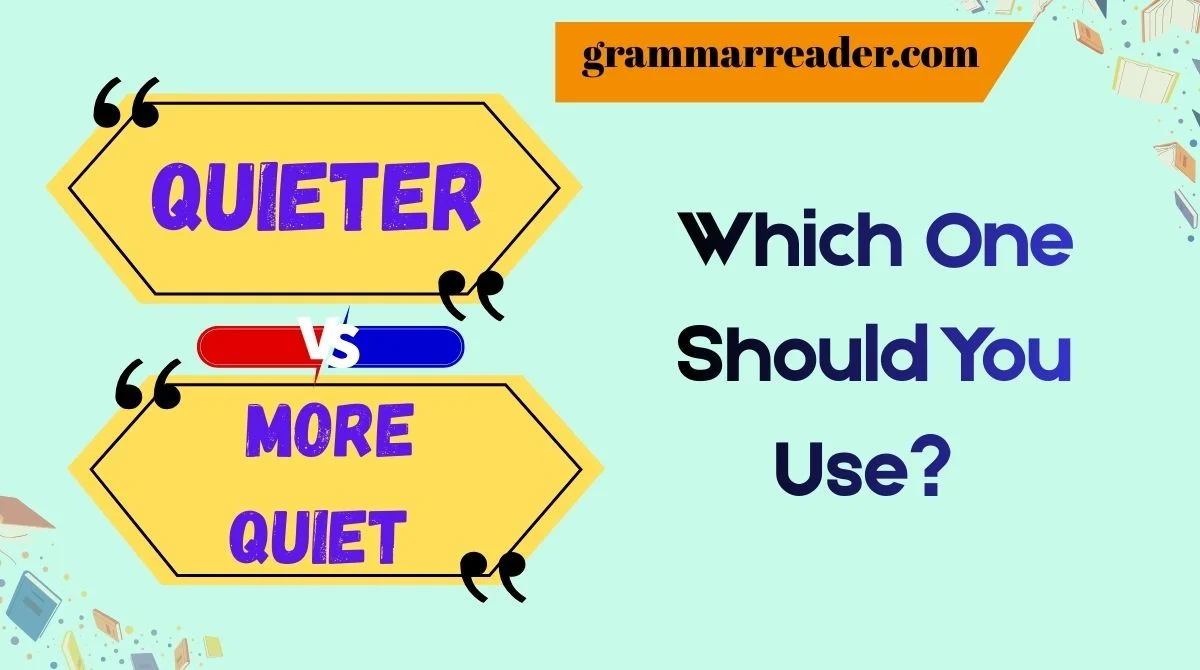
Have you ever paused mid-sentence wondering whether to say quieter or more quiet? You’re not alone. Even fluent English speakers sometimes stumble over this choice.
While both forms are technically understandable, one is often more natural, more common, and easier for readers and listeners to process.
In this guide, we’ll break down everything you need to know about quieter vs more quiet, from grammar rules to real-world usage.
Understanding “Quiet” as an Adjective
The word quiet is simple yet versatile. At its core, it describes a lack of noise or calmness. But its meaning can shift slightly depending on context:
- Physical silence: “The library is quiet.”
- Abstract calm or moderation: “She has a quiet personality.”
Understanding this distinction is key because it influences how comparatives like quieter or more quiet are used. When describing sound, most native speakers prefer quieter, while more quiet can appear in formal or poetic contexts.
How Comparatives Work in English
English has a fairly predictable system for forming comparatives:
- One-syllable adjectives usually take -er:
- fast → faster
- tall → taller
- Two-syllable adjectives ending in -y also typically take -er:
- happy → happier
- quiet → quieter
- Longer adjectives often use more:
- beautiful → more beautiful
- interesting → more interesting
The confusion with quiet arises because it is two syllables but ends with a consonant sound that makes -er feel natural, so both quieter and more quiet can exist grammatically, but usage preferences differ.
Quieter as the Preferred Comparative Form
Native speakers overwhelmingly favor quieter in everyday speech. Here’s why:
- Sound and rhythm: Quieter is quicker and easier to say.
- Rule of thumb: Two-syllable adjectives that can take -er usually do.
- Fluency: In spoken English, quieter sounds natural and effortless.
Examples:
- “The coffee shop is quieter in the mornings.”
- “Can you keep your voice quieter while she’s studying?”
Notice how quieter feels immediate and conversational. It rarely draws attention to itself, which is exactly what a comparative should do—it clarifies, not distracts.
When More Quiet Is Grammatically Acceptable
You might see more quiet in formal writing or literary contexts. While it’s technically correct, it has subtle differences:
- Emphasis: It can sound more deliberate.
- Poetic tone: Writers might use it for rhythm or contrast.
- Rare formal contexts: Academic writing sometimes prefers more quiet for stylistic reasons.
Examples:
- “The garden became more quiet as the sun set.”
- “Her thoughts grew more quiet with every passing hour.”
In most everyday communication, more quiet is less common. It can sound slightly awkward or overthought in casual speech.
Quieter vs More Quiet in Real-World Usage
How often do people actually use these forms? Let’s break it down:
| Form | Common Context | Naturalness | Example |
|---|---|---|---|
| Quieter | Spoken, informal writing | Very high | “The classroom is quieter than yesterday.” |
| More Quiet | Formal, literary, deliberate | Medium | “The night grew more quiet as the stars appeared.” |
From the table, it’s clear: if you want natural, fluent English, use quieter. More quiet is reserved for specific stylistic purposes.
Frequency Comparison: What Native Speakers Actually Use
Studies of modern English usage show:
- Quieter appears 10–15 times more often than more quiet in everyday speech and writing.
- More quiet shows up mainly in poetry, descriptive essays, or news articles.
This is why English learners should prioritize quieter for conversations, emails, and articles—it’s the form that sounds native.
Quietest vs Most Quiet
The superlative form follows the same pattern as comparatives:
- Short adjectives: add -est → quiet → quietest
- Long adjectives: use most → interesting → most interesting
So which is better: quietest or most quiet?
- Quietest is overwhelmingly correct and natural:
- “This is the quietest café in town.”
- Most quiet is grammatically possible but rarely used:
- “This café is the most quiet of all.” (sounds awkward)
Rule: Use quietest almost always. Reserve most quiet for specific stylistic or poetic effects.
Quieter vs Less Noisy: Meaning Isn’t Always Equal
Sometimes, people replace quieter with less noisy. While they seem similar, there’s a subtle difference:
| Expression | Meaning Difference | Example |
|---|---|---|
| Quieter | Relative silence or calmness | “The library is quieter in the afternoon.” |
| Less noisy | Focus on reduction of disruptive sound | “The street is less noisy after midnight.” |
- Quieter emphasizes overall calmness, including subtle sounds.
- Less noisy emphasizes reduction of irritating or unwanted noise.
Tip: If the goal is smooth English, use quieter. Use less noisy when you want to highlight noise reduction specifically.
“As Quiet As” for Equal Comparisons
Sometimes you’re not comparing more or less—you’re talking about equality. That’s where as quiet as comes in:
- Structure: as + adjective + as
- Use for equal comparisons: “The bedroom is as quiet as the study.”
- Works naturally with spoken and written English.
Example sentences:
- “The new apartment is as quiet as my old one.”
- “Her voice was as quiet as a whisper.”
This is the safest way to avoid comparative confusion altogether.
Common Idioms Using “As Quiet As”
Some idiomatic expressions lock in structure. Changing them sounds wrong:
- As quiet as a mouse → extremely silent
- As quiet as the grave → completely silent, often metaphorical
- As quiet as a church → calm and respectful environment
Idioms are fixed phrases. Always use them exactly as they are.
Common Mistakes and Misunderstandings
English learners (and even some native speakers) often make these mistakes:
- More quieter → ❌ Incorrect
- “The library is more quieter than before.”
- Correct: “The library is quieter than before.”
- Overusing more quiet → sounds unnatural in casual contexts
- Confusing less noisy with quieter → changes nuance
- Misapplying superlatives → “most quiet” instead of “quietest”
Practical Decision Guide: Choosing the Right Form Instantly
When in doubt, follow this quick guide:
- Comparative of quiet → use quieter (default)
- Superlative of quiet → use quietest
- Equality → use as quiet as
- Emphasizing noise reduction → use less noisy
- Formal or poetic contexts → more quiet is acceptable
Quick Rules You Can Memorize
- Quieter = spoken and written default
- More quiet = rare, formal, or literary
- Quietest = safe superlative
- Most quiet = mostly avoid
- Less noisy = slightly different meaning
- As quiet as = equality comparison
Handy Comparison Chart
| Form | Correctness | Tone/Naturalness | Example |
|---|---|---|---|
| Quieter | ✅ | Very natural | “The room is quieter now.” |
| More Quiet | ✅ | Slightly formal | “The garden grew more quiet as dusk fell.” |
| Quietest | ✅ | Natural | “This café is the quietest in the city.” |
| Most Quiet | ✅ | Awkward | “This café is the most quiet of all.” |
| Less Noisy | ✅ | Neutral | “The street is less noisy after 10 PM.” |
| As Quiet As | ✅ | Very natural | “This library is as quiet as the last one.” |
Frequently Asked Questions (FAQs)
What is the difference between quieter and more quiet?
Quieter is natural and common. More quiet is correct but formal or poetic.
Is it ever correct to say more quieter?
No. More quieter is always incorrect.
Which sounds more natural in American English?
Quieter sounds most natural in speech and writing.
Can less noisy fully replace quieter?
Not always. Less noisy emphasizes noise reduction, not general calmness.
Why does quieter sound more fluent than more quiet?
It follows standard comparative patterns for two-syllable adjectives, making it easier to pronounce and read.
Conclusion
When it comes to quieter vs more quiet, the key takeaway is simple: choose what sounds natural in context.
Use quieter for everyday comparisons, quietest for superlatives, and as quiet as for equality. More quiet exists, but reserve it for formal or literary contexts.
Following these rules will help you speak and write English confidently, naturally, and without hesitation.

Aiden Brooks is an educational writer dedicated to simplifying grammar for learners of all levels. He creates clear, practical explanations that help students read, write, and understand English with confidence.