English looks friendly on the surface. Then words like passerby, passersby, and passerbyers appear and quietly wreck confidence.
You’ve seen it happen.
Someone writes passerbyers in a comment.
Another person types passerbys in an email.
Everyone feels unsure, but nobody wants to correct it.
This guide ends that confusion for good.
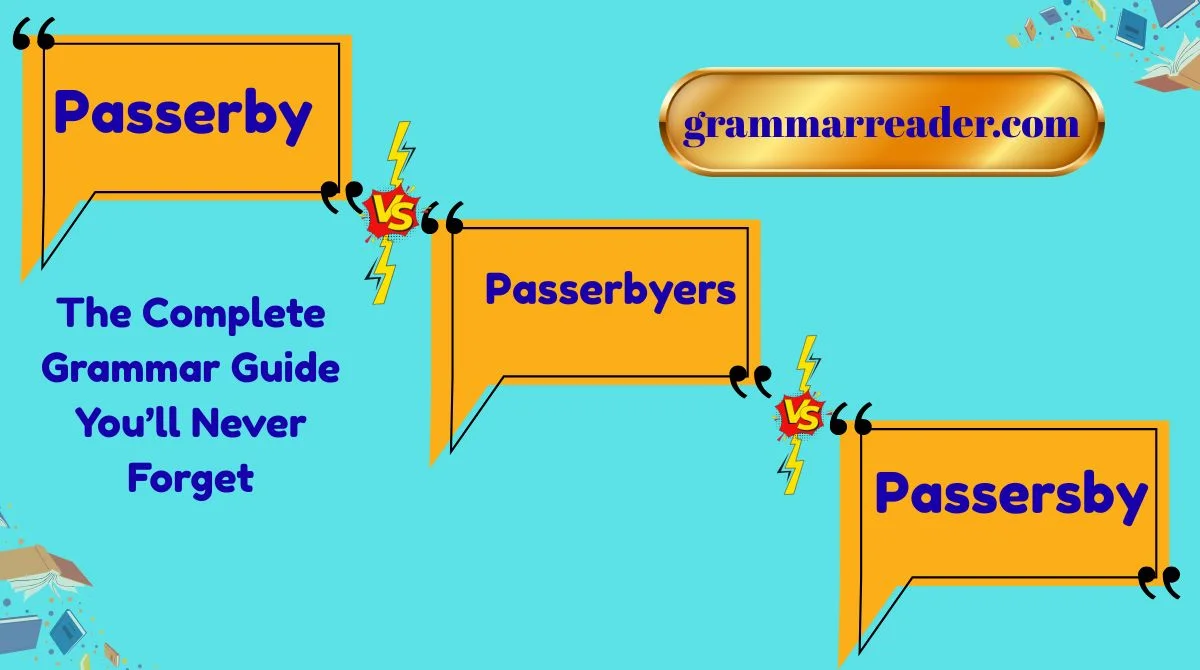
You’ll learn what passerby really means, why passersby is the only correct plural, and why passerbyers is never acceptable—not in formal writing, not in casual writing, not ever. By the end, this topic won’t trip you up again.
Let’s walk through it carefully, clearly, and without fluff.
Understanding “Passerby”: Meaning, Structure, and Origin
A passerby is a person who passes by a place casually, usually without stopping or getting involved.
Think of someone:
- Walking past an accident
- Moving along a street
- Passing through a crowd
That person is a passerby.
What makes “passerby” unusual
The word passerby is a compound noun.
It combines:
- passer (the person doing the action)
- by (the direction or manner of movement)
The key word here is passer.
That’s the noun.
By only modifies it.
This structure is the reason pluralization causes confusion.
Singular Form Explained: When to Use “Passerby”
Use passerby when you are talking about one person.
Correct singular examples
- A passerby called emergency services.
- One passerby stopped to help.
- A curious passerby watched the scene.
The meaning is always singular.
No “s.” No extra endings.
If you’re talking about one person passing by, passerby is correct every time.
The Correct Plural Form: Why “Passersby” Is Standard English
Here’s the rule that solves everything:
👉 In compound nouns, the main noun takes the plural.
In passerby, the main noun is passer, not by.
So the plural becomes:
passer → passers
passerby → passersby
Comparison Table: Correct vs Incorrect Forms
| Form | Correct? | Why |
|---|---|---|
| passerby | ✔ | singular form |
| passersby | ✔ | correct plural |
| passerbyers | ✘ | nonstandard |
| passerbys | ✘ | incorrect structure |
This same rule applies to many other compound nouns.
How Compound Nouns Like “Passerby” Really Work
English already uses this pattern everywhere.
Most people just don’t realize it.
Similar compound noun examples
- mother-in-law → mothers-in-law
- runner-up → runners-up
- editor-in-chief → editors-in-chief
Notice the pattern.
The plural attaches to the person, not the position or direction.
Passersby follows the same logic.
Why “Passerbyers” Is Incorrect (But Still Popular)
Let’s be honest.
Passerbyers sounds logical at first.
People think:
- driver → drivers
- teacher → teachers
- passerby → passerbyers
That pattern works for regular nouns.
But passerby isn’t a regular noun.
Why people misuse “passerbyers”
- Spoken English encourages sound-based spelling
- People forget compound noun rules
- “By” feels like part of the noun instead of a modifier
Still, logic doesn’t override grammar here.
Passerbyers is not a real word in standard English.
Using it signals weak grammar awareness, especially in writing.
Is “Passerbys” Ever Acceptable?
Short answer: no.
Adding an “s” at the end breaks the structure of the compound noun.
Why “passerbys” fails
- It pluralizes the wrong part
- It ignores the head noun (passer)
- It doesn’t follow English compound rules
You might see passerbys online.
That doesn’t make it correct.
Professional writing never accepts it.
The Role of Hyphenation: Passer-by and Passers-by
Older English sometimes used hyphens:
- passer-by
- passers-by
These forms appeared more often in 18th and 19th century writing.
Modern usage reality
- Passerby (no hyphen) is standard today
- Passersby (no hyphen) is preferred in modern style
Hyphenated versions aren’t wrong historically, but they’re uncommon now.
Most editors and style guides favor the closed form.
Real-World Usage: “Passersby” in Context
Understanding rules is good.
Seeing them in action is better.
News and reporting
- Several passersby witnessed the incident.
- Police questioned nearby passersby.
Legal and official writing
- Statements were taken from passersby.
- Video footage showed multiple passersby.
Everyday writing
- Curious passersby stopped to watch.
- The artist attracted dozens of passersby.
You’ll notice one thing.
Professionals always use passersby.
Spoken English vs Written English: Where Confusion Starts
People often say passerbyers out loud.
Speech is forgiving. Writing is not.
Spoken language favors:
- Rhythm
- Ease
- Familiar patterns
Written language demands:
- Structure
- Standard forms
- Consistency
That’s why mistakes creep in when people write the way they speak.
Why “Passersby” Has Survived Language Change
English evolves constantly.
Some rules bend. Some break.
But compound noun pluralization has stayed surprisingly stable.
Why “passersby” endures
- It follows a logical noun-head structure
- Editors enforce it consistently
- Readers recognize it instantly
Other forms never gained legitimacy.
So passersby remained the standard.
Quick Memory Trick to Never Get It Wrong Again
Ask one simple question:
Who is the person?
The answer is passer.
That’s the word you pluralize.
If you remember that, you’ll never write passerbyers again.
Common Synonyms for “Passersby”
Sometimes it helps to swap the word entirely.
Useful alternatives include:
- pedestrians
- onlookers
- bystanders
- observers
- people nearby
These words avoid compound noun confusion altogether.
FAQs About Passerby, Passersby, and Passerbyers
What is the singular form of passersby?
The singular form is passerby.
Why is passersby the correct plural?
Because passer is the main noun, and it takes the plural form.
Is passerbyers a real word?
No. Passerbyers is grammatically incorrect in standard English.
Can I use passerbys informally?
No. Even informal writing avoids this form.
Are hyphenated forms like passer-by still correct?
They’re historically correct but rarely used in modern English.
Final Takeaway
Here’s the rule that matters:
- One person → passerby
- More than one person → passersby
Never use:
- passerbyers
- passerbys
If you stick to that, your writing stays clean, confident, and professional.
Grammar doesn’t need to be scary.
Sometimes it just needs a clear explanation.

Aiden Brooks is an educational writer dedicated to simplifying grammar for learners of all levels. He creates clear, practical explanations that help students read, write, and understand English with confidence.