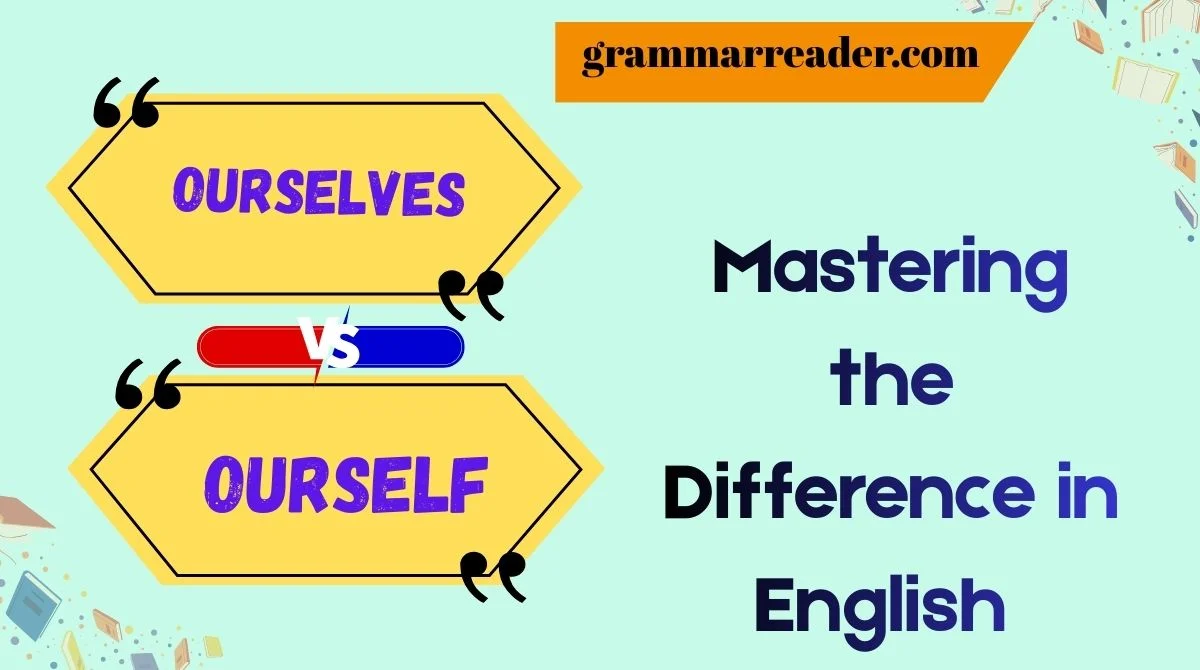
Do you ever pause mid-sentence, wondering whether to write “ourselves” or “ourself”? You’re not alone.
English reflexive pronouns can be tricky, especially when history, formal writing, and modern usage collide.
This guide will help you confidently distinguish between ourselves and ourself, understand when each is appropriate, and even explore why monarchs and editors sometimes still use “ourself.”
Understanding Reflexive Pronouns
Reflexive pronouns reflect the action of a verb back onto the subject. They are crucial in English because they clarify who performs an action and who receives it. Common reflexive pronouns include:
| Singular | Plural |
|---|---|
| Myself | Ourselves |
| Yourself | Yourselves |
| Himself/Herself | Themselves |
Reflexive pronouns always refer back to the subject of the sentence. For example:
- I taught myself French.
- We prepared ourselves for the presentation.
The key is matching the pronoun to the subject in number and perspective. Misalignment leads to awkward or grammatically incorrect sentences.
The Basic Distinction Between ‘Ourselves’ and ‘Ourself’
The general rule is simple but often misunderstood:
- Ourselves → Used for plural subjects (we, you + plural, they).
- Ourself → Rarely used; typically singular, often in royal or formal contexts, or when a collective entity is viewed as a single unit.
Quick Comparison Table
| Pronoun | Subject Type | Common Use | Example |
|---|---|---|---|
| Ourselves | Plural | Standard modern English | We prepared ourselves for the journey. |
| Ourself | Singular collective / formal | Rare, historical, royal, editorial | The monarch congratulated ourself on the successful treaty. |
The confusion arises because “ourself” is so rare in modern English, people often assume it’s always wrong. That’s a misconception we’ll clear up.
Historical Context and the ‘Royal We’
One of the most fascinating aspects of “ourself” is its connection to the royal or editorial “we.” Monarchs and high-ranking officials have historically used “we” to refer to themselves, a tradition that conveys authority, dignity, and collective representation.
- Royal “we” example:
“We are pleased with ourself for guiding the kingdom wisely.”
Here, “ourself” reflects the singular monarch in the plural form, emphasizing that the action belongs to the person but represents the office or the state.
- Editorial “we” example:
“In reviewing the manuscript, we found ourself inclined to recommend revisions.”
Editors historically used “we” and “ourself” to signify authority and judgment, distinguishing the voice of the institution from the individual writer.
Usage in Literature and Historical Texts
“Ourselves” and “ourself” appear frequently in historical literature. Studying these examples helps us understand how usage has evolved:
- Shakespearean example:
“Let us consider ourself in this reflection.”
Here, the king or narrator uses the singular collective “ourself” to express self-reflection in a formal tone. - Victorian literature:
“We must prepare ourself for the challenges ahead.”
Often written by editors or authors adopting a formal, authoritative voice. - Early 20th-century texts:
Editors of academic or institutional works used “ourself” when writing on behalf of a group.
Modern vs Historical Comparison Table
| Era | Example | Pronoun | Purpose |
|---|---|---|---|
| 16th-17th century | Let us consider ourself | Ourself | Formal, reflective, authority |
| 19th century | We must prepare ourself | Ourself | Editorial, institutional voice |
| 21st century | We prepared ourselves | Ourselves | Standard plural usage |
From this, it’s clear that “ourself” survives only in formal, ceremonial, or historical contexts, while “ourselves” dominates modern English.
Correct Usage of ‘Ourselves’ in Modern English
For everyday writing and speech, ourselves is the safe and standard choice. It applies to any plural subject, such as we, the team, or the company.
Key Rules for Using Ourselves:
- Always match the subject: plural subjects take “ourselves.”
- We congratulated ourselves on the achievement.
- Never use “ourselves” for singular individuals:
- ❌ I congratulated ourselves → wrong
- ✅ I congratulated myself → correct
- Use reflexive pronouns to emphasize or reflect back:
- We prepared ourselves thoroughly for the test.
- Use in compound subjects:
- John and I found ourselves confused by the instructions.
Common Mistakes Table
| Incorrect | Correct | Explanation |
|---|---|---|
| The team congratulated ourself | The team congratulated themselves | Team is plural, use plural reflexive |
| I taught ourselves | I taught myself | Singular subject, use singular reflexive |
| We congratulated ourself | We congratulated ourselves | Plural subject, use plural reflexive |
Special Contexts Where ‘Ourself’ Makes Sense
Though rare, “ourself” still has legitimate use in specific situations:
- Singular collective nouns:
When a group is treated as a single entity:- The committee found ourself responsible for the error.
- Royal or ceremonial use:
Monarchs and high-ranking officials sometimes use:- We will defend ourself against all threats.
- Formal editorial writing:
Editors or institutions may use:- In this report, we found ourself compelled to adjust the methodology.
Examples of Correct “Ourself” Usage Today
- The board considers ourself accountable for the outcomes.
- The queen reminded ourself of her duties before addressing the nation.
- As a collective organization, we must see ourself as part of a larger mission.
The key is context. If the audience expects formality, ceremony, or authority, “ourself” may be acceptable.
Common Misconceptions and Grammar Myths
Let’s clear up some persistent myths about “ourselves” and “ourself”:
- Myth 1: “Ourself is always incorrect”
❌ False. Historical, formal, and royal contexts validate “ourself.” - Myth 2: “Ourselves can be used for singular subjects”
❌ False. Only singular reflexives like “myself” are correct for one person. - Myth 3: “The two words are interchangeable”
❌ False. Using them incorrectly can sound awkward or archaic. - Myth 4: “Ourself sounds archaic in all cases”
✅ Partially true. It’s archaic in everyday speech but correct in formal contexts.
Mini test: Which sentence is correct?
- We congratulated ourself. ❌
- We congratulated ourselves. ✅
Practical Tips for Correct Pronoun Usage
Here’s a quick checklist to ensure you’re always correct:
- Identify the subject: singular or plural?
- Is the context formal, royal, or editorial?
- For plural subjects in modern English → always use “ourselves.”
- For singular collective or ceremonial contexts → “ourself” may be acceptable.
- When in doubt, default to “ourselves” unless you’re emulating historical or royal style.
Mnemonic Trick
- Ourselves = Our group (plural → safe in modern English)
- Ourself = Our single authority (singular, formal, historical)
FAQs
What is the difference between “ourselves” and “ourself”?
Answer: “Ourselves” is plural, standard usage; “ourself” is singular, mostly historical or formal.
When should I use “ourselves”?
Answer: Use “ourselves” for plural subjects in modern English, like “we,” “the team,” or “the company.”
Is “ourself” grammatically correct?
Answer: Yes, in historical, royal, or formal contexts, and sometimes with singular collective nouns.
Can I use “ourselves” for singular subjects?
Answer: No, singular subjects require “myself” or “yourself.”
Why do monarchs and editors use “ourself”?
Answer: To convey authority, formality, and the singular-person-as-collective perspective in speech or writing.
Conclusion
Mastering ourselves vs ourself is less about memorizing a rule and more about understanding context.
- Ourselves → modern, plural, safe choice.
- Ourself → rare, formal, historical, or singular collective.
By observing subject number, context, and tone, you can confidently choose the right reflexive pronoun. Using them correctly not only improves grammar but also lends clarity, authority, and elegance to your writing.
Remember, history and tradition sometimes allow flexibility, but modern English favors simplicity. When in doubt, “ourselves” keeps you safe and grammatically correct.

Aiden Brooks is an educational writer dedicated to simplifying grammar for learners of all levels. He creates clear, practical explanations that help students read, write, and understand English with confidence.