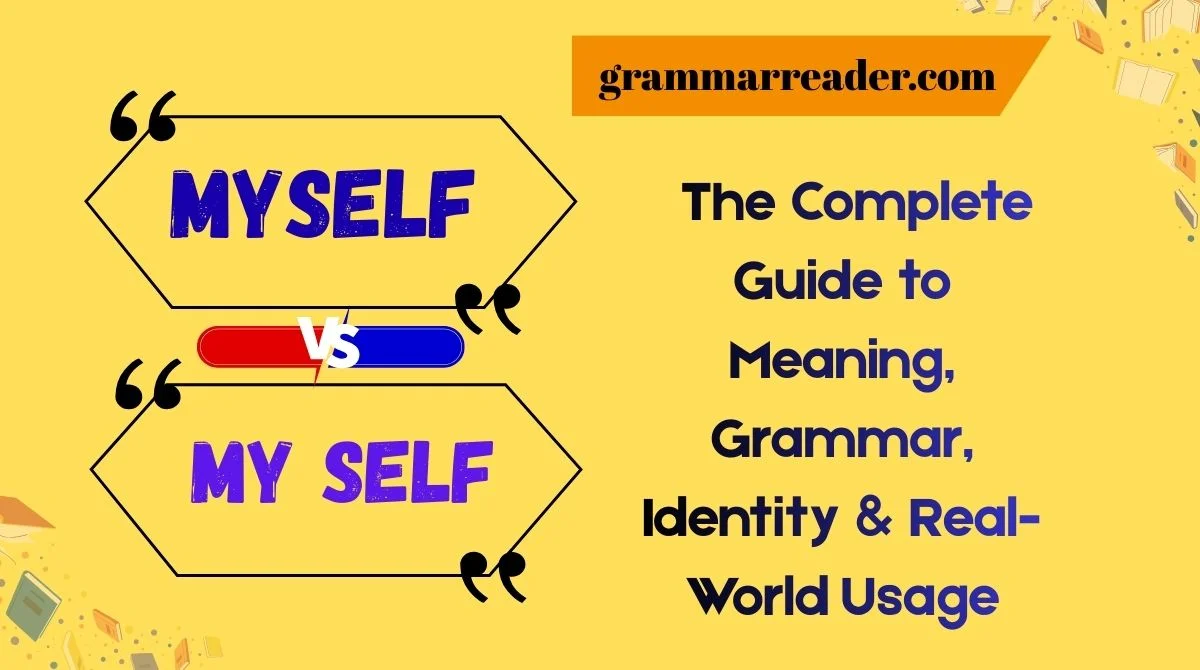
Understanding the difference between “myself” and “my self” might look simple at first glance—but once you dig in, you’ll realize these two forms carry very different meanings.
One belongs to grammar, and the other belongs to identity. Writers, students, professionals, and even native speakers mix them up all the time.
This guide breaks everything down in a clear, conversational, and practical way. You’ll learn how each form works, when to use it, and how to avoid mistakes—without wading through fluff or complicated jargon.
Let’s dive in.
Myself vs My Self: What’s the Real Difference?
Confusion usually happens because the two forms look almost identical. But only one of them—myself—is an actual pronoun. The other—my self—is a phrase about identity, reflection, and the inner person you believe yourself to be.
This article will clarify:
- How “myself” functions in real grammar
- When to use “my self” to talk about identity
- Why “myselves” is never correct
- How psychology and philosophy use “self”
- Common mistakes and how to fix them
- A quick decision guide
- 5 FAQs for easy recall
Let’s start with the one you see every day: “myself.”
What “Myself” Really Means in English
“Myself” as a Reflexive & Intensive Pronoun
“Myself” is one of the eight reflexive/intensive pronouns in English:
| Subject | Reflexive/Intensive |
|---|---|
| I | myself |
| you | yourself |
| he | himself |
| she | herself |
| it | itself |
| we | ourselves |
| you (plural) | yourselves |
| they | themselves |
A reflexive pronoun reflects the action back to the subject:
- I taught myself guitar.
- I cut myself while cooking.
- I convinced myself to finish the project.
An intensive pronoun adds emphasis:
- I baked the cake myself.
- I fixed the problem myself.
- I’ll handle it myself.
Two main functions of “myself”:
- Reflexive: action loops back to “I”
- Intensive: adds emphasis, like bold text in speech
Correct Examples in Everyday Sentences
Reflexive Use
- I told myself I could do it.
- I blame myself for the mistake.
- I pushed myself to finish the race.
Intensive Use
- I checked the results myself.
- I cooked dinner myself.
- I personally wrote that paragraph myself.
Incorrect Uses of “Myself” (Very Common!)
People often use “myself” to sound formal, especially at work:
❌ If you have questions, contact John or myself.
✔️ If you have questions, contact John or me.
❌ My colleague and myself will assist you.
✔️ My colleague and I will assist you.
Why is this wrong?
Because “myself” cannot replace me or I. It must be reflexive or emphatic—not a fancy substitute pronoun.
Understanding “My Self” (Two Separate Words)
“My self” is not a pronoun.
It’s a noun phrase:
- my → possessive adjective
- self → noun (meaning identity, personhood, essence)
Think of it as similar to:
- my house
- my car
- my idea
- my self
What “My Self” Actually Means
It refers to:
- your identity
- your being
- your personality
- your consciousness
- your inner self
This usage appears often in psychology, philosophy, and personal journaling.
Examples
- I feel disconnected from my self lately.
- Meditation helps me understand my self better.
- I’m trying to return to my true self—my real self.
- There is a difference between my self and the role I play at work.
Notice something?
If you can replace self with identity, the phrase works:
- I feel disconnected from my identity.
If that works, “my self” is correct.
Where “My Self” Is Commonly Used
Psychology
- self-concept
- self-esteem
- sense of self
- ideal self vs. actual self
Philosophy
- the nature of consciousness
- the observing self
- the constructed vs. authentic self
Literature
- personal reflection
- inner conflict
- transformation narratives
Writers use “my self” to slow the reader down, highlight introspection, or emphasize the difference between the outer “me” and the inner “self.”
Why “Myselves” Is Incorrect — Always
Some learners mistakenly try to pluralize “myself,” but English reflexive pronouns have fixed forms.
Here’s why “myselves” can never exist:
- “Myself” refers to one individual (the speaker).
- “I” cannot be pluralized; therefore, neither can “myself.”
- The plural of “I” is not a thing.
- English reflexive pronouns don’t change structure based on the number of objects.
There is only:
- myself (singular)
- ourselves (plural form for “we”)
“Myselves” has no grammatical foundation.
How “Myself” Functions in Grammar
Reflexive Structure: Subject = Object
A reflexive pronoun is used only when the subject and object refer to the same person.
Structure:
Subject + verb + myself
Examples:
- I remind myself to stay calm.
- I taught myself photography.
- I prepared myself for the interview.
Without a reflexive need, you must use me:
❌ He gave myself a gift.
✔️ He gave me a gift.
Intensive Structure: Adding Emphasis
Structure:
Subject + verb + … + myself
or
Myself + verb + object
Examples:
- I washed the car myself.
- I, myself, don’t agree.
- I’ll clean it up myself.
Tip: If removing “myself” doesn’t change the meaning, it’s being used for emphasis.
Identity & Philosophy: The Non-Reflexive “Self”
When you write “my self,” you step outside grammar and enter the world of identity.
“Self” as a Concept
In psychology, “self” includes:
- Self-image: how you see yourself
- Self-esteem: your evaluation of yourself
- Self-concept: mental model of who you are
- True self vs. false self: authenticity vs. persona
In philosophy, “self” explores:
- consciousness
- awareness
- ego
- mind
- personal essence
When someone writes about “my self,” they’re usually describing the deeper inner experience of being who they are.
How Spacing Changes Meaning
Here’s a clear comparison:
| Form | Meaning | Example |
|---|---|---|
| myself | reflexive/intensive pronoun | I blame myself. |
| my self | noun phrase referring to identity | I’m rediscovering my self. |
Spacing matters—a lot.
Common Errors and How to Avoid Them
Here are the most frequent mistakes and how to correct them.
Using “Myself” Instead of “Me” or “I”
People do this to sound polite, but it’s wrong.
❌ John and myself went to the store.
✔️ John and I went to the store.
Using “My Self” When “Myself” Is Correct
❌ I told my self to stay calm.
✔️ I told myself to stay calm.
Adding “Myself” to Sound Formal
❌ You can return the documents to Sarah or myself.
✔️ You can return the documents to Sarah or me.
Confusing Identity With Grammar
“Myself” = grammar
“My self” = identity, feelings, consciousness
Keep them separate.
Quick Decision Guide to Remember the Difference
Use this simple rule:
Ask yourself: Is it about grammar or identity?
If the sentence needs a pronoun, choose:
➡️ myself
If the sentence is about who you are, choose:
➡️ my self
Fast Test
Try replacing the phrase with a different reflexive pronoun:
- himself
- herself
- themselves
If it fits → use myself
If it doesn’t → use my self
One-Line Rule
Use myself for actions.
Use my self for identity.
Real-Life Examples & Micro Case Studies
Case Study 1: Email at Work
Sentence:
❌ Please contact John or myself if you have questions.
Problem: “Myself” cannot replace “me.”
Fix:
✔️ Please contact John or me if you have questions.
Case Study 2: Personal Journal Entry
Sentence:
✔️ I feel like I’m losing my self.
Why it’s correct:
Talking about identity, not grammar.
Case Study 3: Classroom Grammar
Sentence:
❌ I gave myself and Sarah a gift.
This sounds correct but is wrong because reflexive pronouns can’t pair with another object like this.
Fix:
✔️ I gave Sarah and me a gift.
Case Study 4: Meditation Coaching
Sentence:
✔️ Meditation brings me back to my self.
Identity is the focus—correct usage.
Frequently Asked Questions
What is the difference between “myself” and “my self”?
“Myself” is a reflexive/intensive pronoun. “My self” refers to your identity or inner being.
When should I use “myself”?
Use it only when it’s reflexive (action returns to you) or for emphasis.
When is “my self” correct?
Use it in psychological, reflective, or philosophical contexts involving identity.
Is “myself” ever incorrect?
Yes—when it’s used to replace “I” or “me” in an attempt to sound formal.
Why is “myselves” incorrect?
Because “I” cannot be pluralized, and English reflexive pronouns don’t form plurals that way.
Conclusion
Understanding the difference between “myself” and “my self” helps you become a sharper writer, a clearer communicator, and a more thoughtful thinker.
While “myself” functions strictly as a pronoun, “my self” opens the door to discussions about identity, consciousness, and personal growth.
Both forms matter—but for very different reasons.
Mastering this distinction will improve not just your grammar but also your ability to express deeper parts of your inner world.

Aiden Brooks is an educational writer dedicated to simplifying grammar for learners of all levels. He creates clear, practical explanations that help students read, write, and understand English with confidence.