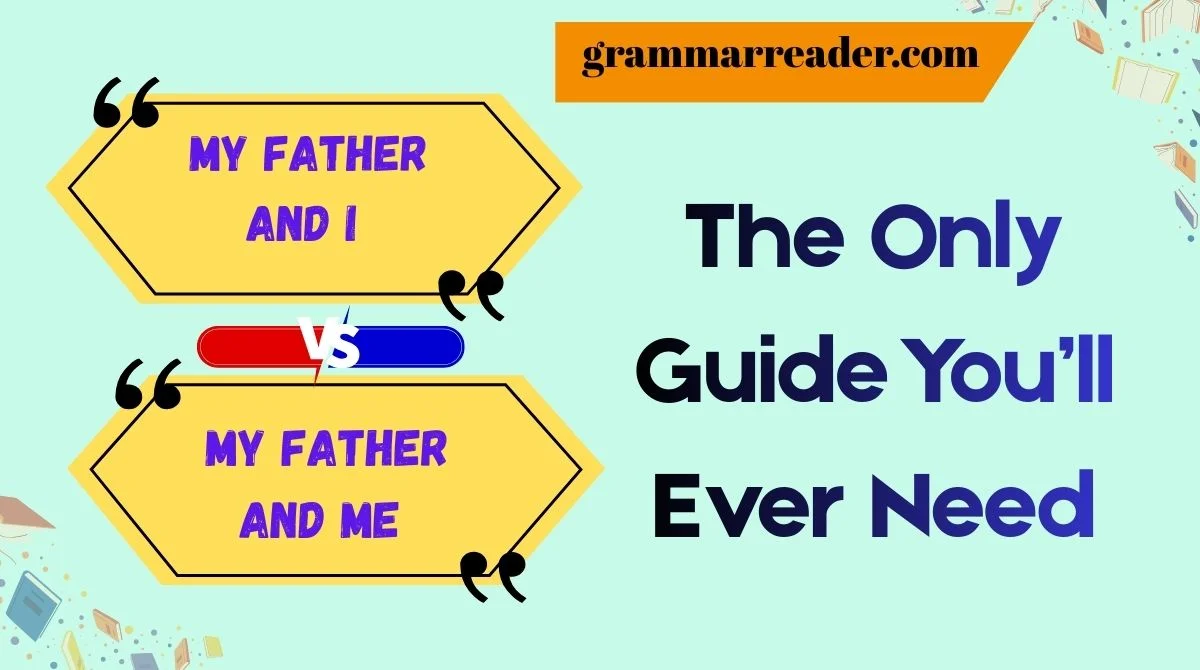
When you write or speak, you want your words to sound natural, confident, and correct. Yet one tiny grammar choice often throws people off: should you say “My father and I” or “My father and me”?
You’ve probably paused mid-sentence at some point. Maybe you corrected yourself. Maybe someone corrected you. Maybe you weren’t sure which one was right.
Don’t worry. This guide walks you through everything step-by-step and helps you understand the difference once and for all.
Understanding the Core Rule Behind “My Father and I” vs “My Father and Me”
You can solve this grammar puzzle by learning subject and object pronouns. Once you get these two categories, the entire topic becomes easy.
Subject Pronouns (Do the Action)
These pronouns perform the action in a sentence.
- I
- He
- She
- We
- They
Example:
I walked to the store.
Object Pronouns (Receive the Action)
These pronouns receive the action.
- Me
- Him
- Her
- Us
- Them
Example:
The teacher called me.
Quick anchor rule
“I” does the action. “Me” receives the action.
This simple rule helps you decide which one to use in the phrase “My father and I vs My father and me.”
The Solo Pronoun Trick (The Easiest Test in the World)
Here’s a quick test you can use in any situation.
Step 1: Remove “my father.”
Step 2: Read the sentence using only “I” or “me.”
Step 3: Choose the one that sounds correct.
Step 4: Put “my father” back in front of it.
Example 1
❌ My father and me went to the store.
Test: “Me went to the store.” → Incorrect
Correct: My father and I went to the store.
Example 2
❌ The teacher saw my father and I.
Test: “The teacher saw I.” → Incorrect
Correct: The teacher saw my father and me.
Why this trick works
Removing the other person exposes the pronoun’s true grammatical role. It forces your brain to choose the correct form naturally.
When to Use “My Father and I”
Use “My father and I” when you and your father are the subject of the sentence—the people doing the action.
Correct Examples
- My father and I are going to the wedding.
- My father and I baked a cake yesterday.
- My father and I share a love for old movies.
How to check
Try the solo test:
- I am going to the wedding. → Correct
- I baked a cake yesterday. → Correct
Politeness Rule: Place Others First
English prefers placing the other person before yourself.
So write:
- My father and I
Not: I and my father
It simply sounds more respectful and natural.
When to Use “My Father and Me”
Use “My father and me” when you and your father are the object of the sentence.
Someone else is doing the action to you.
Correct Examples
- The coach praised my father and me.
- The gift was for my father and me.
- They invited my father and me to dinner.
- She took a photo of my father and me.
After a preposition
Whenever there’s a preposition such as:
- with
- for
- to
- between
- from
- about
You must use me (never I).
Examples
- She walked with my father and me.
- This message is for my father and me.
- The fight was between my father and me.
Why “Me and My Father” Is Often Misused
You’ve heard people say:
- Me and my father went…
- Me and my father are going…
It’s common, especially in casual speech. But here’s the truth:
Why it sounds wrong
- Grammatically incorrect when used as a subject.
- Politeness rule places the other person first.
- It often signals informal or unpolished speech.
When is it acceptable?
In casual conversation among friends or family, people sometimes use it. Spoken language is flexible. Written English, however, requires correctness.
Better alternatives
- My father and I went…
- They sent the package to my father and me.
Swap “me and my father” for the correct form, and your writing instantly feels clear and confident.
Common Misuses and How to Fix Them
Let’s look at mistakes people make with “My father and I vs My father and me.”
Mistake #1: Overusing “I”
People think “I” sounds smart, so they use it everywhere—even when it’s wrong.
❌ They gave my father and I a gift.
✔️ They gave my father and me a gift.
Mistake #2: Using “me” as the subject
❌ My father and me arrived late.
✔️ My father and I arrived late.
Mistake #3: Forgetting the preposition rule
❌ She baked a cake for my father and I.
✔️ She baked a cake for my father and me.
Mistake #4: Incorrect word order
❌ I and my father went to the store.
✔️ My father and I went to the store.
Case Study: A Real Example of Confusion
A student named Amir kept writing:
“The principal called my father and I.”
He insisted that “I” sounded more educated. He had learned this phrase growing up because adults around him said it that way.
What we did
We used the solo test:
- The principal called I. ❌
- The principal called me. ✔️
His face lit up.
He finally understood.
After that, he never got it wrong again.
The Role of Context: Formal vs Informal English
Context shapes how you choose between “My father and I vs My father and me.”
Formal Settings
You need correct grammar in:
- Essays
- Emails
- Job applications
- School assignments
- Professional messages
Here, correctness matters more than casual style.
Informal Settings
In conversations with:
- Friends
- Family
- Messages on WhatsApp
- Social media comments
People often break grammar rules. It’s normal.
The golden rule
Write formally, speak naturally—but always know the correct form.
Quick Grammar Tips You’ll Actually Remember
1. Replace “my father and…” with “I” or “me.”
- If “I” fits → use my father and I
- If “me” fits → use my father and me
2. Before a preposition → always use “me.”
Words like to, for, with, between, about call for an object pronoun.
3. Ask: Who is doing the action?
If you’re doing the action → use I
If you’re receiving it → use me
4. Listen to your ear
Sometimes the sentence sounds wrong even before you dissect it.
5. Use this short mnemonic
I = doer, me = receiver.
Short Quiz: Test Yourself
Try answering before checking the answers.
1. ___ went to the park with my father.
A) I
B) Me
Correct: I (subject)
2. They invited my father and ___ to the trip.
A) I
B) Me
Correct: Me (object)
3. ___ and my father cleaned the garage.
A) Me
B) My father and I
Correct: My father and I
4. The teacher praised my father and ___.
A) me
B) I
Correct: me
5. This gift is for my father and ___.
A) me
B) I
Correct: me
Table: Quick Comparison Guide
| Situation | Pronoun | Example |
|---|---|---|
| You and your father do the action | My father and I | My father and I cooked dinner. |
| Someone else does the action to you | My father and me | She thanked my father and me. |
| After a preposition | Me | They walked with my father and me. |
| At the beginning of a sentence | My father and I | My father and I stayed late. |
| Casual speech (informal) | Sometimes “me and my father” | Me and my father went out (informal only). |
Real-Life Scenarios to Build Confidence
Scenario 1: Writing an Email to a Teacher
“My father and I will attend the meeting.”
Scenario 2: Talking to a Friend
“Yeah, the gift was for my father and me.”
Scenario 3: Posting on Social Media
“Had fun with my father and me at the concert!”
Scenario 4: Writing in a College Essay
“My father and I have always shared a deep bond.”
Scenario 5: Professional Communication
“The manager spoke to my father and me after the event.”
Famous Quote That Helps Remember the Rule
“Grammar is the difference between knowing your stuff and knowing you’re stuff.”
—Anonymous
Same way, choosing between I and me changes the meaning of your sentence.
FAQs About ‘My Father and I vs My Father and Me’
Can I ever use “My father and I” in the object position?
Short answer: No. Object positions require me, not I.
Is it wrong to say “Me and my father”?
In innormal speech, people say it. In writing or formal speech, it’s incorrect.
What’s the fastest way to check which one is correct?
Do the solo test. Remove “my father” and see if “I” or “me” fits.
Why do people overuse “My father and I”?
Because they think “I” sounds more proper. So they use it even when it’s wrong.
Can “My father and me” ever start a sentence?
Only in extremely casual speech. Grammatically, it’s incorrect.
Final Thoughts
Once you understand subject vs object pronouns, everything clicks.
Remember:
- Use “my father and I” when you’re doing the action.
- Use “my father and me” when the action happens to you.
- Use the solo test whenever you’re confused.
- Keep it natural, keep it simple, and trust your ear.
With these tools, you’ll never struggle with “My father and I vs My father and me” again.

Aiden Brooks is an educational writer dedicated to simplifying grammar for learners of all levels. He creates clear, practical explanations that help students read, write, and understand English with confidence.