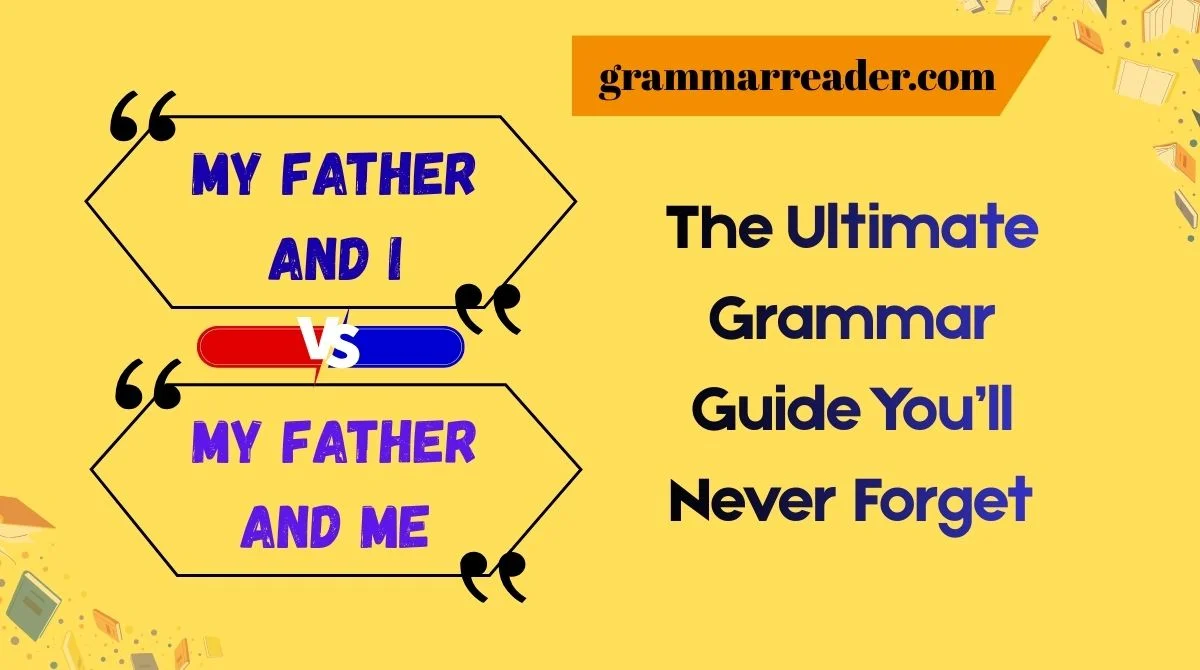
English grammar loves to trick people, especially when two simple words—I and me—show up next to family members. Almost everyone has stopped mid-sentence wondering: “Should I say My father and I… or My father and me…?”
You’re not alone. This is one of the most common grammar dilemmas native speakers face. Good news though—you’re about to learn everything you need in a simple, friendly, and practical way.
This guide breaks it down with examples, stories, tables, and memory tricks so you’ll never doubt yourself again.
Why “My Father and I” vs. “My Father and Me” Confuses So Many People
You grew up hearing both versions. Teachers pushed “My father and I” as the “correct” answer for everything. Meanwhile everyday conversations around you probably sounded like:
- “Me and my father went to the store.”
- “They gave the tickets to me and my father.”
You hear both. You say both. And eventually everything starts to sound right and wrong at the same time.
This confusion happens because:
- People overcorrect and use I everywhere.
- We copy the way people around us speak.
- English sentences change depending on position in the sentence.
Let’s make this easy. Really easy.
The Core Grammar Rule You Need to Know
Everything in this guide revolves around one simple rule:
Use I as the subject.
Use me as the object.
Understanding this rule removes all confusion. So let’s break it down.
Subject Pronouns vs. Object Pronouns (Simple Definitions)
Subject Pronouns
These pronouns perform the action.
Examples:
I, he, she, we, they
You use I when it’s doing something:
- I walked.
- I called her.
When you add your father, the rule doesn’t change:
- My father and I walked.
- My father and I called her.
Object Pronouns
These pronouns receive the action.
Examples:
me, him, her, us, them
You use me when something is done to you:
- She called me.
- They saw me.
When you add your father:
- She called my father and me.
- They saw my father and me.
Quick Table to Remember
| Situation | You Use | Example |
|---|---|---|
| You’re doing the action | My father and I | My father and I cooked dinner. |
| The action is happening to you | My father and me | They invited my father and me. |
| You’re the object of a preposition | My father and me | She sat next to my father and me. |
This table alone solves 90% of your grammar questions.
The “Remove the Other Person” Trick (Fastest Test)
Here’s the simplest, smartest grammar tip you’ll ever learn. If you can remember this, you’ll never make a mistake again.
How it works
Remove “my father” from the sentence and see what sounds natural.
Example:
❓ My father and I went to the wedding.
Remove “my father”:
👉 I went to the wedding. ✓
Sounds right → so the full sentence is right.
Another example:
❓ They gave the gifts to my father and I.
Remove “my father”:
👉 They gave the gifts to I. ✗
Doesn’t work → use me instead.
Correct sentence:
👉 They gave the gifts to my father and me.
Why this works
Because your ear already knows English. You’d never say:
- “to I”
- “for I”
- “with I”
You automatically choose me in those situations. This test uses that natural instinct.
When to Use “My Father and I”
You use My father and I when the pair is the subject—the ones doing the action.
The Subject Position Explained
The subject answers the question: Who is doing this action?
Examples:
- My father and I went hiking.
- My father and I planned the surprise.
- My father and I made dinner.
If you can replace it with just I, then it’s correct.
Examples:
- I went hiking.
- I planned the surprise.
- I made dinner.
All correct → so “My father and I” works perfectly.
Correct Examples
Here are clean and clear examples you can use as reference:
- My father and I read the same book last week.
- My father and I will fix the car tomorrow.
- My father and I host the family reunion every year.
- My father and I traveled to Italy together.
- My father and I enjoy long morning walks.
With dependent clauses
- After breakfast, my father and I washed the dishes.
- While everyone else slept, my father and I left for the airport.
Common Mistakes With “My Father and I”
People often overuse I because it sounds polite. But sometimes it’s wrong.
Incorrect:
- They invited my father and I.
- She thanked my father and I.
- The gift was for my father and I.
These sound “formal” but they’re actually incorrect.
Use me in these cases because the pair is not doing the action—they’re receiving it.
When to Use “My Father and Me”
You use My father and me when the pair is the object—they’re receiving the action.
The Object Position Explained
The object answers the question: Who is receiving the action?
Examples:
- They helped my father and me.
- She gave my father and me a tour.
- The teacher praised my father and me.
Direct Objects
The action is directed at them.
- They saw my father and me.
- The coach picked my father and me.
Indirect Objects
They receive the result of an action.
- The host served my father and me dessert.
- She offered my father and me a deal.
Objects of a Preposition
This is extremely common.
- She sat beside my father and me.
- The letter was addressed to my father and me.
- The gift came from my father and me.
Correct Examples
- The manager spoke to my father and me.
- The package arrived for my father and me.
- Everyone laughed at my father and me when we slipped on the ice.
- The guide walked with my father and me through the museum.
Why “Me” Often Feels Wrong
A lot of people are taught that “me” sounds rude or childish. So they avoid it even when it’s correct. This leads to hypercorrection—fixing something that wasn’t broken.
Example of hypercorrection:
❌ “They gave my father and I the tickets.”
People think it sounds formal, but it’s wrong.
Use:
✔ “They gave my father and me the tickets.”
Is “Me and My Father” Wrong?
Let’s clear up a big misconception.
Grammatically
If the position requires me, then “me and my father” is not grammatically wrong. The only issue is order, not grammar.
Politeness Rule
English follows a politeness convention:
Put the other person first.
So we say:
- “My father and me”
not - “Me and my father”
In Real Speech
People often say:
- “Me and my father went fishing.”
Is it technically incorrect? Yes (because here the pair is the subject).
Does it happen in normal conversation? Absolutely.
People won’t judge you in casual speech, but in writing or formal settings, always choose:
✔ “My father and I.”
Quick Grammar Tools You Can Use Anytime
Here are fast tools you can use on the spot.
One-Sentence Rule
If you’re doing the action, use I.
If something is happening to you, use me.
Checklist
- Remove the other person → Does it sound right?
- Is there a preposition? (“to,” “for,” “with,” “beside”) → Use me.
- Are you being polite? → Put the other person first.
Memory Trick
Imagine two signs:
- “I do things”
- “Things happen to me”
That’s the whole rule.
Common Misuses and How to Fix Them
Here’s a table of the most common wrong sentences and their correct forms.
| Incorrect Sentence | Why It’s Wrong | Correct Sentence |
|---|---|---|
| They invited my father and I. | Object position → needs me. | They invited my father and me. |
| This gift is for my father and I. | After “for” → always me. | This gift is for my father and me. |
| Me and my father went to the game. | Subject position → needs I. | My father and I went to the game. |
| She spoke with my father and I. | After “with” → always me. | She spoke with my father and me. |
| The coach praised my father and I. | Receiving action → needs me. | The coach praised my father and me. |
Context Matters: Formal vs. Casual Usage
English shifts depending on where you’re speaking.
Formal Writing
Always follow the grammar rules:
✔ My father and I
✔ My father and me
✗ Me and my father
Examples:
- Academic papers
- Emails to teachers
- Work-related writing
- Social media captions where you want to sound polished
Casual Speech
People commonly say:
- “Me and my father went…”
- “Me and dad saw…”
Is it grammatically perfect? No.
Is it acceptable casually? Yes. People rarely judge speech the same way they judge writing.
Social vs. Grammatical Rules
Grammar rule:
Use I as a subject, me as an object.
Politeness rule:
Put the other person first.
Combine both and you get:
✔ My father and I (subject)
✔ My father and me (object)
FAQs
When do you use “My father and I”?
Use it when the pair is the subject—the ones doing the action.
Example: My father and I traveled to Dubai.
When do you use “My father and me”?
Use it when the pair is the object—receiving the action or following a preposition.
Example: They invited my father and me.
Is it wrong to say “Me and my father”?
Grammatically it depends on position, but socially it’s considered less polite. It’s best avoided in formal writing.
How do I check quickly which one to use?
Remove “my father” from the sentence. If “I” fits, use I. If “me” fits, use me.
Can “My father and I” ever be used as an object?
No. Objects always require me, not I.
Final Thoughts
You now know the rule, the trick, the explanation, and the context. When you read or hear these phrases again, you’ll spot the correct one instantly. Just remember:
- “I” does the action.
- “Me” receives the action.
- Politeness puts the other person first.
Once you apply the remove-the-other-person trick, everything falls into place. Grammar doesn’t need to feel like a puzzle. With the simple tools you just learned, you’ll never doubt yourself again.

Aiden Brooks is an educational writer dedicated to simplifying grammar for learners of all levels. He creates clear, practical explanations that help students read, write, and understand English with confidence.