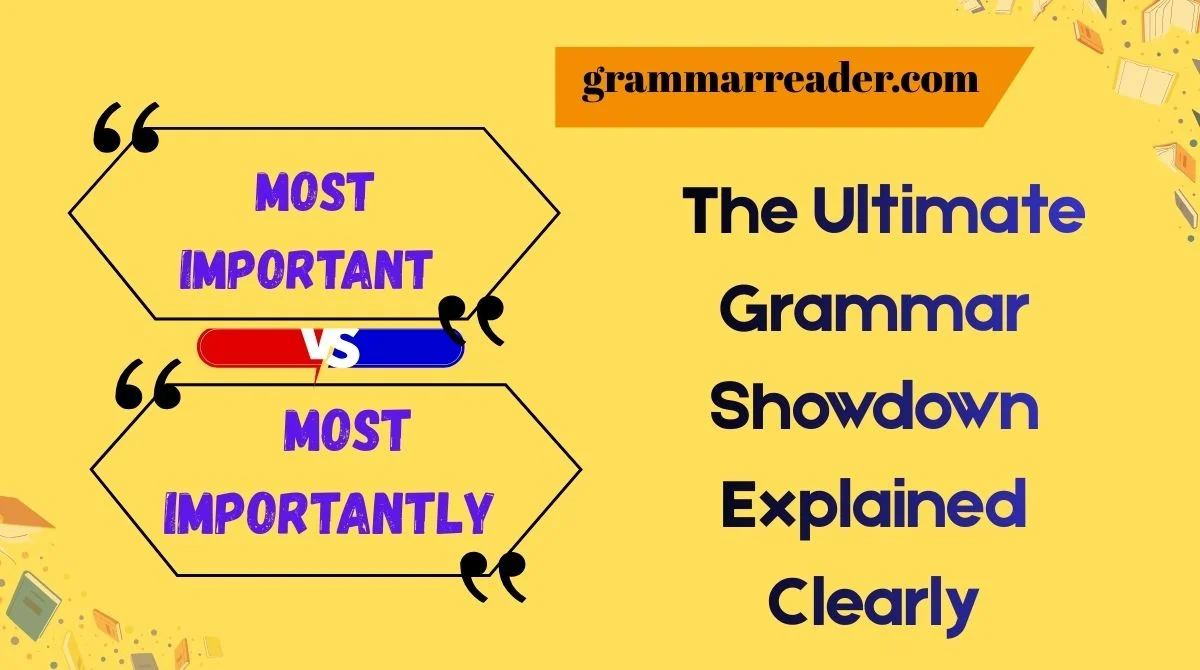
Language evolves every single day. Some words rise, others fade, and a few spark endless debates—like the classic tug-of-war between “most important” and “most importantly.”
Both look similar. Both sound similar. Both seem correct.
Yet the moment you use one, someone will insist the other is “more grammatically correct.”
So which one is right?
Do writers use them differently in academic, business, and everyday English?
And is there even a “correct” answer—or is this debate blown out of proportion?
This guide dives deeply into everything you need to know about the phrases most important and most importantly—their history, grammar, real-world examples, trends, and best use cases, along with practical rules you can apply instantly.
Let’s break it down in a way that’s easy, friendly, and grounded in real language patterns.
Understanding “Most Important” vs. “Most Importantly”
Before we dive into the heavier sections, here’s the quick overview:
| Phrase | Part of Speech | Common Use | Tone | Example |
|---|---|---|---|---|
| Most important | Adjective (sometimes used as a sentence adverb) | Highlights the top priority or point | Neutral, formal | “Most important, we must stay focused.” |
| Most importantly | Adverb | Adds emphasis to a statement or action | Slightly more formal | “Most importantly, we must stay focused.” |
They overlap in use, but how you pick one over the other depends on grammar, tone, and context.
Let’s now unpack everything in detail.
What “Most Important” Actually Means
At its core, “most important” is an adjective phrase.
It describes a noun—explicit or implied.
Examples (as an adjective):
- “The most important lesson is patience.”
- “Her most important goal is finishing school.”
Here, the phrase clearly modifies a noun (lesson, goal).
But the phrase also appears as a sentence adverb—this is where people get confused.
Examples (as a sentence adverb):
- “Most important, you must stay disciplined.”
- “Most important, we need clean data.”
In these cases, “most important” behaves like an adverbial phrase meaning “what matters most.”
Why this use confuses people
Some grammar purists argue only adverbs should modify entire sentences, not adjectives.
But the truth? English speakers have been using “most important” as a sentence adverb for centuries. It’s widely accepted in modern writing.
When “most important” works best
Use “most important” when:
- You want concise, smooth wording.
- You’re writing in a slightly formal or neutral tone.
- You want your point to sound direct, not overly emphasized.
Quick examples in different tones
| Tone | Use |
|---|---|
| Formal | “Most important, the findings were accurate.” |
| Neutral | “Most important, stay calm.” |
| Conversational | “Most important, don’t quit.” |
What “Most Importantly” Actually Means
“Most importantly” is an adverb.
It modifies a verb—often an implied one.
Examples:
- “Most importantly, we must consider safety.”
- “Most importantly, she believed in herself.”
- “Most importantly, the research supports the claim.”
Here, “most importantly” generally means:
➡️ “Above all else”
➡️ “More than anything else”
Why writers choose this version
- It sounds slightly more formal.
- It aligns cleanly with strict grammatical rules.
- It emphasizes a concluding or key point.
Use it when…
- You want to highlight priority in a structured, academic, or polished tone.
- You need a traditional adverb to match conventional grammar.
Examples by writing style
| Style | Example |
|---|---|
| Academic | “Most importantly, the results were consistent across all trials.” |
| Business | “Most importantly, we met our quarterly goals.” |
| Emotional | “Most importantly, he never gave up.” |
Historical Evolution of Both Phrases
Understanding their origins helps explain why the debate even exists.
Early English (17th–18th Century)
- Writers heavily favored adjectives as sentence modifiers.
- Phrases like “most important” and “more important” commonly opened sentences.
19th Century
- Early grammarians began distinguishing adjectives and adverbs more strictly.
- Despite this, literary works still used “most important” freely.
20th Century Shift
- With the rise of formal education and prescriptive grammar, teachers pushed: “Use –ly adverbs to modify verbs and clauses.”
This led to:
- Growing acceptance of “most importantly” in academic and professional writing.
- Attempts to phase out “most important” as a sentence opener.
21st Century Reality
Today:
- Both are widely used.
- Modern style guides accept both.
- Writers choose depending on tone, not “right vs. wrong.”
A Quick Timeline
| Era | Popular Form |
|---|---|
| 1600s | Most important |
| 1800s | Split usage |
| 1900s | Most importantly rises |
| Today | Both accepted |
English evolves—and so have these phrases.
Grammar Authority Opinions (What Experts Actually Say)
Different grammar experts and style guides have different takes.
Here’s a clear breakdown:
Experts Who Accept Both
- Many modern linguists
- Contemporary English teachers
- Most editors working with real-world writing
Reason:
👉 English is functional, not rigid.
👉 Both forms appear in respected literature and academic work.
Experts Who Prefer “Most Importantly”
Often traditionalists who argue:
- Sentence adverbs should be adverbs.
- “Most importantly” fits the rule neatly.
Experts Who Prefer “Most Important”
Writers who value:
- Brevity
- A clean, direct tone
- Historical usage patterns
What’s MOST consistent across guides?
- Both are correct.
- Use depends on tone, not correctness.
- Neither form is considered wrong by mainstream authorities.
Real-World Usage in Literature & Media
Writers use these phrases in different ways depending on period, tone, and medium.
Classic Literature
Older works lean toward “most important.”
Case Study:
A 19th-century novel might open a chapter with:
- “Most important, the family faced great financial trouble.”
This reflects traditional adjective usage.
Academic Writing
Academic writers lean toward “most importantly.”
Case Study:
A study might say:
- “Most importantly, the data confirms the hypothesis.”
Why? Academic tone prefers grammatical clarity and consistency.
Newspapers & Journalism
Writers use both, depending on the desired punch.
Short, punchy news:
- “Most important, the votes were counted.”
Longer analysis:
- “Most importantly, the report shows long-term progress.”
Digital Content
Bloggers and online educators use whichever sounds smoother or more conversational.
“Most Important” vs. “Most Importantly”: Direct Comparison
Below is the cleanest side-by-side explanation of how they differ.
Meaning Difference
| Phrase | Meaning |
|---|---|
| Most important | The key point or priority |
| Most importantly | Above all or more than anything else |
Part of Speech Difference
| Phrase | Part of Speech |
|---|---|
| Most important | Adjective (sometimes acts like an adverb) |
| Most importantly | Adverb |
Tone Difference
- Most important → direct, sharp, decisive
- Most importantly → smoother, slightly more formal
Which Should You Use?
Use “most important” when:
- You want a punchy, clear tone.
- The sentence is short or direct.
Use “most importantly” when:
- Emphasizing priority.
- Writing academically or formally.
Contemporary Usage Insights
If you listen to modern speech or read current digital content, you’ll notice:
In Speech
People overwhelmingly say:
- “Most importantly…”
Why? It flows more naturally in conversation.
In Business Writing
Both show up, depending on company tone.
Professional emails often use:
- “Most importantly” (polished, polite)
Reports or memos may use:
- “Most important” (direct, faster to read)
In Creative Writing
Authors pick what matches character voice, pacing, and emotion.
How Modern Grammar Guides Advise Writers
Most guides today offer flexible advice:
General Recommendations
- Either phrase is acceptable.
- Consistency within a paragraph is helpful.
- Match tone to context.
When Guides Prefer “Most Important”
When clarity, simplicity, and brevity matter.
When Guides Prefer “Most Importantly”
In academic structures or formal arguments where adverbs are expected.
What no guide says:
❌ Neither guide labels either form as incorrect.
❌ Neither tells you to avoid one completely.
❌ Neither says one is “more educated.”
The debate is more stylistic than grammatical.
Choosing the Right Phrase: Practical Guidelines
Here’s a simple, practical system.
Ask yourself: Am I emphasizing a statement?
If yes → use “most importantly.”
Am I pointing to the key point?
If yes → use “most important.”
Do I want a punchy, bold opening?
Use → “Most important,”
Do I want a polished, smooth transition?
Use → “Most importantly,”
Quick Decision Table
| Your Goal | Choose |
|---|---|
| Sound formal | Most importantly |
| Sound concise | Most important |
| Emphasize emotion | Most importantly |
| Emphasize logic | Most important |
| Academic tone | Most importantly |
| Conversational tone | Either |
Formal vs. Informal Writing
Formal Writing
Examples include academic essays, research papers, business reports.
Preferred phrase: “Most importantly”
Why? It aligns with traditional grammar and feels smoother.
Neutral or Semi-Formal Writing
Emails, instructions, presentations.
Both phrases appear commonly.
Informal Writing
Blogs, casual emails, conversations.
Both are acceptable—authors often choose based on rhythm.
Creative Writing
Characters may use either depending on personality.
Common Myths and Misconceptions
Myth 1: One of them is grammatically incorrect.
Fact: Both are correct and widely accepted.
Myth 2: You must use an adverb to modify a whole sentence.
Fact: English allows adjectives as sentence modifiers.
Myth 3: “Most importantly” is more intelligent.
Fact: Tone, not intelligence, determines choice.
Myth 4: Using “most important” first makes your writing less formal.
Fact: Many respected authors use it intentionally.
Frequently Asked Questions
Here are your 5 FAQs as requested.
What is the difference between “most important” and “most importantly”?
Short answer:
“Most important” is an adjective; “most importantly” is an adverb. Both can start sentences but serve slightly different tones.
Can “most important” act like an adverb?
Short answer:
Yes. English commonly uses adjectives as sentence modifiers.
Which is better for formal writing?
Short answer:
“Most importantly” is preferred in academic or formal contexts.
Are the two phrases interchangeable?
Short answer:
In many cases, yes—you can swap one for the other without changing meaning.
Which sounds more natural in speech?
Short answer:
“Most importantly” is more common in spoken English.
Conclusion
Choosing between “most important” and “most importantly” isn’t about right or wrong—it’s about tone, clarity, and emphasis.
- If you want a sharp, direct opener, choose most important.
- If you want smooth emphasis and formality, choose most importantly.
- Both forms are valid.
- Both appear in respected writing.
- And both help you express priority effectively.
The real skill is knowing which one fits your writing voice and the moment.
When you focus on clarity, flow, and intention, the choice becomes easy—and your writing becomes stronger.

Aiden Brooks is an educational writer dedicated to simplifying grammar for learners of all levels. He creates clear, practical explanations that help students read, write, and understand English with confidence.