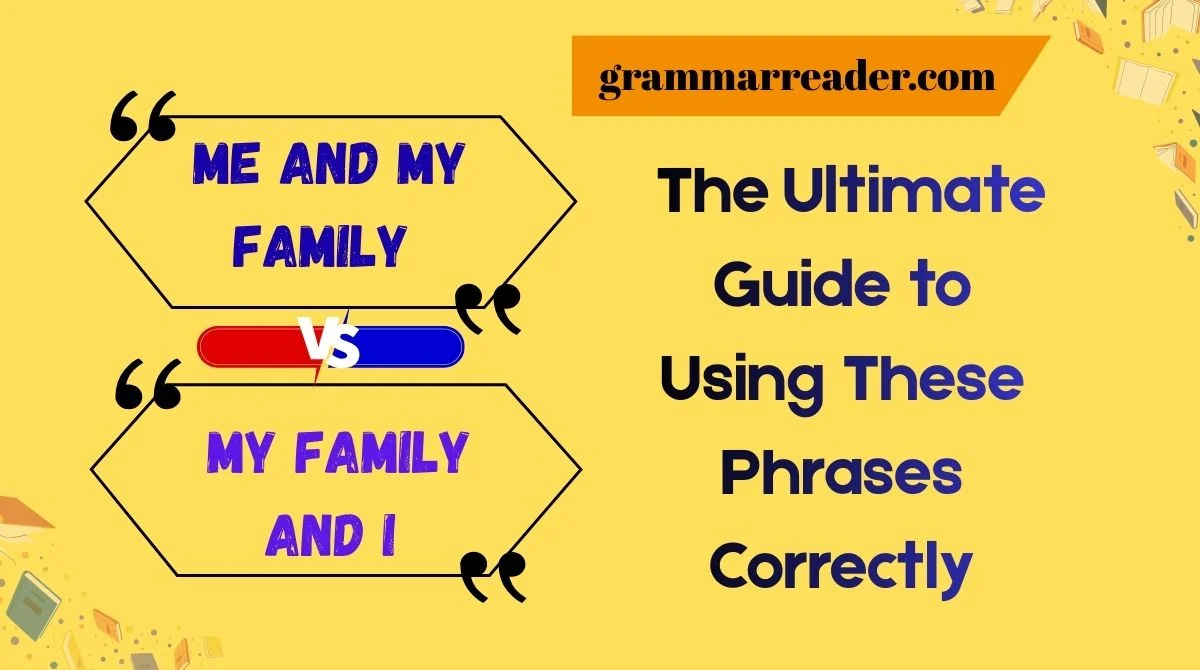
If you’ve ever stopped mid-sentence wondering whether to say “Me and my family” or “My family and I,” you’re not alone.
This tiny grammar detail confuses millions of English speakers—native and non-native alike. And honestly, it’s not your fault. The rule seems simple, yet the real-world usage, social expectations, and cultural habits make it trickier than it appears.
This guide will walk you through everything—clarity, context, culture, correctness, and confidence. By the time you finish reading, you’ll never hesitate again.
Everyday English has a personality of its own. People speak casually, bend rules, drop words, and rearrange phrases without giving grammar a second thought.
That’s why phrases like “Me and my family” often slip into conversations naturally—because they sound familiar and comfortable.
But then school grammar rules jump in and say,
“No! You must say ‘My family and I’.”
So what’s right?
Is one always wrong?
Does context matter?
Does politeness change anything?
This article answers all of that—clearly, simply, and deeply.
Understanding the Core Rule: Subject vs. Object Pronouns
Everything starts with one basic rule of grammar:
“I” is a subject pronoun. “Me” is an object pronoun.
Subject pronouns do the action.
Examples:
- I walked to the store.
- We made dinner.
- He helped me.
Object pronouns receive the action.
Examples:
- The teacher called me.
- They invited us.
- She talked to him.
So the rule becomes very simple:
✔ Use “My family and I” when you are doing the action.
✔ Use “My family and me” when you are receiving the action.
The One-Second Test
Here’s the simplest trick:
- Remove “my family.”
- See what’s correct.
Example:
“___ went to the park.”
- “Me went to the park” ❌
- “I went to the park” ✔
So the full sentence becomes:
“My family and I went to the park.”
Example:
“The teacher spoke to ___.”
- “The teacher spoke to I” ❌
- “The teacher spoke to me” ✔
So the correct version is:
“The teacher spoke to my family and me.”
This test alone solves 95% of confusion.
Pronoun Order Etiquette (Why “My Family and I” Comes First)
Here’s a secret:
Grammar isn’t the only thing at play here. Social etiquette also influences what “sounds right.”
In English-speaking cultures, you typically mention others before yourself. This isn’t a strict grammar rule—it’s more like a politeness habit.
Examples:
- “My friends and I went shopping.”
- “Sarah and I volunteered yesterday.”
- “My parents and I shared dinner.”
If you reverse it:
- “I and Sarah volunteered…” ❌ (sounds awkward)
- “Me and my family went shopping…” ❌ (seen as childish or informal)
People won’t always judge you—but formal settings will expect the polite order.
When order matters
- Academic writing
- Professional emails
- Presentations
- Formal speech
When it doesn’t
- Casual conversation
- Texting
- Speaking with close friends
- Social media posts
Etiquette ≠ grammar. But they work together to influence natural-sounding English.
When to Use “My Family and I” (Subject Position)
Use “My family and I” when you’re talking about who is performing the action.
Correct Examples
- My family and I traveled to Italy last summer.
- My family and I love hiking on weekends.
- My family and I are planning a reunion.
How to Confirm It’s Correct
Use the replacement test:
- Remove “my family”:
- “I traveled to Italy.” ✔
- “I love hiking.” ✔
Common Verbs That Often Trigger This Mistake
| Verb | Correct Example |
|---|---|
| went | My family and I went to the beach. |
| are | My family and I are excited. |
| will | My family and I will join you. |
| have | My family and I have finished dinner. |
| want | My family and I want to help. |
Notice the pattern: These are all actions you perform, so “I” makes sense.
When to Use “Me and My Family” or “My Family and Me” (Object Position)
Here’s where things get interesting.
You’re allowed to say:
- My family and me (grammatically correct in object position)
- Me and my family (also grammatically correct but not polite order)
But—both forms only work when you are receiving the action.
Correct Uses
- The gift was for my family and me.
- The teacher thanked my family and me.
- The neighbors invited my family and me.
Why “Me” is Correct Here
Remove “my family”:
- “The gift was for me.” ✔
- “The teacher thanked me.” ✔
So “me” is the correct pronoun.
When “Me and my family” is allowed
Gramatically:
✔ Allowed
Socially:
❌ Considered immature or informal
So use it in casual speech if you want, but avoid it in formal writing.
Examples Broken Down Step-by-Step
Let’s compare real sentences to cement the rule in your mind.
| Sentence | Correct or Incorrect? | Why |
|---|---|---|
| Me and my family went to the zoo. | Incorrect (formal grammar) | “Me” cannot be a subject pronoun. |
| My family and I went to the zoo. | Correct | “I” is a subject pronoun. |
| The teacher spoke to my family and I. | Incorrect | “spoke to I” is wrong. |
| The teacher spoke to my family and me. | Correct | “spoke to me” is correct. |
| This photo is of my family and me. | Correct | Object of a preposition (“of”). |
| This photo is of me and my family. | Correct but informal | Order reversed but grammatically fine. |
Case Study Example
Scenario: You’re writing a scholarship essay.
❌ “Me and my family have always valued education.”
✔ “My family and I have always valued education.”
Why does it matter?
Essays evaluate clarity and professional tone. Switching “me” into the subject position makes writing look careless.
The Role of Context and Tone
Grammar exists, but so does real life. People bend rules depending on:
- Who they’re talking to
- The situation
- The level of formality
Context Matters
| Context | Preferred Form |
|---|---|
| Formal writing | My family and I |
| Job interview | My family and I |
| Speech on stage | My family and I |
| Text to a friend | Me and my family / My family and me |
| Casual conversation | Any, but “My family and I” still sounds natural |
Spoken English vs. Written English
Spoken English is:
- Looser
- Faster
- More emotional
- Less structured
- Influenced by slang
So people often say:
- “Me and my family went…”
But in writing, correctness is more noticeable.
The Most Common Mistakes (and How to Fix Them)
Mistake 1: Thinking “My family and I” is always correct
Many people overcorrect because they were scolded as kids.
So they say:
- “The teacher gave homework to my family and I.” ❌
- “This message is for my family and I.” ❌
Fix it:
Replace with “me.” If the sentence works, use “me.”
Mistake 2: Starting a sentence with “Me…”
Grammar rule:
“Me” cannot start a sentence unless it’s answering a direct question.
Example:
Q: Who wants cake?
A: Me! (acceptable)
But in full sentences:
❌ Me and my family went to the party.
✔ My family and I went to the party.
Mistake 3: Mixing formal and informal language
Some people say:
- “My family and I, we went to the mall.”
This is redundant.
Mistake 4: Confusing grammar rules with politeness rules
Grammar says:
- “Me and my family” can be correct in object position.
Etiquette says:
- It sounds childish in subject position.
Cultural and Social Influences on Pronoun Order
Language isn’t just rules—it’s behavior, culture, and identity.
Politeness Norm
English speakers typically mention others first.
It reflects humility and respect.
Regional Variations
- In some areas, “Me and my family” is very common in speech.
- In others, teachers correct it aggressively in school.
Formality Level
Using “My family and I” signals:
- maturity
- education
- confidence
- clarity
Using “Me and my family” signals:
- casual speech
- comfort
- informality
Neither is “wrong”—but they fit different situations.
Quick Decision Guide: “I” or “Me”?
Here’s the easiest rule you can memorize:
The Golden Rule
If you’re doing the action → My family and I
If something is done to you → My family and me
Flowchart (Text Version)
- Remove “my family.”
- Choose the pronoun that sounds right (“I” or “me”).
- Add “my family” back in front.
- Put “my family” first to sound polite.
Example:
- “The officer talked to ___.”
- “me” → Correct answer: my family and me
FAQs About Me and My Family vs My Family and I
When should I use “My family and I”?
Use it when you are the subject—the one performing the action.
When is “My family and me” correct?
Use it when you are the object—receiving the action or placed after a preposition.
Is “Me and my family” wrong?
Not always.
It’s grammatically correct in object position but sounds informal in subject position.
Why does pronoun order matter?
It reflects politeness. English etiquette encourages placing others before yourself.
How can I check my sentence quickly?
Remove “my family.”
Use whichever pronoun makes sense on its own.
Conclusion
Choosing between “Me and my family” and “My family and I” doesn’t have to be confusing. Once you understand subject vs. object pronouns and learn the simple replacement trick, the choice becomes obvious almost every time.
Remember:
- Use “My family and I” when you’re doing the action.
- Use “My family and me” when the action happens to you.
- Keep politeness in mind—but don’t let it confuse grammar.
- Context matters: formal writing prefers structure, casual speech allows flexibility.
Mastering this tiny detail improves your communication, boosts your confidence, and helps you sound naturally fluent in both written and spoken English.

Aiden Brooks is an educational writer dedicated to simplifying grammar for learners of all levels. He creates clear, practical explanations that help students read, write, and understand English with confidence.