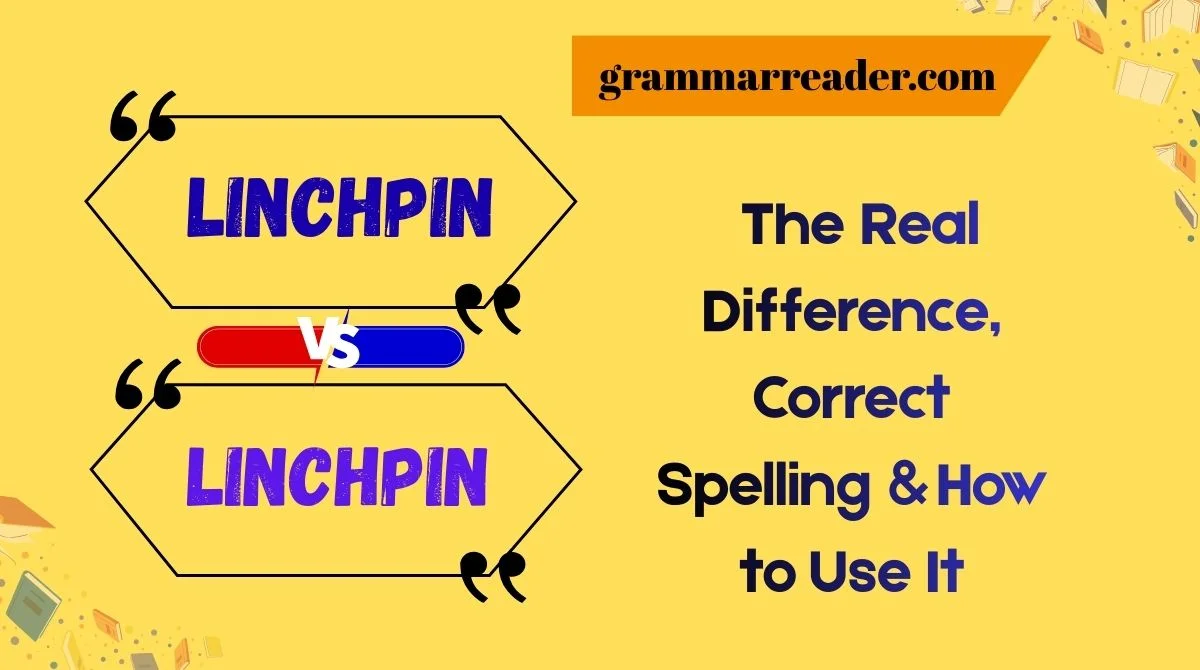
Language evolves like everything else. But every now and then, a small spelling difference sparks big confusion—and “linchpin vs. lynchpin” is one of those classic cases.
Even people who consider themselves strong writers often hesitate before typing it out. Is it linchpin? Is it lynchpin? Are both correct? And where did the second version even come from?
This deep-dive guide cuts through the noise and gives you an easy, clear, and fact-supported explanation of the difference.
You’ll learn:
- The true origin of the word
- Why the variant “lynchpin” exists
- How the mechanical meaning shaped the metaphorical one
- Which spelling you should use
- Example sentences, usage trends, tables, FAQs, and more
Let’s jump in.
What Does Linchpin Mean? (Primary Keyword: Linchpin vs Lynchpin)
At its core, a linchpin is something—or someone—that holds everything together. Remove it, and the whole system can fall apart.
Writers, leaders, and business experts love this word because it instantly paints a picture of importance, connection, and dependency.
But its roots stretch far back into literal mechanics, long before it became a metaphor.
Understanding the Origin of “Linchpin”
To understand the spelling debate, you first need to understand where the word came from.
Etymology of Linchpin
The word “linchpin” comes from two Old English parts:
- “lynis” → meaning an axle
- “pin” → meaning a fastener
Put them together, and you get a pin that holds an axle in place.
Early spellings varied wildly because English spelling wasn’t standardized yet. Historical documents show spellings like:
- lynespyn
- lynspin
- lynchpyn
- lynchpin
- lynch-pin
- lynch-pin
- linchpin
Over hundreds of years, one version slowly became the dominant and accepted spelling: linchpin.
This didn’t happen overnight, but it’s the version that dictionaries, style guides, and professional writers favor today.
Historical Function and Mechanical Purpose
Originally, a linchpin was a small but essential metal pin hammered into the end of an axle.
Why was it essential?
Because without it, the wheel could literally slide off.
That meant:
- wagons could collapse
- carts could crash
- cargo could spill
- travel could become dangerous or impossible
This small part prevented chaos. Naturally, the word eventually evolved to describe anything that plays a similarly central role.
Technical & Mechanical Definition
Even though most people now use “linchpin” metaphorically, it still has a concrete mechanical meaning.
What a Linchpin Physically Is
A linchpin is:
- a solid metal pin
- usually straight
- inserted horizontally
- often secured by a ring or clip
- used to keep wheels or rotating parts in place
Where You’ll Find Linchpins Today
| Machine / Tool | Purpose of Linchpin |
|---|---|
| Trailers | Secures hitch and towing connections |
| Farm equipment | Keeps joints and moving parts in place |
| Bicycle trailers | Secures wheels and safety hinges |
| Industrial machines | Locks mechanical components together |
| Carts & wagons | Prevents wheels from sliding off the axle |
Even today, if a linchpin fails, wheels fall off—literally.
That’s why the metaphor is so powerful.
From Mechanics to Metaphor: How “Linchpin” Became a Symbol of Importance
At some point, writers began using linchpin figuratively.
Why?
Because the mechanical linchpin does one thing beautifully:
It holds everything together.
Metaphorical Evolution
When you call someone a linchpin, you’re saying:
- They are essential
- They keep the system functioning
- Everything depends on them
- If they disappear, something major collapses
This is why the word shows up everywhere from leadership books to corporate emails.
Modern Metaphorical Usage
You’ll see linchpin used in:
Work & Leadership
- “Sarah is the linchpin of our sales team.”
- “The project won’t move forward without our linchpin designer.”
Economics
- “Oil production is the linchpin of the region’s economy.”
Politics
- “This agreement is the linchpin of the peace treaty.”
Technology
- “User trust is the linchpin of any cybersecurity system.”
The word works because it carries both strength and fragility—a linchpin holds everything together, but if removed, everything falls apart.
Clear Examples of Linchpin in Real Use
Here are examples that show its meaning in action:
- “Trust is the linchpin of any successful marriage.”
- “Backup servers act as a linchpin in preventing data loss.”
- “She became the linchpin of the whole charity operation.”
- “This policy is the linchpin of the new healthcare system.”
Notice how each example conveys centrality and critical support.
Real-World Case Studies
Case studies help make the concept even clearer.
Case Study 1: The Startup Linchpin
A tech startup had only 12 employees, and one person—its product manager—understood every part of the app. When she left, development stalled for six months.
She was the linchpin.
Case Study 2: The Supply Chain Linchpin
During global shipping delays, a single missing part (a microchip) halted production for entire industries. That microchip was the linchpin of the supply chain.
Case Study 3: Sports Team Linchpin
A football team relies heavily on its strategist midfielder. When he gets injured, the team collapses.
He’s the linchpin of the team’s performance.
These cases make it obvious how the word works metaphorically.
The Variant: Lynchpin — Why Does It Exist?
Now the big debate.
People see “linchpin” and “lynchpin” used interchangeably online and assume both must be correct.
So where did “lynchpin” even come from?
Where Lynchpin Comes From
“Lynchpin” likely appeared due to:
- phonetic spelling
- older English spellings like “lynspin” and “lynchpyn”
- natural drift in regional dialects
- mistaken association with the word “lynch”
While it does show up in some writing, it’s far less common.
Most dictionaries list linchpin as the preferred spelling and lynchpin as a minor, less-common variant.
Is Lynchpin Wrong—or Just Less Common?
It’s not technically wrong in the sense that:
- some British sources accept it
- it appears in older historical documents
- some dictionaries mention it as “less common”
But it’s not the recommended spelling in:
- academic writing
- journalism
- professional communication
- business writing
- publishing
- SEO content
In short:
It’s allowed, but not preferred.
Should You Use Lynchpin?
If you want your writing to look polished, modern, and standard:
➡️ Use “linchpin.”
“Lynchpin” can be interpreted as:
- a misspelling
- a typo
- an outdated variant
Unless you write specifically for an audience that uses the variant (mainly certain British contexts), stick with the widely accepted version.
Usage Across English Variants
Different English-speaking regions show slightly different preferences.
American English
- Overwhelming preference: linchpin
- “Lynchpin” is rarely seen
British English
- “Lynchpin” appears more often here than in the US
- But even in the UK, linchpin is still more widely accepted
Canadian English
- Matches American usage
- “Linchpin” dominates overwhelmingly
Comparison Table: Linchpin vs. Lynchpin
| Feature | Linchpin | Lynchpin |
|---|---|---|
| Correct / Standard spelling | ✔ yes | ⚠ less common |
| Preferred by dictionaries | ✔ yes | ❌ mostly no |
| Seen in professional writing | ✔ widely | ❌ rarely |
| Used in American English | ✔ dominant | ❌ uncommon |
| Used in British English | ✔ common | ✔ minor variant |
| Risk of looking like a typo | ❌ very low | ✔ high |
How to Choose the Correct Spelling
Here’s your quick cheat sheet:
Use Linchpin When:
- Writing professionally
- Publishing a blog
- Submitting assignments
- Writing business or legal documents
- Doing SEO
- Writing for an international audience
Use Lynchpin Only When:
- You’re quoting historical texts
- You’re intentionally using a British variant
- You’re following a style guide that specifies it
Otherwise, “linchpin” is your safest, cleanest, and most accepted spelling.
Example Sentences Using Each Spelling
Correct (Recommended)
- “Communication is the linchpin of great teamwork.”
- “This strategy is the linchpin of our long-term success.”
Variant (Not Recommended)
- “He played the lynchpin role in the decision-making process.”
(The meaning is clear, but the spelling looks off.)
Common Confusions & Misconceptions
Misconception 1: “Lynchpin” Looks More Logical
Some people assume that since a lynch is a violent act, the word must relate to that.
It doesn’t. Completely separate roots.
Misconception 2: “Lynchpin” Is More Modern
Actually, linchpin is the modern standardized spelling.
“Lynchpin” is older and fell out of favor.
Misconception 3: Both Are Equally Acceptable Everywhere
Not true.
In most environments—especially professional ones—linchpin is the expected spelling.
Examples of Linchpin in Advanced Writing
Here are some polished example sentences:
- “The CTO served as the linchpin of the entire digital transformation.”
- “Empathy acts as the linchpin of strong leadership.”
- “The treaty’s verification framework is the linchpin that prevents escalation.”
Notice how the meaning stays consistent across contexts.
FAQs About Linchpin vs Lynchpin
What is the correct spelling: linchpin or lynchpin?
Linchpin is the correct and standard spelling across modern English.
Why is “linchpin” preferred?
Because dictionaries, professional style guides, and modern usage overwhelmingly favor linchpin as the standard.
What does “linchpin” mean exactly?
It means a crucial element that holds everything together—originally a mechanical pin that holds a wheel on an axle.
Is “lynchpin” incorrect?
Not entirely, but it is non-standard and considered a less-common variant.
Can you use “linchpin” metaphorically?
Definitely. That’s now the most common way it’s used.
Conclusion
When you put the pieces together, the answer becomes clear:
👉 The correct, modern, professional, and widely accepted spelling is “linchpin.”
👉 “Lynchpin” exists, but only as a rare or older variant.
Whether you’re writing for business, school, SEO, or everyday communication, choose “linchpin.”
It’s clean, standard, and instantly understood.
And now you’ll never hesitate before typing it again.

Aiden Brooks is an educational writer dedicated to simplifying grammar for learners of all levels. He creates clear, practical explanations that help students read, write, and understand English with confidence.