You’ve seen it.
You’ve probably typed it.
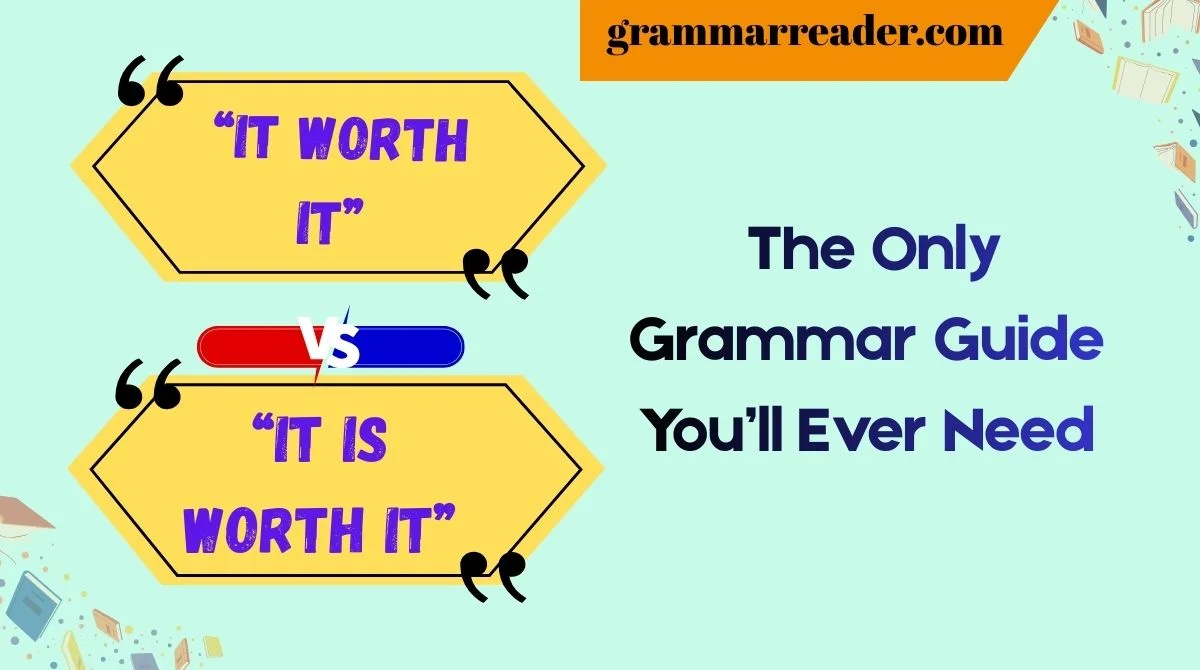
“It worth it.”
Something feels off. But why?
Is the correct phrase “it worth it” or “it is worth it”? Can you say just “worth it”? And why do so many people write “does it worth it?”
Today, you’ll clear the confusion once and for all.
This guide breaks down grammar, structure, usage, common mistakes, professional alternatives, and real-life examples. No fluff. No vague explanations. Just clear rules you can apply instantly.
Let’s fix this.
Understanding the Confusion: “It Worth It” vs. “It Is Worth It”
Here’s the short answer:
- ❌ It worth it — Incorrect
- ✅ It is worth it — Correct
But the real question is: Why?
Many learners drop the verb “is” because:
- Spoken English often sounds compressed
- Texting encourages shortcuts
- Native speakers sometimes say just “worth it” in replies
- Some languages don’t require linking verbs
That last point matters.
In English, a sentence must contain a verb. Remove the verb and the structure collapses.
Think of it like a chair. Remove one leg and it falls.
The Correct Form: “It Is Worth It”
Now let’s understand what’s actually happening grammatically.
The Grammar Structure Behind “It Is Worth It”
Break it down:
- It → subject
- Is → linking verb
- Worth → adjective
- It → object/complement
So the pattern looks like this:
Subject + linking verb + adjective + complement
English requires that linking verb. Without it, the sentence isn’t complete.
Why “Worth” Is an Adjective
Here’s the key insight:
“Worth” is not a verb.
You can’t conjugate it. You can’t add -ed. You can’t use do/does/did with it.
That’s why:
- ❌ Does it worth it?
- ❌ It worthed it
- ❌ It worth it
All fail grammatically.
Because adjectives cannot replace verbs.
What “It Is Worth It” Actually Means
When you say “it is worth it”, you’re expressing a comparison between:
- Effort vs. reward
- Cost vs. benefit
- Risk vs. outcome
- Pain vs. gain
It answers this silent question:
Was the result valuable enough to justify the effort?
That’s powerful.
Everyday Examples of “It Is Worth It”
Let’s bring this into real life.
Education
“Studying late was exhausting but it was worth it.”
You sacrificed sleep. You gained a degree.
Fitness
“The workouts were brutal but it is worth it.”
You endured discomfort. You gained strength.
Business
“The investment was risky but it is worth it.”
You took a chance. You earned returns.
Relationships
“Long-distance is hard but it is worth it.”
You faced distance. You kept connection.
See the pattern?
There’s always a tradeoff.
Why “It Worth It” Is Incorrect
Let’s get technical for a moment.
English requires a verb in every complete sentence. The verb can be:
- An action verb → run, build, invest
- A linking verb → is, was, seems, feels
In “it worth it”, there is no verb.
It’s like saying:
- ❌ She happy
- ❌ He tall
- ❌ This good
You instinctively know those are wrong.
The correct forms are:
- She is happy
- He is tall
- This is good
Same rule applies here.
When “Worth It” Alone Is Acceptable
Now here’s where things get interesting.
You can say just:
“Worth it.”
But only in conversation.
Informal Spoken English
Example dialogue:
Friend: Was the movie good?
You: Worth it.
Here, the full sentence is implied:
It was worth it.
Context completes the grammar.
However, in formal writing, you should always write the full structure.
Texting and Social Media Usage
On social platforms, people shorten everything:
- “Worth it.”
- “Totally worth.”
- “So worth it.”
That works casually.
But in essays, business emails, or exams, always write:
It is worth it.
Professional writing demands complete structure.
Question Forms: What’s Correct and What’s Not
Now let’s tackle common question mistakes.
“Is It Worth It?” ✅
This is correct.
Structure:
Linking verb + subject + adjective + complement
Examples:
- Is it worth it?
- Is it worth the effort?
- Is it worth trying?
This follows standard question inversion rules.
“Is It Worth…?” (When It’s Correct)
This works when followed by:
- A noun
- A gerund (verb + ing)
Examples:
- Is it worth the time?
- Is it worth the money?
- Is it worth studying?
- Is it worth applying?
Pattern:
Worth + noun
Worth + gerund
That’s it.
“Does It Worth It?” ❌
This one is everywhere.
And it’s wrong.
Why?
Because “does” only works with base verbs.
Examples:
- Does it work?
- Does it matter?
- Does it help?
But “worth” is not a verb.
So the correct alternative is:
Is it worth it?
Simple.
“Worth” vs. “Worthy” – Know the Difference
Many learners confuse these two.
They look similar. They are not interchangeable.
| Word | Part of Speech | Meaning | Example |
|---|---|---|---|
| Worth | Adjective | Equal in value to | It is worth the price |
| Worthy | Adjective | Deserving respect or attention | She is worthy of praise |
Notice something important.
“Worthy” requires of.
- Worthy of recognition
- Worthy of respect
- Worthy of attention
But “worth” does not use “of”.
- Worth the effort
- Worth the money
- Worth trying
Mixing these creates awkward sentences.
The Myth of “Worthed”
Let’s clear this quickly.
❌ Worthed
❌ Worthed it
These don’t exist.
Because “worth” is not a verb.
To express past meaning, you change the verb “is”, not “worth.”
- It was worth it
- It has been worth it
- It will be worth it
That’s how tense works here.
Synonyms and Professional Alternatives to “Worth It”
Repeating “worth it” over and over weakens writing.
Let’s upgrade your vocabulary.
Casual Alternatives
- It paid off
- Totally worth it
- Worth the hassle
- Glad I did it
- No regrets
- It worked out
Example:
The road trip was long but it paid off.
Professional Alternatives
In business writing, avoid sounding casual.
Use these instead:
- Justified the investment
- Delivered measurable value
- Yielded strong returns
- Produced significant benefits
- Generated positive outcomes
- Demonstrated clear ROI
Example:
The marketing campaign delivered measurable value.
See how much stronger that sounds?
Quick Reference Table: Correct vs. Incorrect Usage
| Phrase | Correct? | Why |
|---|---|---|
| It worth it | ❌ | Missing verb |
| It is worth it | ✅ | Complete sentence |
| Is it worth it? | ✅ | Correct question form |
| Does it worth it? | ❌ | Incorrect auxiliary |
| It was worth it | ✅ | Proper past tense |
| It worthed it | ❌ | “Worth” is not a verb |
| Worth it | ✅ (informal only) | Context implied |
Save this table. It clears 90% of confusion.
Real-Life Case Studies: “Worth It” in Action
Let’s see how this phrase works in real decision-making.
Case Study: Education Investment
Average college tuition in the U.S. exceeds $10,000 per year for public institutions and over $30,000 for private institutions.
That’s serious money.
Students often ask:
Is it worth it?
Research consistently shows that bachelor’s degree holders earn significantly more over a lifetime compared to those with only a high school diploma.
So when graduates say:
It was worth it.
They’re weighing debt against earning power.
That’s how the phrase functions in economic reality.
Case Study: Fitness Journey
Personal training can cost $50 to $100 per session.
Gym memberships range from $300 to $800 per year.
At first, results feel slow.
Muscles ache. Motivation drops.
Then strength increases. Energy improves. Confidence grows.
People look back and say:
It was worth it.
Pain vs. progress. Effort vs. reward.
Case Study: Business Investment
Imagine investing $5,000 in a digital ad campaign.
The campaign generates $20,000 in revenue.
Now ask:
Was it worth it?
Absolutely.
In professional settings, executives might say:
The initiative yielded strong returns.
That’s the polished version of “it was worth it.”
Advanced Grammar Insight: Why “Worth” Behaves Differently
Now let’s level up.
“Worth” is what linguists call a predicative adjective.
That means it appears after linking verbs like:
- Is
- Was
- Seems
- Feels
- Looks
Example:
- It seems worth it.
- It feels worth it.
Notice something?
You still need a verb.
That’s the golden rule.
The Rule You’ll Never Forget
If there’s no verb, the sentence is broken.
So remember:
If you remove “is,” you remove the grammar.
Simple.
FAQs
What is correct: It worth it or It is worth it?
“It is worth it” is correct because English requires a linking verb.
Can I say just “worth it”?
Yes, but only in informal conversation where the full sentence is implied.
Is “Does it worth it?” correct?
No. “Worth” is an adjective, not a verb. Use “Is it worth it?”
What is the past form of “It is worth it”?
The correct past form is “It was worth it.”
What’s the difference between “worth” and “worthy”?
“Worth” describes value. “Worthy” describes deserving respect and requires “of.”
Conclusion
Grammar doesn’t have to feel overwhelming.
When you understand structure, mistakes disappear.
So here’s your takeaway:
- Always include the linking verb
- Use “worth it” correctly
- Avoid “does it worth it”
- Never write “worthed”
Language rewards precision.
Now you know the rule.
And yes — learning it was worth it.

Aiden Brooks is an educational writer dedicated to simplifying grammar for learners of all levels. He creates clear, practical explanations that help students read, write, and understand English with confidence.