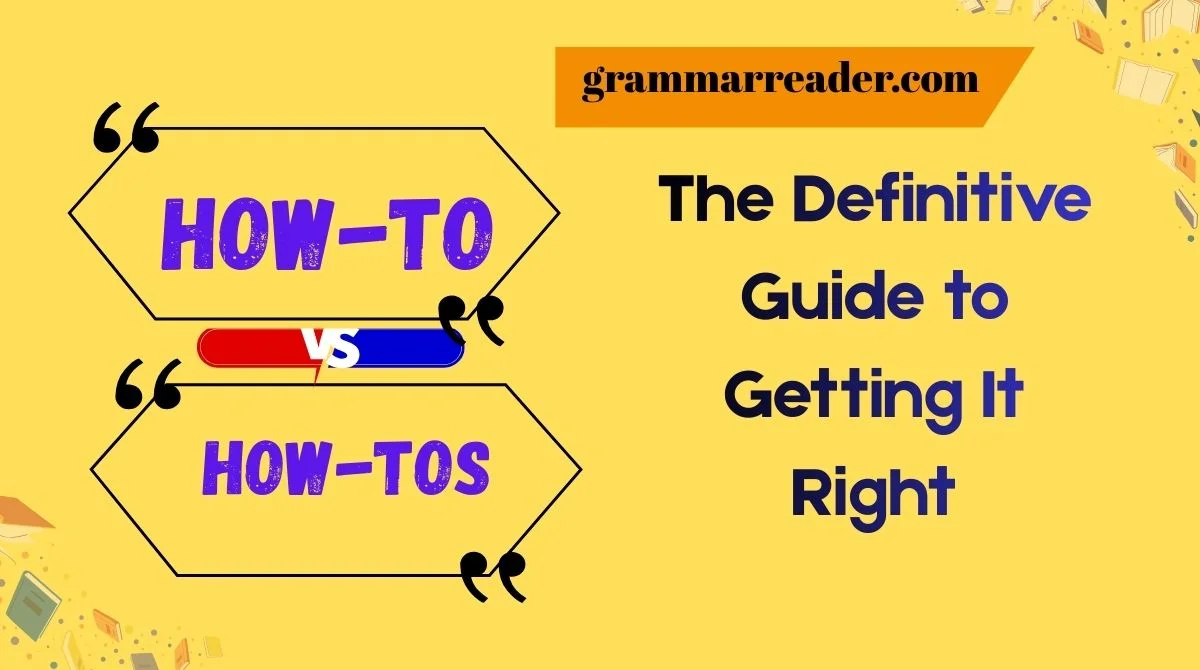
If you’ve ever paused mid-sentence wondering whether to write how-to, how to, how-tos, or how to’s, you’re not alone.
Writers stumble on this tiny grammar puzzle because one hyphen or apostrophe can shift meaning, clarity, and readability.
This guide breaks everything down in a friendly, practical way—without fluff, without confusion, and without grammar lectures. Just clear answers, real examples, and useful rules you can actually apply.
Understanding What “How-To” Really Means
Before tackling plurals or punctuation, it helps to understand what how-to actually represents.
At its core, “how-to” means instructional. It can operate two ways:
As a noun
- “I love reading how-tos about gardening.”
As an adjective (noun modifier)
- “She bought a how-to guide on starting a business.”
The hyphen signals that the two words work together as one idea. Without it, the meaning becomes vague or fragmented.
When You Should Hyphenate “How-To”
Writers often wonder when the hyphen matters. The truth is simple:
You hyphenate “how-to” when:
- It’s used as a noun
Example: “This website publishes helpful how-tos.” - It’s used as an adjective before a noun
Example: “I’m creating a how-to video today.”
You don’t hyphenate when:
- You’re writing the phrase how to in a normal sentence structure
Example: “Here’s how to fix your laptop.”
Quick Reference Chart
| Usage | Hyphen? | Example |
|---|---|---|
| Noun | Yes | “I collect good how-tos.” |
| Adjective (before noun) | Yes | “A helpful how-to tutorial.” |
| Verb phrase or clause | No | “Here’s how to start.” |
If the phrase names a thing, it’s hyphenated.
If it describes an action, skip the hyphen.
The Plural Problem: “How-Tos” vs. “How To’s”
This is where most writers get stuck. Both versions appear in the wild, which creates even more confusion.
Here are the two contenders:
- how-tos
- how to’s
So which one is correct?
Why “How-Tos” Is the Correct Plural Form
Pluralizing a hyphenated noun follows a simple rule:
Add the “s” to the end of the entire term—not to the first word, not with an apostrophe.
So:
- how-to → how-tos
- runner-up → runner-ups
- check-in → check-ins
This pattern keeps plurals consistent and predictable.
Why “how-tos” is the preferred form
- It follows standard pluralization rules.
- It avoids the apostrophe confusion between plural and possessive.
- Modern grammar and style guidelines support it.
- It’s widely accepted in publishing and education.
Simple rule to memorize
Plural = drop the apostrophe. Always.
Why “How To’s” Creates Confusion
Apostrophes usually show possession or contraction—not plurals.
So when a writer uses how to’s, readers may wonder:
- Is something belonging to the how-to?
- Is this a contraction?
- Is this supposed to be plural?
Apostrophes in plurals are considered outdated and potentially misleading. That’s why modern writing avoids them almost entirely.
Incorrect vs. Correct Examples
| Incorrect | Correct |
|---|---|
| I teach several how-to’s. | I teach several how-tos. |
| These how to’s are outdated. | These how-tos are outdated. |
| She collects old how to’s. | She collects old how-tos. |
Once you see the difference, the choice becomes obvious.
Using “How-To” as a Noun Modifier (Adjective Position)
When how-to comes before a noun, it transforms into a descriptor with a clear rule:
You must keep the hyphen.
Examples:
- how-to guide
- how-to lesson
- how-to training
- how-to blog
Table: Correct vs. Incorrect Usage
| Incorrect | Correct |
|---|---|
| how to guide | how-to guide |
| how to article | how-to article |
| how to tips | how-to tips |
| how to section | how-to section |
When you forget the hyphen, the phrase looks like two unrelated words instead of one connected concept.
Common Misunderstandings About “How-To” and Its Plural
Many grammar mistakes come from mixing up parts of speech.
Misunderstanding #1: Treating “how to” as a noun
Incorrect:
“Did you read that how to?”
Correct:
“Did you read that how-to?”
Misunderstanding #2: Putting the plural “s” in the wrong place
Incorrect:
“how-tos” → Correct
“how’s-to” or “how-to’s” → Incorrect
Misunderstanding #3: Thinking apostrophes make things look ‘cleaner’
Writers sometimes think how-to’s “looks nicer.”
But clarity beats aesthetics.
How Punctuation Changes the Whole Meaning
Look at how much punctuation affects understanding:
Examples
- how to
- A verb phrase
- “Here’s how to assemble the table.”
- how-to
- A noun
- “I wrote a how-to on gardening.”
- how-tos
- Plural noun
- “These are the most popular how-tos.”
- how-to’s
- Incorrect plural
- Or accidentally possessive
- “The how-to’s instructions…” (confusing)
Quote to remember
“A hyphen can bring two words together, but an apostrophe rarely belongs between them.”
Workarounds: Avoiding the Need to Pluralize “How-To”
Sometimes the simplest solution is to rewrite the sentence. This avoids pluralization entirely.
Useful Alternatives
- instructional guides
- tutorial pieces
- learning materials
- step-by-step articles
- educational content
Examples
- Instead of “These how-tos are confusing,” try “These tutorials are confusing.”
- Instead of “I’m writing several how-tos,” try “I’m writing multiple instructional guides.”
Rewriting often makes sentences cleaner and more natural.
Practical Usage: “How-Tos” in Real-World Context
Seeing the term in everyday writing helps lock in the rules.
Examples from different fields
Technology
- “The site publishes coding how-tos for beginners.”
DIY / Home Improvement
- “Their woodworking how-tos are incredibly detailed.”
Business
- “Leadership how-tos receive strong monthly traffic.”
Education
- “Students love interactive how-tos in digital textbooks.”
Case Study: Publishing Industry
Publishing teams often standardize terminology to avoid inconsistency across articles and books. Here’s a small example drawn from typical editorial guidelines:
Case Study: Standardizing “How-To” in Editorial Stylebooks
A mid-sized digital publishing company noticed that writers used how-to’s, how tos, and how-tos interchangeably, confusing readers and editors. Their solution was to adopt a unified rule:
Use “how-to” as the noun or adjective, and “how-tos” as the plural.
The result? Fewer editing cycles, cleaner headlines, and consistent SEO performance across instructional content categories.
Consistency builds trust—especially in instructional writing.
FAQs
What is the correct plural of “how-to”?
The correct plural form is how-tos—no apostrophe.
Is “how-to’s” ever acceptable?
Not in modern writing. It creates confusion and looks possessive.
Should “how-to” always be hyphenated?
Hyphenate when used as a noun or adjective.
Do not hyphenate when used in a phrase like “how to cook.”
Why is “how-tos” preferred over “how to’s”?
Because it follows standard plural rules and removes the apostrophe confusion.
Can I avoid pluralizing “how-to” altogether?
Yes! Use alternatives like “tutorials,” “guides,” or “instructional content.”
Final Takeaways
Here’s the whole guide compressed into quick-use rules:
- Hyphenate “how-to” when it’s a noun or adjective.
- Use “how to” when describing an action.
- Pluralize as “how-tos”—never “how to’s.”
- Avoid apostrophes in plurals unless showing possession.
- Rewrite the sentence if it feels clunky.
- Consistency builds clarity and improves reader experience.
Once you internalize these simple rules, you’ll never hesitate over the phrase again.

Aiden Brooks is an educational writer dedicated to simplifying grammar for learners of all levels. He creates clear, practical explanations that help students read, write, and understand English with confidence.