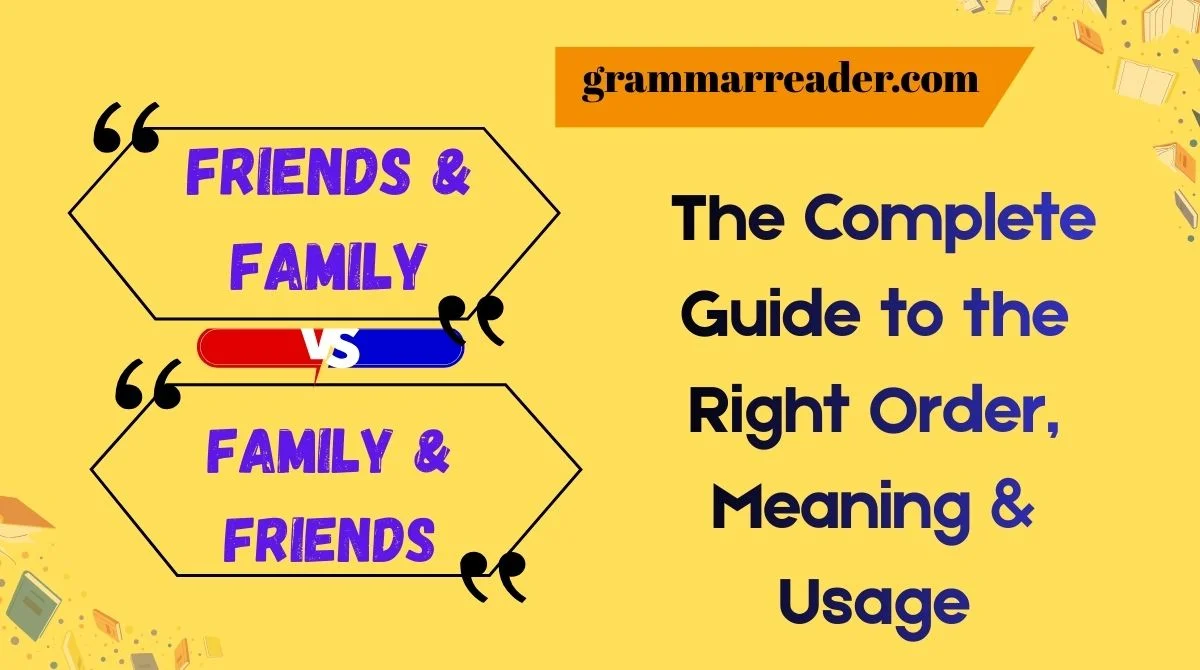
Choosing between “Family & Friends” and “Friends & Family” seems simple. You’ve probably used both without thinking twice.
Yet the order carries history, culture, grammar patterns, and even emotional weight. This guide walks you through everything you need to know—clearly, practically, and with examples you can apply right away.
Let’s dive in.
Family & Friends or Friends & Family: Which One Feels Right and Why It Matters
Language reflects how we think. When you choose Family & Friends or Friends & Family, you’re doing more than arranging two nouns. You’re signaling priorities, relationships, cultural values, and the tone of your message.
This article unpacks every angle—grammar, culture, rhythm, etiquette, history, and real usage—so you can confidently choose the version that fits your intention.
Small word choices shape how your message feels. When you say Family & Friends, you put family first. When you flip it to Friends & Family, you shift the emotional center. Neither version is wrong. They just do different jobs.
In this article, you’ll learn:
- Why most people naturally say Family & Friends
- Why some prefer Friends & Family
- The grammar patterns behind word order
- Cultural and regional differences
- Which order suits invitations or formal writing
- Proper capitalization and etiquette
- Historical and modern usage trends
- Smart alternatives that sound more inclusive
- FAQs and practical examples
Let’s break it down in a simple, conversational way.
Why People Commonly Say “Family & Friends”
You’ve heard Family & Friends thousands of times. It rolls off the tongue. It feels familiar. There’s a reason for that.
Cultural Norms Put Family First
Most societies place family at the center of life. You grow up hearing phrases like:
- “Family first”
- “Family comes before everything”
- “Blood is thicker than water”
Because culture shapes language, the order sticks.
Emotional Foundations
Family represents:
- Origins
- Safety
- Identity
- Support
Our minds often group familiar concepts by importance. Since family typically ranks highest, your brain naturally places it first.
Marketing Reinforced the Pattern
Companies use “Family & Friends” in:
- Holiday promotions
- Discount campaigns
- Greeting cards
- TV commercials
Repetition cements the phrase into everyday use.
Why Some People Prefer “Friends & Family”
Even though Family & Friends dominates, you’ll hear people flip it. That choice has meaning too.
When Friends Become Your Chosen Family
Not everyone has a close or supportive family. In many communities, friends fill that role.
Think about:
- College years
- Moving to another city
- LGBTQ+ “chosen family” circles
- Immigrant communities
For them, Friends & Family reflects reality.
Modern Social Dynamics
Younger generations value friendships deeply. Cohabiting friends, best friend groups, and community-based living are more common now. This shift influences language.
A Subtle Tone Change
“Friends & Family” feels:
- Warmer
- More inclusive
- Slightly less traditional
It’s why some modern brands prefer it in campaigns.
Language and Grammar Considerations
So does grammar actually care which comes first? Let’s break that myth.
Does English Grammar Decide the Order?
No strict rule forces you to choose one order. However, English has guidelines that influence natural word flow.
Here are three:
1. Importance Hierarchy
English often orders words by social or logical importance.
Examples:
| Common Phrase | Why This Order? |
|---|---|
| mother and child | Parent precedes child |
| king and country | Authority first |
| day and night | Diurnal cycle begins with day |
By that logic, “family” usually outranks “friends.”
2. Length and Sound
Shorter words often appear before longer ones.
Family has 6 letters.
Friends also has 7 letters, so this factor is minor but still plays a tiny role.
3. Rhythm and Flow
Say both phrases out loud:
- Family & Friends
- Friends & Family
The first flows more smoothly, which is another reason we tend to prefer it.
Rhythm, Sound, and Natural Flow
Humans love patterns that feel natural. The consonant-vowel pattern in “Family & Friends” just sounds clean. It’s almost musical.
Cultural and Regional Differences
Different regions show different preferences, influenced by customs and local language habits.
United States
Most Americans use Family & Friends in everyday speech and formal writing.
United Kingdom
Both versions appear, but formal invitations lean toward Friends & Family for a warmer tone.
Australia, New Zealand, Canada
These regions follow US-style patterns.
Marketing and Advertising
Global brands often choose Friends & Family in campaigns, because it:
- Sounds modern
- Feels inclusive
- Carries a friendly tone
Which Phrase Works Best for Invitations, Cards & Announcements?
Choosing the right phrase depends on your event’s tone.
Use “Family & Friends” When:
- Your event is traditional
- Guests include extended family
- You want a formal feel
- It’s a religious or cultural ceremony
Use “Friends & Family” When:
- The event is casual or fun
- Your friend group is central
- You want a modern vibe
- Guests aren’t primarily family
Examples of Correct Formal Salutations
Here’s a quick reference:
| Tone | Greeting |
|---|---|
| Formal | Dear Family and Friends, |
| Warm | To Our Friends and Family, |
| Casual | Hey Friends and Family! |
| Inclusive | To Everyone We Love, |
Understanding Capitalization Rules
Here’s the simple rule:
- Capitalize both words only if they’re part of a title, header, or formal salutation.
- Use lowercase in regular sentences.
Examples:
- Correct: We invited our family and friends to the celebration.
- Correct: Dear Family and Friends,
- Incorrect: Dear family And Friends,
- Incorrect: FAMILY & friends (unless it’s intentional design)
Common Capitalization Mistakes
Avoid:
- Capitalizing “and” unless it starts a line
- Using all caps for only one word
- Mixing uppercase and lowercase for stylistic reasons in formal writing
Historical and Modern Usage Trends
Language evolves constantly. Let’s look at how these phrases changed.
Historical Perspective
Older societies placed strong emphasis on lineage and ancestry. Family often determined:
- Social status
- Inheritance
- Occupation
- Marriage choices
So the phrase Family & Friends dominated for centuries.
Writings from the 1700s onward show consistent use of this order.
Modern Shifts
In modern life:
- People move more
- Friendships last longer
- Online communities form “digital families”
- Younger generations value emotional bonds over blood ties
This shift explains why Friends & Family appeals to many today.
Marketing Influence
Brands like to sound friendly. “Friends & Family Sale” became a widespread phrase. Retail language often pushes trends into everyday speech.
Practical Alternatives to “Family & Friends”
Sometimes neither phrase fits your message. You might want something more inclusive, shorter, or modern.
Neutral, Flexible Alternatives
- Loved Ones
- Everyone Special to Us
- Our Community
- Those We Hold Dear
- Our People
When to Use Alternatives
You might prefer these if:
- Your audience spans multiple age groups
- You want modern branding
- You’re writing for a diverse group
- You want simplicity in invitations
Table: Choosing the Best Phrase
| Situation | Best Option |
|---|---|
| Formal event | Family & Friends |
| Casual gathering | Friends & Family |
| Inclusive community event | Loved Ones |
| Corporate announcement | Valued Guests |
| Social media caption | Friends & Family or Our People |
| Holiday greeting | Family & Friends |
Case Study: How Order Changes Tone
Scenario
A couple is sending invitations for a backyard engagement party. Most of their closest people are lifelong friends, not relatives.
Option A: Family & Friends
Tone feels slightly formal and traditional. Good for older guests, but doesn’t match the event vibe.
Option B: Friends & Family
Tone feels warm, relaxed, and true to their reality.
Result
They choose Friends & Family, because it reflects how their relationships work and matches the casual nature of the event.
Lesson:
The right order isn’t about grammar—it’s about emotional accuracy.
Real Quotes Showing Preference
“Friends became my family when my family wasn’t around.”
– Anonymous
“Family is who’s there during the hard times. Sometimes those people aren’t blood.”
“The order doesn’t matter. The love does.”
Quotes like these show why people choose different versions.
FAQs
What’s more common: Family & Friends or Friends & Family?
Family & Friends is more common because of cultural tradition and natural language rhythm.
Why do people say Friends & Family instead?
Some say Friends & Family to highlight chosen family, modern values, or a warmer tone.
Which phrase works better for invitations?
Use Family & Friends for formal events.
Use Friends & Family for casual or modern events.
Does grammar dictate the order of the phrase?
No strict rule dictates the order. It’s mostly rhythm, culture, and preference.
Should both words be capitalized?
Capitalize both only in titles or salutations. Use lowercase in sentences.
Conclusion
Choosing between Family & Friends and Friends & Family isn’t about right or wrong. It’s about tone, intention, audience, and emotional meaning.
Use Family & Friends when tradition matters. Choose Friends & Family when warmth and inclusivity fit better.
Language is flexible. Pick the phrase that feels true to you and your message.

Aiden Brooks is an educational writer dedicated to simplifying grammar for learners of all levels. He creates clear, practical explanations that help students read, write, and understand English with confidence.