When you’re writing quickly—whether it’s an email, a caption, or a business proposal—“invision” can look right. It sounds natural when spoken. It even appears everywhere because of brand names like InVision, the popular design platform.
But here’s the truth:
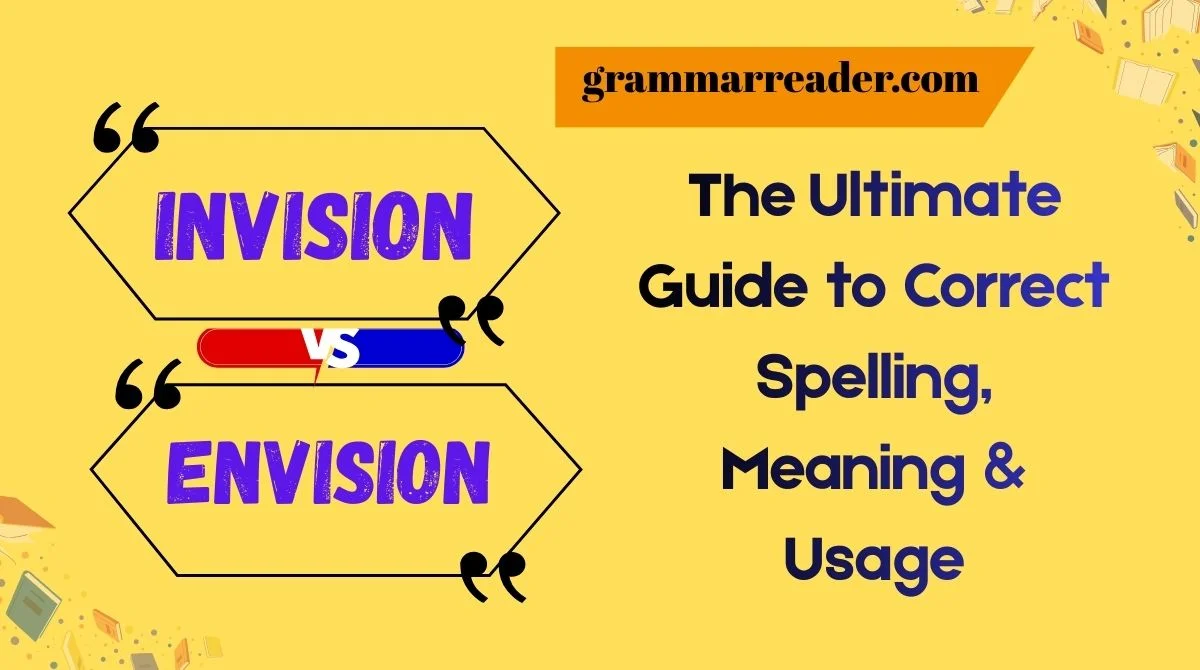
👉 The only correct spelling in standard English is envision.
This guide walks you through everything you need to know—history, usage, examples, memory tricks, comparisons, and more. The goal? Help you understand the invision vs. envision confusion once and for all.
Let’s dive in.
Envision or Invision? Why This Spelling Confuses Millions
If you’ve ever paused mid-sentence wondering which version is right, you’re definitely not alone.
A few things make this mix-up common:
- Phonetic confusion: When we say en, it often sounds like in.
- Autocorrect habits: Devices sometimes “learn” misspellings from users.
- Brand influence: Tech products like InVision normalize the wrong spelling.
- Mental shortcuts: The brain tends to choose faster, simpler paths when spelling.
A quick example:
- ❌ I invision a better future.
- ✅ I envision a better future.
The second version is the only grammatically acceptable one in English.
Envision: The Correct Word & What It Really Means
At its core, envision means to picture something in your mind. It’s an action word used when someone imagines, foresees, or mentally constructs an idea.
Core Definition
Envision (verb): to imagine or visualize a future possibility, goal, or outcome.
You use it when:
- Planning a project
- Imagining a future
- Setting goals
- Describing a creative idea
- Crafting a business vision
Why “envision” begins with en- instead of in-?
English uses the prefix en- to form verbs that mean “to cause to become” or “to put into.”
Examples:
- Encourage → cause someone to gain courage
- Enable → make able
- Enrich → make richer
- Envision → form a vision inside your mind
The prefix in- has different roles:
- It often means not (inactive, incomplete)
- Or refers to location (inland, inside)
This is why invision doesn’t match English construction rules.
Why “Invision” Looks Right… but Isn’t
Let’s explore why so many people still write it. The reasons are surprisingly logical.
1. Speech vs. Spelling Conflict
When you pronounce envision, the first syllable blends into “in.”
So your brain picks the shorter, easier version while typing.
2. The InVision Brand
A major cause of global confusion is the well-known digital product “InVision.”
Millions of designers see this name daily, so the incorrect form becomes normalized.
3. Pattern Misinterpretation
Because words like involve and invent begin with “in,” many assume “envision” follows the same rule.
4. Autocorrect Reinforcement
Your device may “learn” the wrong spelling if you’ve typed it repeatedly.
5. Visual Familiarity
“Invision” looks correct to many people simply because they’ve seen it in branding, ads, or social media posts.
A Short History of “Envision”: Where This Word Comes From
Understanding the evolution of the word makes its modern spelling easier to remember.
Etymology
- Derived from French roots involving vision and the formation of images.
- Entered English in the mid-1800s.
- Has always been spelled envision in formal writing.
Unlike many English words, British and American English agree on its spelling.
That consistency is rare—another clue that “invision” never existed as a legitimate variant.
Envision in Modern English: Correct Usage
Let’s look at how to use the word properly in sentences and different contexts.
Grammatical Role
- Verb (transitive): It requires an object.
Correct example:
I envision a more efficient workflow.
Incorrect example:
❌ I envision. (object missing)
Usage Contexts
- Business: envisioning business growth
- Leadership: envisioning strategic change
- Creativity: envisioning a story, design, or concept
- Personal goals: envisioning your future self
- Innovation: envisioning new technology
How it differs from similar words
| Word | Difference |
|---|---|
| Imagine | Broader; not always future-focused |
| Visualize | Often involves creating a mental image visually |
| Foresee | Predicting based on knowledge or analysis |
| Dream | More emotional or aspirational than envision |
Quick Comparison: Envision vs. Invision
Below is a clear comparison to eliminate all confusion.
Comparison Table
| Feature | Envision | Invision |
|---|---|---|
| Correct spelling | ✅ Yes | ❌ No |
| Meaning | To imagine, picture, foresee | None (not a real English word) |
| Part of speech | Verb | Not applicable |
| Usage | Standard English | Incorrect outside brand names |
| Acceptable in academic writing | Yes | No |
| Found in dictionaries | Yes | No |
| Only correct exception | None | Brand names like “InVision” |
Key takeaway
👉 Use envision for language. Use InVision only when referring to the software company.
Synonyms of Envision for Better Writing
Using synonyms helps diversify your vocabulary and adds richness to your writing.
Creative or Visual Synonyms
- Visualize
- Picture
- Imagine
- Render
- Depict mentally
Strategic or Business Synonyms
- Forecast
- Project
- Conceptualize
- Map out
- Predict
Formal Synonyms
- Contemplate
- Conceive
- Speculate
Quick Usage Notes
- Visualize works well in health, meditation, and self-help contexts.
- Forecast suits business, economy, or data-driven topics.
- Picture is casual and conversational.
Example Sentences Using Envision
Using examples helps the meaning stick quickly.
Everyday Examples
- I envision a peaceful weekend with no meetings.
- She couldn’t envision living anywhere else.
Business Examples
- The CEO envisions a company built on innovation.
- We need to envision how customers will interact with this product.
Creative Examples
- The author envisioned a world beyond human imagination.
- He envisioned the final painting long before the first brushstroke.
Incorrect vs. Correct Examples
| Incorrect | Correct |
|---|---|
| I invision great results. | I envision great results. |
| Can you invision this design? | Can you envision this design? |
| They invisioned the future. | They envisioned the future. |
How to Avoid Misspelling “Envision”
Here are memory tricks and strategies to ensure you never get it wrong again.
1. Remember: en- means “to cause to become.”
Think of:
- Enable
- Encourage
- Empower
- Envision
2. The IN-version means “not.”
“In-” often creates the opposite meaning:
- Inactive
- Incomplete
- Insecure
“Invision” would literally imply “not vision” if it were a real word—which it’s not.
3. Link it to “vision.”
The core of the word is vision.
So the correct prefix must be en-, making the meaning “put vision inside your mind.”
4. Use the sentence trick
Try this memory sentence:
If you want a vision, use envision.
5. Recognize brand exceptions
Only one place where “InVision” is correct:
InVision = the design collaboration platform.
Every other use?
Envision. Always.
FAQs About Envision vs. Invision
What is the correct spelling: invision or envision?
The correct spelling is envision. Invision is always incorrect unless referring to a brand name like InVision.
Why is “invision” considered a wrong spelling?
Because no English dictionary recognizes it as a real word. It does not follow English prefix rules.
Do envision and imagine mean the same thing?
They’re close, but envision often involves mental planning or picturing a future, while imagine is broader and more general.
Is “InVision” ever correct?
Only when talking about the design software company named InVision. It’s a trademark, not a spelling variant.
How can I avoid misspelling “envision”?
Remember this rule: If the word relates to vision, start with “en.”
Conclusion
The confusion between envision and invision is understandable—speech patterns, branding, and mental shortcuts all play a role. But when it comes to proper English, there’s only one correct spelling: envision.
It’s a powerful verb that helps you express imagination, planning, creativity, and future-thinking. By understanding its history, structure, and usage, you’ll avoid common mistakes and strengthen your writing instantly.
Whenever you need to talk about imagining or mentally visualizing something—
👉 Choose envision. Every single time.

Aiden Brooks is an educational writer dedicated to simplifying grammar for learners of all levels. He creates clear, practical explanations that help students read, write, and understand English with confidence.