
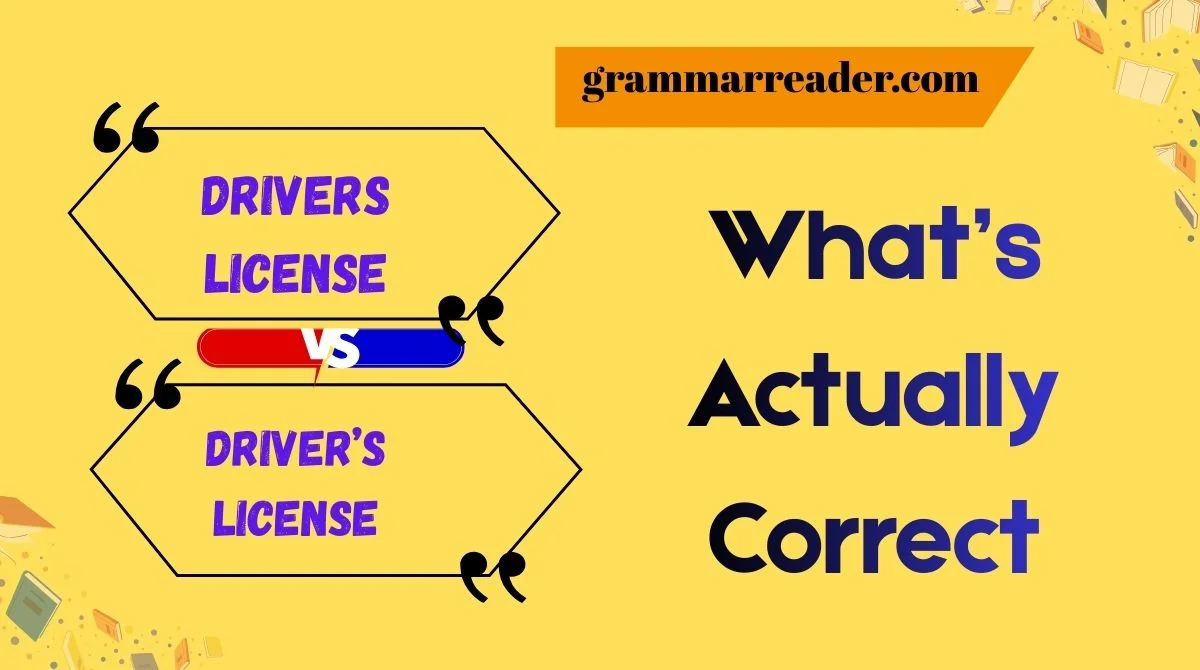
Writing about your driver’s license seems simple until you hit that tiny apostrophe. Does it belong there? Should you write driver license, drivers license, or driver’s license?
This confusion hits writers, students, bloggers, and even professionals because the term appears in several forms. Some are grammatically correct, some are legally correct, and some are just common mistakes.
This comprehensive guide clears it all up in a simple, conversational way. You’ll see real grammar rules, legal variations, regional differences, examples, tables, and practical advice so you never second-guess yourself again.
Driver’s License vs Drivers License: The Real Grammar Behind the Apostrophe
You’ll understand this topic faster when you know what’s actually happening grammatically. The phrase driver’s license follows a very basic rule of possession.
- A driver owns the license
- The license belongs to the driver
- So you write driver’s license
Here’s the simple logic:
| Term | Meaning | Correct? |
|---|---|---|
| Driver’s license | License of a single driver | ✅ Grammatically correct |
| Drivers license | Implies multiple drivers own one license | ❌ Grammatically incorrect |
| Driver license | Used officially by some governments | ⚠️ Legal variant, not grammatically possessive |
If you’ve ever written “drivers license,” you’re not alone. Many people remove the apostrophe because it feels faster or looks cleaner, but that doesn’t make it grammatically right.
Think about similar phrases:
- pilot’s license
- fisherman’s permit
- teacher’s guide
All of these use singular possessive, so driver’s license follows the same pattern.
Why You Keep Seeing “Drivers License” Everywhere
When you browse social media or fill out forms, you see “drivers license” so often that your brain starts thinking it’s acceptable. This happens for a few reasons.
People Type Fast
When you type on your phone, dropping the apostrophe feels natural. Autocorrect doesn’t always fix it.
Signs Rarely Use Apostrophes
Businesses and public institutions often skip apostrophes for simplicity. For example:
- DMV signs
- Website buttons
- Forms
- Labels
- Database fields
A big sign might read:
DRIVERS LICENSE SERVICES
But grammar rules aren’t based on signage convenience.
Software Systems Don’t Like Apostrophes
Databases sometimes break when you add apostrophes into field names. Software engineers avoid them, which slowly influences public usage.
This creates a world where the grammatically correct term and the visually common term don’t always match.
Legal Usage: What Government Agencies Actually Say
Here’s where things get interesting. In grammar, driver’s license is correct. In law, each U.S. state decides its own wording.
Most states officially use “Driver’s License”
You’ll see apostrophes in most titles because they follow traditional English rules.
Some states officially use “Driver License”
These states remove the apostrophe on purpose. They aren’t wrong. They simply choose a non-possessive version for official terminology.
Reasons governments avoid apostrophes:
- Standardization in computer systems
- Consistency in documentation
- Simplified legal wording
- Avoiding errors in database fields
Important Note
“Drivers license” is almost never used in official government documents.
Quick Comparison Table
| Version | Type | Why It Exists |
|---|---|---|
| Driver’s license | Grammatical standard | Shows possession (license of a driver) |
| Driver license | Legal standard in some states | Simpler administrative wording |
| Drivers license | Mistake | Not grammatically or legally standard |
Accepted Variants and When to Use Them
Not every situation requires the same phrasing. Use depends on:
- context
- audience
- legal accuracy
- writing style
Use “driver’s license” when:
- Writing articles
- Writing essays
- Writing emails
- Writing books
- Communicating in natural English
This is the grammatically correct form.
Use “driver license” when:
- Quoting a state’s official terminology
- Filling out DMV paperwork
- Matching an exact legal phrase
- Writing government-related documents
Avoid “drivers license” unless:
You’re quoting someone’s incorrect spelling for explanation.
Singular vs Plural Forms: People Mess This Up All the Time
Possessive forms confuse everyone, so let’s make this simple.
Correct Forms
- One person → driver’s license
- Two or more people → drivers’ licenses
Here’s the breakdown:
| Phrase | Meaning | Correct? |
|---|---|---|
| driver’s license | One license belonging to one driver | ✔️ |
| drivers’ licenses | Multiple licenses belonging to multiple drivers | ✔️ |
| drivers license | Error | ✖️ |
| driver licenses | Legal variant only | ⚠️ |
Example Sentences
- “She forgot her driver’s license at home.”
- “Police checked all the drivers’ licenses at the checkpoint.”
Small changes create big differences.
Regional Differences Around the World
Different countries treat the word license/licence differently.
United States
- Uses license for both noun and verb.
- Uses “driver’s license” or “driver license” depending on the state.
United Kingdom
- Uses licence for the noun.
- Official term: driving licence
- They don’t say driver’s license at all.
Australia
- Follows British rules.
- Uses driver licence or driving licence depending on state or territory.
Canada
- Mixed usage.
- Most provinces use driver’s licence.
- Keeps British “licence” spelling but uses apostrophes more consistently.
Quick Global Comparison
| Country | Official Term | Notes |
|---|---|---|
| USA | Driver’s License / Driver License | Depends on state |
| UK | Driving Licence | British spelling + different structure |
| Australia | Driver Licence / Driving Licence | Depends on state |
| Canada | Driver’s Licence | British spelling, keeps apostrophe |
A Short Historical Look at the Term “Driver’s License”
You don’t need a long history lesson, but a little context helps.
- Early 1900s: States began regulating vehicles
- Terms varied wildly (operator permit, chauffeur card, automobile certificate)
- As vehicles became mainstream, states standardized wording
- “Driver’s license” became the dominant spelling
- Later, states simplified wording for administrative use → “driver license”
Apostrophes often disappeared as documents moved to digital systems, which don’t always support special characters.
So the “apostrophe war” isn’t about grammar. It’s about technology catching up with language.
Practical Advice: What Should You Use?
Here’s the answer you actually need.
If you’re writing for general readers
Use driver’s license.
It’s correct, clear, and accepted everywhere.
If you’re writing legal documents
Match the exact wording used by the issuing state or country.
If you’re writing for SEO
Use variations naturally but prioritize:
- driver’s license
- drivers license (because people search incorrectly)
- driver license
If you’re unsure
Follow this rule:
When in doubt, choose the grammatically correct “driver’s license.”
Quick Reference Table: What to Use and When
| Context | Correct Term |
|---|---|
| Grammar | Driver’s license |
| U.S. legal documents | Driver’s License or Driver License (state-specific) |
| British English | Driving Licence |
| Australian English | Driver Licence / Driving Licence |
| Canadian English | Driver’s Licence |
| Search queries | Include variations |
Case Studies: Real-World Situations
These examples show how choosing the right term creates clarity.
Case Study 1: A Writer Submitting a Magazine Article
A travel writer mentions needing a driver’s license to rent a car.
Correct because magazines follow grammar rules, not DMV rules.
Case Study 2: A Lawyer Preparing a Motion
A defense lawyer writes “Florida Driver License” exactly as the state defines it.
Correct because legal accuracy outweighs grammar.
Case Study 3: A Blogger Targeting SEO
The blogger uses all three terms naturally, ensuring search variations catch traffic.
Correct because Google respects content quality more than rigid grammar.
Case Study 4: A Teacher Grading Essays
Students lose points for writing “drivers license.”
Correct because it’s grammatically wrong.
Key Takeaways
- The grammatically correct term is driver’s license.
- “Driver license” is used by certain U.S. states for official reasons.
- “Drivers license” is almost always incorrect.
- English-speaking countries use different spellings and structures.
- Always match the legal term used by the issuing authority.
FAQs
Is it driver license or driver’s license?
Both appear, but driver’s license is grammatically correct. Some states use driver license legally.
Why do some states drop the apostrophe?
Mostly for administrative simplicity and to avoid issues in computer systems.
Is “drivers license” ever correct?
No. It’s a common mistake unless you’re quoting incorrect usage.
How do you pluralize driver’s license?
Use drivers’ licenses when talking about multiple people.
Is “licence” spelled differently?
Yes. British English uses licence (noun) and license (verb).
Conclusion
The debate between driver’s license and drivers license comes down to grammar versus legal convention. If you want to write clearly, confidently, and correctly, stick to driver’s license.
Use driver license only if your state or country uses that form officially. With this guide, you can now make the right choice every time and avoid common mistakes that confuse readers.

Aiden Brooks is an educational writer dedicated to simplifying grammar for learners of all levels. He creates clear, practical explanations that help students read, write, and understand English with confidence.