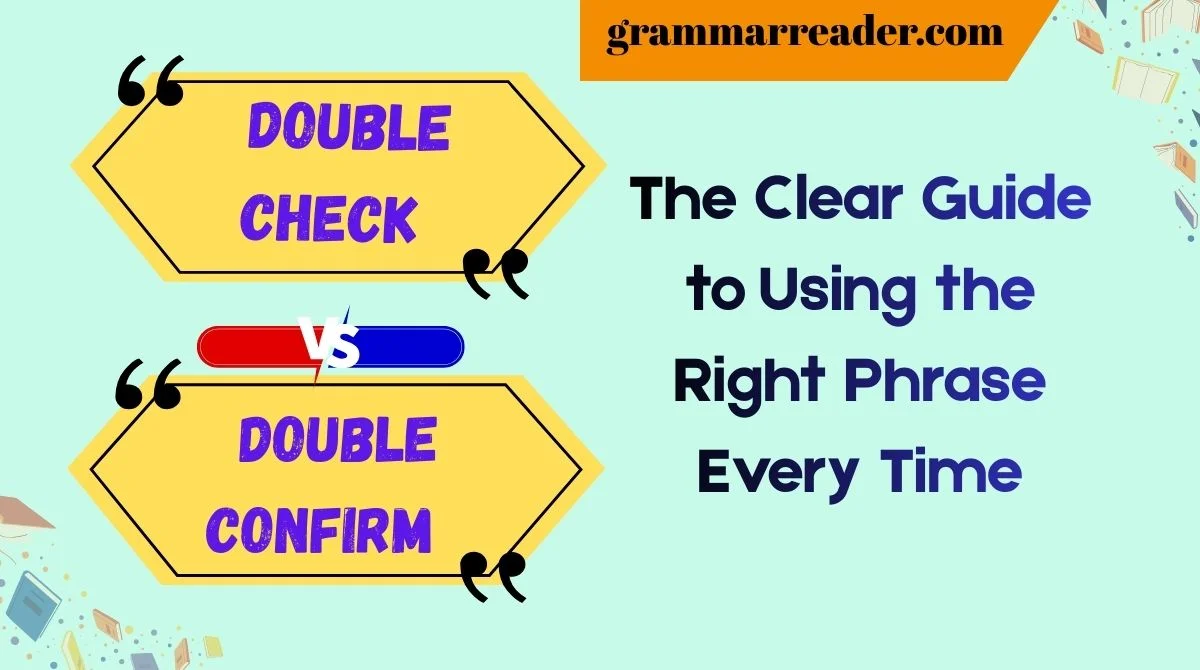
Language shapes perception. One small phrase can quietly signal competence or confusion. When you write “double check” or “double confirm”, you’re not just choosing words. You’re choosing tone, clarity, and credibility.
Many professionals use these phrases interchangeably. That seems harmless. It isn’t. Subtle differences affect how your message lands, especially in business emails, travel communication, academic writing, and cross-cultural settings.
Let’s break it down clearly. By the end, you’ll know exactly when to use double check, when to avoid double confirm, and how to sound precise without overcomplicating your message.
Why “Double Check or Double Confirm” Actually Matters
Words carry weight. In professional communication, small wording choices create large impressions.
Imagine this email:
“Please double confirm the meeting.”
Now compare:
“Please double check the meeting details.”
They feel similar. Yet they imply different actions.
- One asks for verification of accuracy.
- The other suggests reaffirmation of certainty.
- One sounds standard in American English.
- The other can sound redundant.
Clarity builds trust. Precision reduces friction. And in fast-moving environments, vague phrasing costs time.
What “Double Check” Really Means
Definition and Core Meaning of Double Check
To double check means to examine something again to ensure it’s correct. You review information a second time to catch errors.
At its core:
- Check = examine for accuracy
- Double check = examine again for certainty
It focuses on evidence. You look at facts, numbers, spelling, timing, or details.
You don’t “double check” feelings. You double check data.
Historical Roots of “Check”
The word check comes from the Old French eschec, linked to the game of chess. In chess, a “check” alerts a player to danger. Over time, the word evolved to mean examine, control, or verify.
Adding “double” strengthens the action. It signals repetition for security.
English often uses “double” for emphasis:
- Double-click
- Double-check
- Double-checking
This structure feels natural in American English. It doesn’t sound forced.
Grammar and Structure of Double Check
“Double check” works as:
- A verb phrase
- A compound verb
- Sometimes hyphenated when used adjectivally
Examples:
- Please double check the numbers.
- I’ll double-check the invoice before sending.
- We need a double-check process for payroll.
In American style guides, hyphenation usually appears when the phrase modifies a noun.
Tone and Professional Perception
Here’s the key: double check sounds responsible.
It implies:
- Care
- Attention to detail
- Accountability
- Prevention mindset
It does not imply insecurity.
In fact, in industries like aviation, finance, engineering, and healthcare, double checking prevents catastrophic errors.
Consider aviation. Pilots follow checklist procedures before takeoff. They double check instruments. That habit saves lives.
The phrase carries seriousness.
Real-World Examples of Double Check
Let’s look at practical usage.
Workplace Email
Please double check the client’s billing address before issuing the invoice.
Academic Setting
Double check your citations before submitting the paper.
Travel Planning
Double check your passport expiration date before booking international flights.
Software Development
Double check the code merge to avoid production errors.
Each example shows review of facts. Not emotion. Not agreement. Data.
What “Double Confirm” Actually Means
Now let’s examine the second phrase.
Literal Meaning of Double Confirm
To confirm means to establish the truth, accuracy, or validity of something.
Examples:
- Confirm a booking.
- Confirm attendance.
- Confirm an appointment.
So what happens when you add “double”?
Logically, double confirm means to confirm again. It implies reaffirming something already confirmed.
That’s where tension begins.
Confirm already means establish certainty. Adding “double” can feel redundant.
Is Double Confirm Standard English?
“Double confirm” appears frequently in global English. However, in standard American English, it is less common and often considered unnecessary.
You’ll hear it often in:
- South Asian English
- Southeast Asian English
- International customer service environments
In US corporate writing, most professionals prefer:
- Confirm
- Reconfirm
- Double check
“Double confirm” is understandable. Yet it can sound slightly off in formal US writing.
Why Double Confirm Became Popular
Language adapts across regions. In multilingual business environments, speakers often reinforce clarity by adding emphasis.
For example:
- “Kindly revert back.”
- “Discuss about.”
- “Double confirm.”
These phrases emerge from translation patterns. They aren’t incorrect in meaning. They simply don’t align perfectly with American idiomatic usage.
Global teams use them regularly. Native US writers tend to avoid them.
Tone and Interpretation of Double Confirm
In American professional writing, “double confirm” can imply:
- Redundancy
- Overemphasis
- Informal phrasing
- Non-native structure
However, in international settings, it may simply signal urgency.
Context shapes perception.
Real-World Examples of Double Confirm
Vendor Communication
Please double confirm shipment dispatch.
Event Planning
Kindly double confirm your attendance.
Hotel Booking
We request you to double confirm your reservation.
These examples appear frequently in global communication. They function. Yet many American editors would revise them to:
- Please confirm shipment dispatch.
- Please reconfirm your attendance.
- Kindly confirm your reservation.
Cleaner. Sharper.
Double Check vs Double Confirm: The Precise Difference
Let’s simplify the distinction.
| Feature | Double Check | Double Confirm |
|---|---|---|
| Focus | Review accuracy | Reaffirm certainty |
| Standard in US English | Yes | Limited |
| Tone | Professional | Context-dependent |
| Risk of redundancy | Low | Moderate |
| Best for | Data and detail | Agreement or commitment |
Conceptual Difference Explained
Think of it this way:
- Checking = Looking at evidence
- Confirming = Declaring something true
When you double check, you look again.
When you double confirm, you reassert truth.
Subtle difference. Big impact.
Example Contrast in Identical Situations
Scenario: Meeting Time
- Please double check the meeting time.
→ Verify the schedule. - Please double confirm the meeting time.
→ Reaffirm that it is correct.
One requests investigation. The other requests affirmation.
Which One Should You Use?
Here’s a simple decision framework.
Use Double Check When:
- You review numbers
- You inspect details
- You audit data
- You proofread text
- You verify accuracy
It works in:
- Business emails
- Academic writing
- Technical documentation
- Professional communication
It is safe. It sounds natural.
Use Confirm or Reconfirm Instead of Double Confirm When:
- You need official agreement
- You want a reply
- You’re finalizing arrangements
- You need acknowledgment
For example:
- Please confirm by 3 PM.
- Please reconfirm your availability.
- Kindly confirm receipt.
Clearer. Cleaner. Stronger.
When to Avoid Both
Sometimes neither phrase fits.
Instead of:
Please double check and double confirm.
Try:
- Verify
- Validate
- Review
- Cross-check
- Authenticate
Choose precision over repetition.
Common Mistakes That Undermine Credibility
Overusing Double Confirm in Formal Writing
Redundancy weakens authority.
For example:
Kindly double confirm again.
That’s triple repetition. It signals uncertainty.
Treating Them as Perfect Synonyms
They aren’t identical. Misusing them can confuse expectations.
If you say “double check,” someone reviews details.
If you say “confirm,” someone replies yes.
Different actions.
Adding Excess Words
Avoid phrases like:
- Kindly revert back.
- Double confirm again.
- Re-double check.
English values clarity. Not padding.
Hyphenation Errors
Correct usage:
- I will double check the report.
- Please double-check the report.
- We need a double-check system.
Spacing matters in professional writing.
Smarter Alternatives to Double Check and Double Confirm
Here are stronger options.
Alternatives to Double Check
- Verify
- Cross-check
- Re-examine
- Audit
- Inspect
- Review
Alternatives to Double Confirm
- Reconfirm
- Validate
- Affirm
- Acknowledge
- Certify
Quick Comparison Table
| Situation | Best Word |
|---|---|
| Financial audit | Verify |
| Hotel booking | Reconfirm |
| Academic citation | Double check |
| Legal document | Validate |
| Email receipt | Confirm |
Choose based on action. Not habit.
Real-World Usage Scenarios
Workplace Communication
Managers often write:
Please double check the figures before presenting.
That signals accountability.
However:
Please double confirm the figures.
That sounds uncertain in US corporate settings.
Travel and Logistics
When booking flights, accuracy matters.
You should double check:
- Passport validity
- Name spelling
- Flight dates
- Baggage allowance
But you confirm:
- Seat selection
- Payment
- Reservation number
Different verbs. Different tasks.
Academic and Research Settings
Researchers double check:
- Data entries
- Statistical outputs
- Citation formatting
- References
They confirm:
- Ethics approval
- Submission receipt
- Authorship agreement
Clear distinction.
Cross-Cultural Communication
Global teams mix language patterns.
In multinational companies, you may see:
Kindly double confirm the delivery schedule.
Instead of correcting colleagues publicly, adapt subtly:
Please confirm the delivery schedule by Friday.
Clarity improves without criticism.
Language evolves. Professional polish still matters.
Case Study: When One Word Changed the Outcome
A project manager emailed an overseas vendor:
Please double confirm the dispatch status.
The vendor replied:
Already confirmed.
The manager still wasn’t sure whether the shipment had actually left the warehouse. Confusion followed. Delays happened.
Rewritten email:
Please confirm whether the shipment has been dispatched. If yes, share tracking details.
The response arrived with tracking numbers within minutes.
Clear wording. Clear action. Faster results.
That’s the power of precision.
Decision Guide: Choosing Between Double Check or Double Confirm
Ask yourself:
- Am I reviewing data? → Use double check.
- Am I asking for official acknowledgment? → Use confirm.
- Am I revalidating a booking? → Use reconfirm.
- Am I emphasizing urgency? → Use direct language, not repetition.
Shorter sentences improve clarity.
FAQs
What does double check mean?
It means to review something again to ensure accuracy.
Is double confirm correct English?
It is understandable but less common in standard American English.
Can I use double confirm in formal writing?
You can, but confirm or reconfirm usually sounds more natural.
What is the difference between double check and double confirm?
Double check means re-examine details. Double confirm means reaffirm certainty.
Is reconfirm the same as double confirm?
Reconfirm is more standard and widely accepted in professional US English.
Conclusion
Choosing between double check or double confirm isn’t grammar trivia. It’s about clarity.
Use double check when reviewing details.
Use confirm or reconfirm when seeking acknowledgment.
Avoid redundancy.
Choose verbs carefully.
Strong writing feels effortless. Yet it relies on deliberate word choice.
One word can sharpen your authority. Or blur it.
Choose wisely.

Aiden Brooks is an educational writer dedicated to simplifying grammar for learners of all levels. He creates clear, practical explanations that help students read, write, and understand English with confidence.