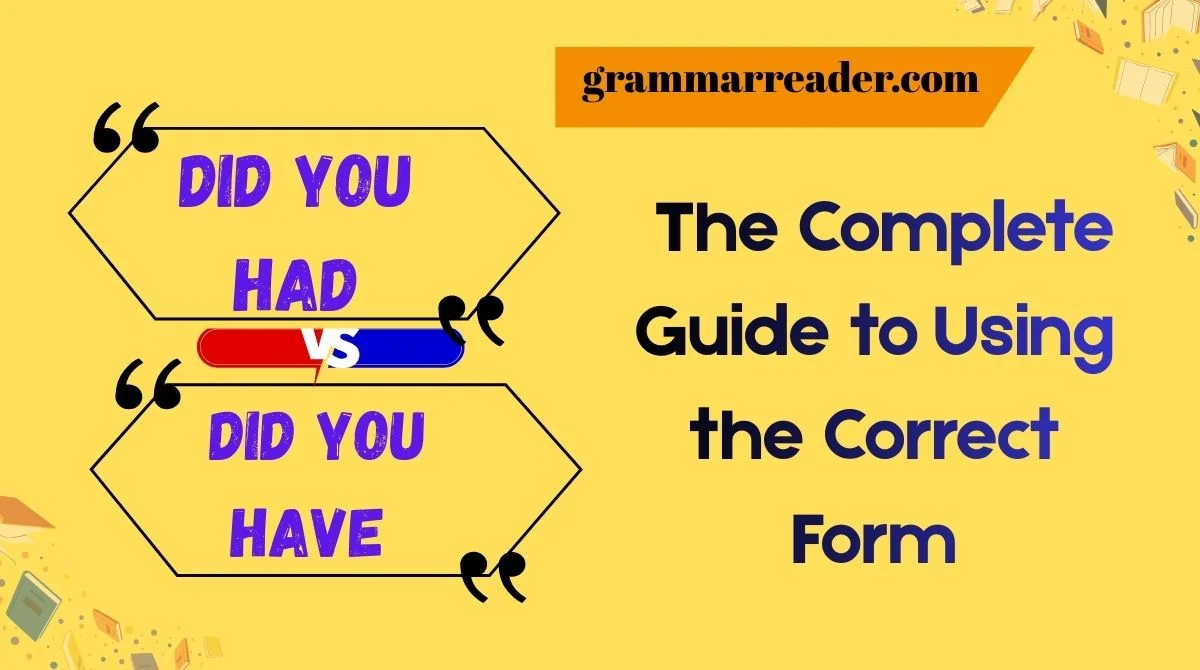
When you’re learning English, some phrases look simple but still trip you up. One of the most common examples is the confusion between “Did you have” and “Did you had.”
You’ve probably seen both phrases floating around online or heard different versions in conversations. So which one is correct?
Here’s the quick answer:
👉 The correct phrase is always “Did you have.”
❌ “Did you had” is never correct in English.
But understanding why makes you a stronger, more confident English speaker. So let’s break everything down step-by-step with examples, comparisons, tables, and clear explanations that you can use immediately.
Understanding Auxiliary Verbs and Past Tense
Before you understand why “Did you had” is wrong, you need to know how English builds questions, especially in the past tense. This is where auxiliary (helping) verbs come in.
What Are Auxiliary Verbs?
Auxiliary verbs are the “helper” verbs that support the main verb.
In English, the most common helping verbs include:
- Do / Does / Did
- Have / Has / Had
- Am / Is / Are / Was / Were
In this topic, we focus on just one:
➡️ Did (the past tense of do)
This word is powerful because it already expresses the past tense by itself.
Quick Fact
“Did” + main verb (base form) = past tense question
Example: Did you eat? (Not Did you ate?)
That single rule solves your entire confusion.
How Past Tense Works with “Did”
When you use did, the verb that comes after it must be in its base form.
Not the past form. Not the present perfect form.
Just the plain, simple form.
Examples
- Did you go? ✔️
- Did you see him? ✔️
- Did you had a good time? ❌ (wrong)
- Did you have a good time? ✔️ (correct)
The mistake happens when learners apply the past tense twice.
“Did” = past
“Had” = past
Using both = ❌ double past = always wrong.
This rule is universal and doesn’t change.
Why the Correct Phrase Is “Did You Have”
Now let’s focus on the main point.
When forming a question in past tense, English follows this structure:
Formula for Past Questions
Did + subject + base verb + object?
And since the base form of “had” is have,
you get:
👉 Did you have…?
That’s it.
It works 100% of the time.
Correct Examples
- Did you have breakfast?
- Did you have enough time?
- Did you have fun last night?
- Did you have any questions?
Common Incorrect Examples
- Did you had breakfast? ❌
- Did you had any issues? ❌
- Did you had a chance to talk? ❌
Why “Did You Had” Is Always Incorrect
Let’s make this clear with a simple explanation.
Reason 1: Double Past Tense
“Did” is already past tense.
“Had” is also past tense.
Using both together is like saying:
“Past you past eat?”
It’s redundant and incorrect.
Reason 2: English Structure Rules
Whenever you use did, the next verb must return to its base form, which is:
- go
- eat
- walk
- play
- have
Not:
- went
- ate
- walked
- played
- had
Quick Chart
| Phrase | Correct? | Why |
|---|---|---|
| Did you have breakfast? | ✔️ | “Have” is the base form |
| Did you had breakfast? | ❌ | Double past tense |
| You had breakfast. | ✔️ | Sentence in simple past |
| Have you had breakfast? | ✔️ | Present perfect tense |
This table alone helps avoid 99% of mistakes.
Clear Example Sentences in Different Contexts
Here are different ways you can use Did you have correctly in real life.
Asking About Events
- Did you have fun at the party?
- Did you have a good day?
- Did you have trouble logging in?
Asking About Possessions
- Did you have my charger?
- Did you have your ID with you?
Asking About Health or Conditions
- Did you have a fever last night?
- Did you have any symptoms?
Asking About Experiences
- Did you have a chance to finish the report?
- Did you have time to watch the movie?
These examples show how broad and useful the phrase is.
Common Mistakes (And How to Fix Them)
Let’s talk about the errors most learners make so you avoid them.
Using “Did” and “Had” Together
This is the biggest and most common mistake.
❌ Did you had a good time?
✔️ Did you have a good time?
Why it’s wrong:
You don’t need the past tense twice.
Forgetting to Use “Did” in a Past Question
Some learners translate directly from their native language, which leads to:
❌ You had fun?
✔️ Did you have fun?
While the incorrect version may be understood, it’s not grammatically standard.
Using “Had” Instead of “Have” in Negatives
Another common mistake:
❌ I didn’t had time.
✔️ I didn’t have time.
Why?
Because did not already takes the past tense role.
So the main verb resets to base form.
“Did You Have” vs “Have You Had”
These two are correct but mean different things.
Understanding the difference makes you sound fluent and natural.
Meaning of “Did You Have”
Used for:
- Specific time in the past
- Finished events
- Actions connected to one moment
Example:
- Did you have lunch yesterday?
Meaning of “Have You Had”
Used for:
- Experiences
- Actions at an unspecified time
- Recent or ongoing situations
Example:
- Have you had lunch yet?
Comparison Table
| Question | Meaning | Used When |
|---|---|---|
| Did you have…? | Simple past, specific time | Asking about yesterday, last night, morning |
| Have you had…? | Experience or recent action | Asking about something done recently or ever |
Examples in Everyday Situations
Meals
- Did you have lunch?
- Have you had lunch yet?
Tasks
- Did you have time to finish the report?
- Have you had time to review it yet?
Appointments
- Did you have your appointment yesterday?
- Have you had your appointment yet?
These subtle differences matter.
Practice Section: Strengthen Your Grammar
Try these exercises to sharpen your understanding.
Fix the Sentence
- Did you had coffee this morning?
- You had a good time?
- I didn’t had money.
- Did she had any questions?
- Have you have breakfast yet?
Correct Answers
- Did you have coffee this morning?
- Did you have a good time?
- I didn’t have money.
- Did she have any questions?
- Have you had breakfast yet?
Fill in the Blanks
- Did you ___ fun?
- I didn’t ___ any issues.
- Did he ___ time to finish it?
- Have you ___ dinner already?
- Did they ___ your message?
Answers
- have
- have
- have
- had
- get / receive (varies by context)
Quick Tips to Remember
- Only one past tense per sentence.
- Did always pairs with the base form of the verb.
- Have you had is for experiences, not specific past times.
- Use did not + have for negative sentences.
Case Studies
Case Study: Ali’s Grammar Confusion
Ali always said:
“Did you had lunch?”
After learning the rule, he corrected it to:
“Did you have lunch?”
Within a week, his teacher noticed a big improvement in his spoken English.
Case Study: Maria’s Interview Mistake
Maria applied for a job and during the interview said:
“Did you had any questions for me?”
The interviewer corrected her politely.
She later practiced and learned the correct form:
“Did you have any questions for me?”
This small improvement boosted her confidence and clarity.
Expert Quote
“Whenever you use an auxiliary verb in English, the main verb becomes simple and bare.”
— Dr. Helen Brooks, Linguistics Professor
This simple idea solves the whole issue.
FAQs Before Conclusion
Why is “Did you had” incorrect?
Because did is already past tense. The verb after it must be base form, not past.
When should I use “Did you have”?
Use it for questions about events that happened at a specific time in the past.
What’s the difference between “Did you have” and “Have you had”?
“Did you have” is simple past.
“Have you had” is present perfect (experience/recent action).
How do I form negative sentences with “Did you have”?
Use did not + have.
Example: I didn’t have time.
Can “Did you have” be used in formal writing?
Yes. It’s grammatically correct and appropriate in both formal and informal contexts.
Conclusion
Understanding the difference between “Did you have” and “Did you had” gives you stronger control over English grammar.
The rule is clear:
✔️ Use Did you have—always.
❌ Never use Did you had—in any situation.
Once you memorize that did + base verb is the correct structure, your confidence in speaking, writing, and understanding English will increase instantly.
Practice a few minutes a day and apply these examples in real conversations. You’ll notice the improvement quickly.

Aiden Brooks is an educational writer dedicated to simplifying grammar for learners of all levels. He creates clear, practical explanations that help students read, write, and understand English with confidence.