Language evolves fast, especially when emotions run the show. Few expressions capture raw frustration as perfectly as “dammit” and “damn it.”
They sound the same, feel the same, and often appear in the same heated moments — yet they’re not interchangeable.
This guide breaks down everything you need to know about the difference between dammit vs. damn it, including grammar, history, offensiveness, pronunciation, examples, and real-world usage.
Short paragraphs, clean explanations, and plenty of examples make it easy to follow along.
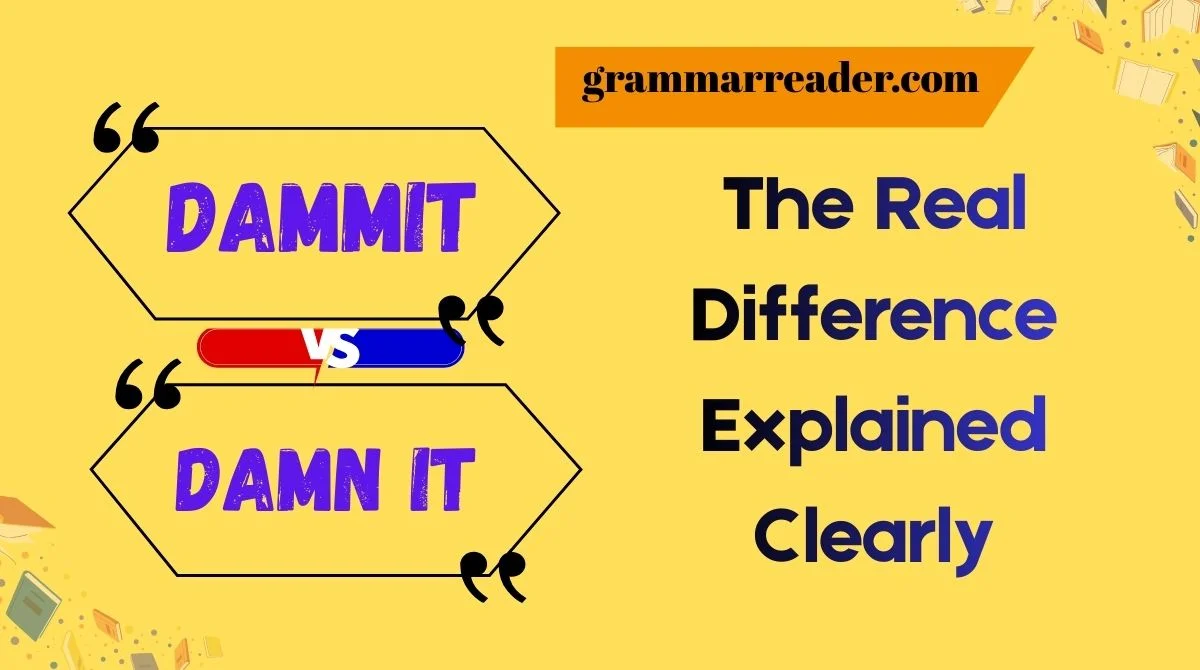
Dammit vs. Damn It: The Real Difference
To kick things off, here’s the simplest way to think about it:
- “Damn it” = a phrase (verb damn + pronoun it)
- “Dammit” = a single interjection used like “ugh!” or “shoot!”
Even though the two sound identical, their structure, grammar, and tone differ. That small shift in spelling changes how the expression functions in spoken and written language.
The Core Difference: One Word vs Two
What “dammit” actually means
“Dammit” works like a punchy emotional outburst. It behaves as one complete word — a pure interjection.
You might yell it when:
- You drop your keys
- You stub your toe
- You get bad news
- You’re annoyed, angry, or overwhelmed
It’s similar to other emotion-loaded words like:
- “Crap!”
- “Ugh!”
- “Seriously?!”
Because it’s compact, it hits fast and feels more like an instinctive reaction.
What “damn it” actually means
This one is grammatical. It’s literally damn + it, which originally expressed condemning something.
Examples:
- “Damn it, why won’t this work?”
- “If you don’t listen, people will damn it.”
- “Damn it all!”
With the space included, the phrase retains a tiny trace of its original religious meaning: to damn, as in to condemn.
Even when used casually, “damn it” functions as a phrase, not an interjection.
Etymology and Evolution of Both Forms
Words rarely stay still. These two spellings reflect centuries of shifts in culture, religion, and spoken English.
Origins of “damn”
The word damn comes from Latin damnare, meaning to condemn or judge guilty. For centuries, the word carried heavy religious weight.
In early English, “damn it” literally meant:
“Send it to eternal punishment.”
Over time, the phrase softened dramatically. By the 1800s, it was used casually to show irritation rather than moral condemnation.
How “damn it” shifted into an emotional outburst
By the early 20th century, writers began using “damn it” less as a religious phrase and more as a frustrated sigh. From diaries to novels, people wrote the phrase the same way they said it — quickly, angrily, and often humorously.
That shift paved the way for its phonetic cousin.
Why “dammit” emerged as a phonetic spelling
As newspapers grew and writing became more informal, phonetic spellings exploded:
- gonna → going to
- wanna → want to
- kinda → kind of
- lemme → let me
- dammit → damn it
“Dammit” helped writers capture the speed and sound of real speech, especially in moments of irritability.
The spelling became popular in comic strips, plays, and handwritten letters because:
- It looked natural
- It saved space
- It matched spoken rhythm
- It showed emotion more realistically
Dictionary Recognition and Accepted Usage
While some older sources prefer “damn it,” modern dictionaries list both “dammit” and “damn it” as correct, but with different functions.
Many define:
- Dammit → Interjection
- Damn it → Phrase
Some style guides prefer keeping them separate, but everyday usage embraces both depending on tone.
Is “Dammit” a Bad Word? Levels of Offensiveness
Whether a word is “bad” depends on generation, culture, and personal comfort. But here’s the general breakdown:
Mild Offensiveness in Modern English
“Dammit” and “damn it” are considered mild profanity — nowhere near as strong as the major swear words.
What determines offensiveness?
- Tone: Shouted vs. typed casually
- Audience: Friends vs. workplace
- Culture: Some cultures dislike religious-based words
- Age group: Older generations may find it harsher
Where it’s usually acceptable
- Casual conversation
- Humor
- Pop culture
- Informal writing
- Digital messaging
Where it’s usually avoided
- Professional emails
- Schools
- Religious settings
- Formal documents
Small word, big context.
Why “Dammit” Exists: The Linguistic Mechanics
Phonetic spelling and American simplification
Americans often write words the way they sound, especially when emotion is involved.
Common phonetic spellings:
| Formal | Phonetic |
|---|---|
| going to | gonna |
| want to | wanna |
| you all | y’all |
| damn it | dammit |
Phonetic spellings make language feel more natural and more human.
Why phonetics matter more in swear words
Swearing is emotional. People don’t enunciate perfectly when they’re irritated — they spit the word out.
Phonetic spellings capture:
- Speed
- Sound
- Rhythm
- Breath patterns
And “dammit” reflects that fast, clipped sound.
Why “dammit” hits faster than “damn it”
Think about how you say it out loud:
- “Damn it” has a tiny pause between words
- “Dammit” is a single burst
That makes “dammit” feel:
- Sharper
- More immediate
- More reactive
Writers choose the spelling that matches the emotional punch they want.
Cultural Variations: American vs. British English
American English
Americans overwhelmingly use dammit in informal writing because it’s quicker and more phonetic.
British English
British speakers use “damn it” slightly more, though both spellings appear widely in UK pop culture.
Global Influence
Hollywood and American media heavily popularized dammit, especially through:
- Sitcom catchphrases
- Movie one-liners
- Comic books
- Music lyrics
Now both forms are recognized worldwide.
Grammar Guide: When to Use Each Form
Use “dammit” when:
- You want an interjection
- You want a quick emotional burst
- You’re mimicking dialogue
- You’re writing humor or drama
Examples:
- “Dammit! I forgot the appointment.”
- “Dammit, that hurt.”
- “Dammit, I knew this would happen.”
Use “damn it” when:
- You want correct grammatical structure
- You want to emphasize the verb
- You’re writing more formally
- You want clarity
Examples:
- “Damn it, stop ignoring the instructions.”
- “If they damn it, the idea is ruined.”
- “Damn it all, I’m done with this.”
Common Mistakes to Avoid
Here are mistakes people often make:
Mistake 1: Using “dammit” in formal writing
It’s fine for dialogue or journaling — not business emails.
Mistake 2: Using “dammit” when the verb is meant literally
Wrong: “They’ll dammit in the records.”
Correct: “They’ll damn it in the records.”
Mistake 3: Using “damn it” when trying to capture emotional dialogue
The space makes it feel slower and less intense.
Mistake 4: Confusing the meaning entirely
Both forms express frustration, but their structure is not the same.
Real-Life Examples of Dammit vs. Damn It
Below are well-structured examples with context.
Correct Use of “Dammit” (Interjection)
| Sentence | Emotion |
|---|---|
| “Dammit! I lost my wallet again.” | Frustration |
| “Dammit, I forgot the charger.” | Annoyance |
| “Dammit, that scared me.” | Shock |
| “Dammit all, I can’t believe this.” | Intensity |
Correct Use of “Damn It” (Verb + Object)
| Sentence | Usage |
|---|---|
| “Damn it, you knew the rules.” | Scolding |
| “Damn it all, leave me alone.” | Strong frustration |
| “If you damn it, the plan fails.” | Literal (rare) |
| “Damn it, that’s enough!” | Commanding |
Case Study: Emotional Impact in Writing
Scenario: A character in a novel drops a glass of water.
Option 1: “Damn it!”
Slower, slightly more formal, feels like controlled frustration.
Option 2: “Dammit!”
Quick, punchy, feels like a sharp burst of annoyance.
Conclusion:
If you want the character to react instinctively, dammit captures the moment better.
Pop Culture Influence: Why “Dammit” Became Mainstream
Pop culture loves fast, sharp expressions. That’s why “dammit” exploded.
Iconic moments using “dammit”
- Sitcom characters yelling “Dammit!” after comedic failures
- Rock and punk songs featuring “dammit” in lyrics
- Movie characters expressing frustration in one-word bursts
Why pop culture chooses “dammit”
- Easier to shout
- Looks more natural in subtitles
- Captures emotional energy
- Fits dramatic timing
As a result, new generations see dammit as the default spelling in casual settings.
Alternatives to Dammit (Mild to Strong)
Sometimes you want emotion without profanity. Here’s a quick guide:
Mild
- “Shoot!”
- “Darn it!”
- “Gosh dang it!”
- “Seriously?”
Medium
- “Crap!”
- “For crying out loud!”
- “Come on!”
Strong
(Still milder than major curse words)
- “What the hell?!”
- “You’ve got to be kidding me!”
These alternatives help you match tone to the situation.
FAQs About Dammit vs. Damn It
What’s the real difference between “dammit” and “damn it”?
“Dammit” is a one-word interjection. “Damn it” is a phrase meaning “condemn it.” They sound the same but differ in grammar and tone.
Is “dammit” considered offensive?
It’s mild profanity. Most consider it soft compared to stronger swear words, but context matters.
Can I use “dammit” in professional writing?
It’s not recommended. For workplace writing, choose neutral or polite alternatives.
Why is “dammit” spelled without a space?
It’s a phonetic spelling designed to capture quick, emotional speech.
Is one version more American than the other?
Americans use “dammit” more often, while Brits use “damn it” slightly more, though both forms appear everywhere.
Conclusion
The distinction between dammit and damn it may seem small, but it shapes tone, grammar, and emotional intensity.
“Dammit” fires off like a spark — fast and expressive. “Damn it” carries lingering echoes of its traditional meaning while staying orderly in grammar.
Knowing when to use each helps you communicate with clarity and confidence.
Whether you’re writing dialogue, journaling your frustrations, or trying to sound more natural in everyday communication, choosing the right form sharpens your expression and deepens your writing style.

Aiden Brooks is an educational writer dedicated to simplifying grammar for learners of all levels. He creates clear, practical explanations that help students read, write, and understand English with confidence.