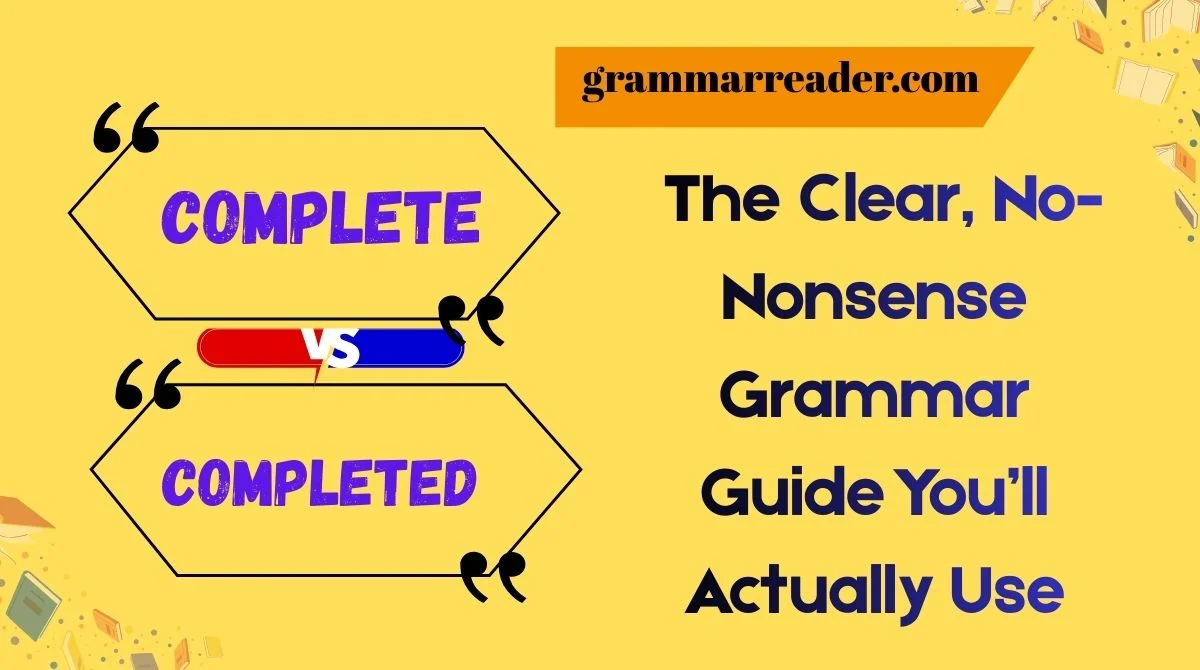
Understanding the difference between complete and completed feels simple at first glance, yet these two words trip up learners, professionals, and even native speakers.
They look similar. They share a root. They both relate to the idea of finishing something. Still, they behave differently in grammar, tone, and meaning.
This guide unpacks those differences with clarity, examples, tables, and real-world applications. Every section focuses on what readers genuinely need to write confidently and choose the right word every time.
Complete vs. Completed — What Makes Them Confusing?
English creates confusion when one word functions as both a verb and an adjective, and another appears as a tense form and an adjectival description. That’s exactly what happens here.
A simple example shows how quickly the meaning can shift:
- “The application is complete.” → describes condition/state
- “I completed the application.” → describes an action you performed
- “The application has been completed.” → confirms the task is finished
At a glance, they feel interchangeable. In practice, they’re not.
To make the difference unmistakable, let’s start with the simplest comparison.
Core Difference at a Glance
Before diving deeper, here’s the quick explanation most people wish someone had given them earlier.
| Form | Part of Speech | Meaning | Example |
|---|---|---|---|
| Complete | Adjective | Whole, entire, no parts missing | “The report is complete.” |
| Complete | Verb (base form) | To finish something, to bring to an end | “I complete tasks on time.” |
| Completed | Past tense / past participle verb form | The action has already been finished | “She completed the task.” |
| Completed | Adjective | Describes something that has already been finished | “The completed form is on your desk.” |
Rule of thumb:
If you’re describing a state, use complete. If you’re describing an action, use completed.
Understanding Complete: Base Word, Two Roles
Complete as an Adjective
“Complete” as an adjective describes the condition of being whole or finished. It doesn’t tell you who finished it or when it was finished. It simply tells you its current state.
Examples:
- “The set is complete.”
- “Your profile isn’t complete yet.”
- “The puzzle looked complete, although one piece was missing.”
This usage is common in:
- Checklists
- Forms and applications
- Business reports
- Educational settings
A sentence with “complete” as an adjective often gives a snapshot: Is the thing finished or not?
Everyday adjective examples
- “A complete guide”
- “A complete stranger”
- “A complete failure”
- “A complete list of requirements”
The word doesn’t just relate to tasks. It also conveys intensity (“a complete mess”) or totality (“complete silence”).
Complete as a Verb
As a verb, “complete” means to finish, finalize, or bring something to its end.
Examples:
- “Please complete the form.”
- “She must complete the assignment by Monday.”
- “We’ll complete the project next week.”
Verb complete always requires an object:
- complete the task
- complete the application
- complete the project
Conjugation of the verb complete
| Tense | Form | Example |
|---|---|---|
| Base | complete | “You must complete the quiz.” |
| Simple Past | completed | “She completed the quiz yesterday.” |
| Past Participle | completed | “The quiz has been completed.” |
| Present Participle | completing | “They are completing the quiz now.” |
Because “completed” is the past and participle form, you’ll see it everywhere in perfect tenses and passive structures.
Understanding Completed: The Finished-Action Form
Completed as a Verb Form
“Completed” in its verb form appears in:
- simple past
- present perfect
- past perfect
- passive structures
Examples:
- Simple past: “He completed the exam.”
- Present perfect: “She has completed her training.”
- Past perfect: “They had completed the work before noon.”
- Passive: “The exam was completed on time.”
Here, “completed” focuses on an action that happened, not merely the state something is in.
Completed as an Adjective
Sometimes “completed” describes a noun, functioning like an adjective.
Examples:
- “The completed application is on the front desk.”
- “Submit only completed documents.”
- “All completed tasks appear in the dashboard.”
This usage usually shows up in:
- Business
- Project management
- Academia
- Government paperwork
A quick test:
If you can add “fully” before it, it’s probably acting like an adjective.
“Fully completed form” → works
“Fully completed yesterday” → sounds wrong → verb form
Complete vs. Completed: How Grammar Shapes Meaning
State vs. Action
One describes how something is, the other describes what was done.
State (complete)
- “The project is complete.”
Describes its condition.
Action (completed)
- “We completed the project.”
Describes what someone did.
Tense-Based Usage Guide
Understanding the role of tense makes the choice effortless.
Simple Present — “is complete”
Used for states.
Examples:
- “The report is complete.”
- “The registration is complete.”
Simple Past — “completed”
Shows someone finished something.
- “She completed her training last week.”
Present Perfect — “has been completed”
Shows completion at a time connected to the present.
- “The upgrade has been completed.”
Past Perfect — “had been completed”
Shows something finished before another event.
- “The form had been completed before submission.”
Passive Voice — “is completed,” “was completed”
Used when the subject isn’t the focus.
- “The work was completed yesterday.”
- “The project is completed annually.”
Quick Decision Flowchart
Make choices instantly using this simple guide:
Do you mean the item is in a finished state?
→ Use complete
Do you mean someone finished it?
→ Use completed
Do you need a past tense verb?
→ Use completed
Do you need a perfect tense?
→ Use has completed / has been completed
Do you want to describe a noun?
→ “complete” and “completed” both work, but mean different things.
Example:
- “a complete form” = whole but maybe not filled
- “a completed form” = filled out and finished
Complete vs. Finished: Why They Aren’t the Same
People often assume “complete” and “finished” are synonyms. They overlap, but they’re not identical.
Here’s the key difference:
- Complete → no missing parts
- Finished → no more work needs to be done
Example:
A book may be complete (all chapters are included)
but not finished (you haven’t read it yet).
Subtle differences:
- Finished sounds more casual and conversational.
- Complete sounds more formal, precise, and task-oriented.
- Finished applies to activities (“I finished eating”).
- Complete applies to things, tasks, and structured processes.
When “finished” cannot replace “complete”
Technical, academic, and legal writing often require “complete” because “finished” might create ambiguity.
Examples:
- “The data set is complete.” (accurate and precise)
- “The data set is finished.” (sounds wrong)
Real-World Usage in Key Fields
Project Management
In project environments, the difference between “complete” and “completed” affects reports, timelines, and stakeholder updates.
Examples:
- “All tasks are completed.” (action done)
- “The project is complete.” (state of being)
- “We completed Phase 1 last quarter.” (action by the team)
- “Phase 1 is complete.” (state after finishing)
Practical project management distinctions
| Phrase | Meaning |
|---|---|
| Task completed | The action is finished |
| Task is complete | The task is whole or finalized |
| Completed tasks | Tasks people finished |
| Complete project | A project that has reached its final state |
Project dashboards usually categorize:
- In progress
- Completed
- Not started
Rarely do they label something as “complete” unless describing an overall state.
Business and Professional Writing
Emails, briefs, and corporate documents often rely on precision.
Examples:
- “The audit is complete.”
- “The team completed the deliverables.”
- “All completed forms must be submitted by Friday.”
Business leaders typically choose “complete” when describing status and “completed” when describing action.
Education and Academic Writing
Academic instructions use both words clearly:
- “Write a complete paragraph.”
- “Students completed the assignment individually.”
- “Submit the completed worksheet to the portal.”
Notice how the shift changes meaning every time.
Everyday Conversation
In speech, people often mix the terms without thinking. Still, grammar rules remain the same.
Examples:
- “Are you done?”
- “I just completed my homework.”
- “The room looks complete now.”
“Completed” usually signals an action you finished, while “complete” feels more descriptive.
Examples from Literature, Media, and Real Usage
Writers often use these words intentionally to shape tone.
Quotes:
- “A complete truth is rarely pure and never simple.” — Oscar Wilde
- “He completed the journey with nothing but determination.”
- “Her world felt complete the moment she stepped inside.”
Literature tends to lean on “complete” because it expresses fullness, wholeness, and emotional depth. Meanwhile, “completed” appears more in action-heavy writing.
Common Errors and How to Avoid Them
❌ Using “complete” when “completed” is needed
Wrong: “I complete the report yesterday.”
Correct: “I completed the report yesterday.”
❌ Using “completed” to describe a current state incorrectly
Wrong: “The project is completed.” (sounds acceptable but can be unclear)
Better: “The project is complete.”
❌ Mixing up passive forms
Wrong: “The work has completed.”
Correct: “The work has been completed.”
❌ Changing meaning unintentionally
“A complete form” → all sections exist
“A completed form” → all sections are filled out
One describes structure, the other action.
Practical Exercises
Fill in the blanks
- The registration is not __________ yet.
- She __________ the final exam last Friday.
- All __________ tasks appear on the right side of the dashboard.
- Please __________ the attached form.
- The manuscript is finally __________.
Suggested answers
- complete
- completed
- completed
- complete
- complete
Case Study: Project Launch Scenario
A tech company finishes Phase 1 of a software rollout. The project manager sends two updates:
Version A:
“The tasks are completed. Phase 1 is complete.”
Version B:
“We completed the tasks. Phase 1 is completed.”
The second version sounds off. Why?
- “Completed tasks” works because the team finished them.
- “Phase 1 is complete” sounds more natural because it describes state, not action.
Professional teams often rely on this nuance for reporting clarity.
Frequently Asked Questions
What is the main difference between “complete” and “completed”?
“Complete” describes a state. “Completed” describes an action already finished.
Can “complete” and “completed” be used interchangeably?
Not accurately. “Complete” works as a state or an adjective, while “completed” shows an action or a finished result.
How do I know when to use “complete”?
Use “complete” when describing the condition or fullness of something, such as “The form is complete.”
Is “completed” only used in the past tense?
It’s used in simple past and also in perfect tenses and passive constructions (has completed, has been completed).
What’s the difference between “is completed” and “has been completed”?
“Is completed” describes a present state.
“Has been completed” links the completion to the present moment with emphasis on the action.
Conclusion
Choosing between complete and completed becomes easy once you focus on state vs. action. One describes how something is right now.
The other reveals what someone did to finish it. Recognizing this difference unlocks clearer writing, stronger communication, and more confident grammar in professional and everyday life.
Whether you’re filling out forms, writing reports, updating stakeholders, or polishing your English skills, remembering this simple distinction keeps your message sharp and accurate.

Aiden Brooks is an educational writer dedicated to simplifying grammar for learners of all levels. He creates clear, practical explanations that help students read, write, and understand English with confidence.