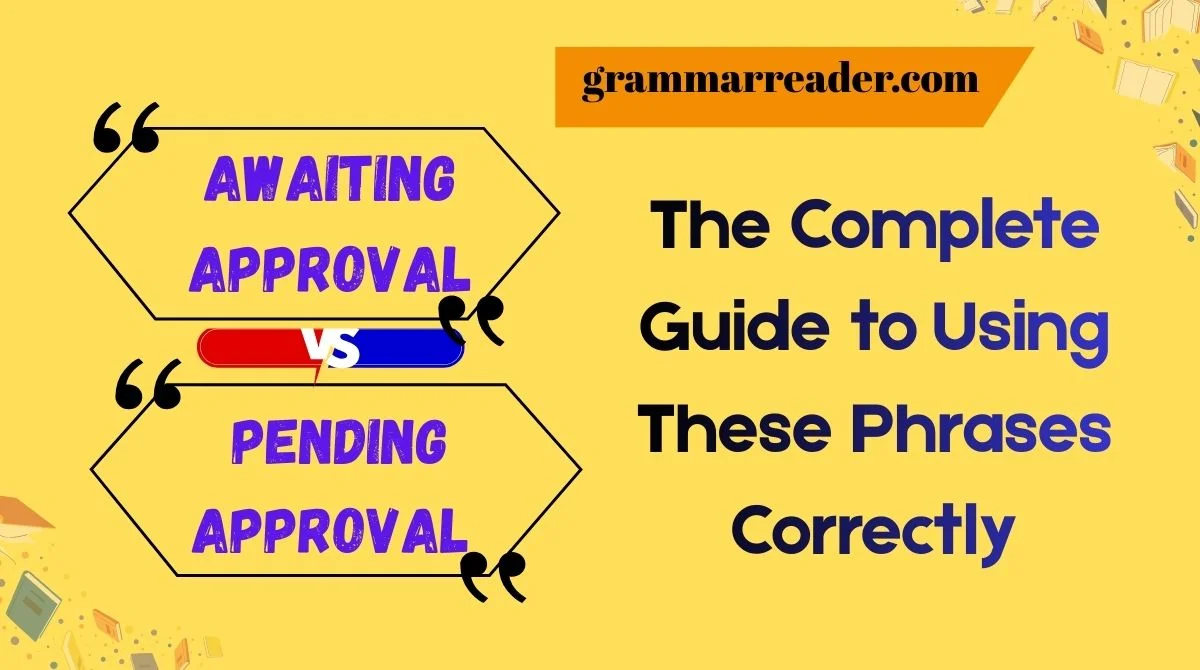
Communication can feel tricky when one small phrase changes the tone of your message. You’ve probably seen awaiting approval and pending approval thousands of times in emails, applications, documents, and project updates.
Yet many people still mix them up or assume they mean the same thing.
This guide breaks everything down for you in a simple, practical way. You’ll learn what each phrase really means, when to use them, and how they affect how people read your message.
The goal is to help you write clearly, sound professional, and choose the best phrase for any situation.
Why Approval Phrases Matter in Professional Communication
You use approval phrases to show that something can’t move forward until someone says yes. These tiny phrases set expectations. They tell your reader three things:
- Who needs to act next
- How urgent something feels
- How final the decision is
If you work in business, education, government, customer support, or any environment where decisions go through layers, using the right phrase can save time and prevent misunderstandings.
For example, when you tell your manager a request is awaiting approval, you imply they need to take action. When you say it’s pending approval, you suggest it’s in a review stage or waiting in a process queue.
These small details shape how someone interprets your message.
What “Awaiting Approval” Really Means
“Awaiting approval” tells the reader that someone specific needs to approve something. You’ve done your part. The responsibility has shifted to a decision-maker.
Here’s what this phrase communicates:
- A task is on hold
- A person must take the next step
- You can’t move forward until approval is granted
- There’s a clear owner responsible for making the decision
Think of it like passing the ball. The moment you say something is “awaiting approval,” you’ve given the ball to the person who now must act.
Quick Definition
Awaiting approval = You’re waiting on a specific person or department to approve something before moving forward.
Tone and Urgency
This phrase feels active. It suggests the approval should happen soon. It creates a gentle nudge.
In internal communication, it often tells the decision-maker, “Hey, it’s your turn.”
When “Awaiting Approval” Fits Best
You’ll use awaiting approval in situations where a human being or team must decide something.
Here are some common examples:
Workplace Scenarios
- Budget requests
- Leave applications
- Project proposals
- Design mockups
- Vendor approvals
- Contract renewals
- Expense reimbursements
HR and People Management
- Hiring decisions
- Salary revisions
- Training requests
Finance & Operations
- Purchase orders
- Invoice sign-offs
Example Sentences
- “The policy update is awaiting approval from the compliance team.”
- “Your leave request is awaiting approval from the manager.”
- “We’ve submitted the design and it’s awaiting approval.”
Why It Works Well
This phrase works when:
- You want clarity
- You want to show who needs to act
- You want to sound approachable
- You want to sound proactive
Variations and Acceptable Alternatives to “Awaiting Approval”
Sometimes you want a more specific or softer tone. Here are some natural alternatives:
| Phrase | When to Use | Tone |
|---|---|---|
| Awaiting your approval | Direct email to decision-maker | Polite, clear |
| Awaiting manager approval | Status updates | Informative |
| Awaiting final approval | End-stage decisions | Formal |
| Waiting for approval | Informal internal messages | Casual |
| Pending your approval | Slightly more formal | Neutral |
| Approval required | Policies or guidelines | Direct |
Use “awaiting approval” when you want clarity and a natural tone. Use alternatives when you want extra specifics.
What “Pending Approval” Actually Means
“Pending approval” describes something that’s in a review stage. It doesn’t focus on a specific person. Instead, it highlights the status rather than the actor.
What It Communicates
- A decision is in progress
- It’s under review
- It’s waiting inside a process (system, workflow, or procedure)
- It might or might not be approved
Quick Definition
Pending approval = A process is ongoing and the outcome hasn’t been finalized yet.
Tone and Formality
“Pending approval” sounds more neutral and formal. You’ll find it in legal documents, applications, policies, and automated systems.
It doesn’t nudge anyone. It just reports a status.
When “Pending Approval” Makes More Sense
Use pending approval when the approval process is formal, structured, or part of a workflow.
Here are common scenarios:
Legal & Compliance
- Contract clauses
- Registration statuses
- Policy updates
Education
- Scholarships
- Admission decisions
- Course registrations
Government
- Visa applications
- Permit applications
- Certification processes
Business & Technology
- Automated system messages
- App notifications
- Form submissions
Example Sentences
- “Your application is pending approval.”
- “The agreement will be effective pending approval from the board.”
- “The update remains pending approval in the system.”
Head-to-Head Comparison: Awaiting Approval vs Pending Approval
Here’s a quick way to understand the difference:
| Feature | Awaiting Approval | Pending Approval |
|---|---|---|
| Focus | Person responsible | Process or system |
| Tone | Slightly urgent | Neutral / formal |
| Implies next action? | Yes | Not always |
| Sounds like? | A reminder | A status update |
| Common use | Emails, workplace tasks | Documents, systems |
| Who uses it? | Employees, managers | Institutions, portals |
Corporate and Workplace Usage
In companies, these phrases carry subtle differences that shape how co-workers respond.
Awaiting Approval in Corporate Settings
- Often used in internal emails
- Helps identify who needs to act
- Makes managers aware something is stuck
- Fits collaborative environments
Pending Approval in Corporate Settings
- Often used in dashboards or workflow software
- Neutral tone makes it ideal for system messages
- Feels more official
- Used when multiple decision-makers may be involved
Why the Difference Matters
Using the wrong phrase can make your message confusing. For instance:
- Saying “pending approval from you” sounds too formal and slightly awkward
- Saying “awaiting approval” in a legal contract may sound informal
A small choice can change how professional you sound.
Sample Corporate Email (Clean, Clear, and Effective)
Subject: Proposal Update – Awaiting Approval
Hi Sarah,
I hope you’re doing well. I wanted to share a quick update on the marketing proposal. The document has been reviewed and is now awaiting your approval before we move to the implementation phase.
Please let me know if you want any changes.
Thanks,
James
Real-World Applications Across Industries
Both phrases appear everywhere. Let’s break it down by sector so you can pick the right option.
Business & Operations
- Awaiting approval shows who needs to sign off
- Pending approval fits reporting tools
Government & Public Services
- Visa and permit forms almost always use pending approval
- It avoids assigning responsibility to a specific officer
Universities & Schools
- Course registration systems use pending approval
- Internal emails between staff use awaiting approval
Customer Service
Support reps prefer:
- “Your refund is pending approval from our system”
- “Your case is awaiting approval from the billing team”
Case Study: Travel Company Workflow
A travel agency handles customer refund requests.
- Customer submits form
- System marks request as pending approval
- Finance sees request
- Team evaluates it
- Agent informs customer: “Your refund is awaiting approval from the finance manager.”
- Manager approves
- System updates to “Approved”
This example shows how both phrases play different roles in a workflow.
Grammar Breakdown: “Awaiting” vs “Pending”
Understanding grammar helps you write more confidently.
Awaiting
- Verb: Present participle of await
- Always requires an object
- Wrong: “Your form is awaiting.”
- Correct: “Your form is awaiting approval.”
Pending
- Adjective or preposition
- Does not require a direct object
- Can start or end sentences
Examples:
- “Pending approval, the event will proceed.”
- “The request is pending approval.”
Common Mistakes
- ❌ “Awaiting for approval” (never add for)
- ❌ “Pending for approval” (don’t use for after pending)
Expert Tips on Choosing the Right Phrase
Here are practical rules you can follow:
Use awaiting approval when:
- A person must decide
- You want clarity
- You want to signal responsibility
- You’re writing to someone who must approve something
Use pending approval when:
- A process is involved
- You want to sound neutral
- You don’t want to mention a specific person
- The outcome is not guaranteed
Quick Decision Table
| Situation | Best Phrase |
|---|---|
| Emailing a manager | Awaiting approval |
| Updating a workflow board | Pending approval |
| Legal document | Pending approval |
| Internal team update | Awaiting approval |
| System status | Pending approval |
FAQs
What’s the difference between “awaiting approval” and “pending approval”?
Awaiting approval points to a specific person who must act. Pending approval explains that something is in a process and no final decision exists yet.
Which phrase should I use in business emails?
Use awaiting approval if your email targets a specific decision-maker. Use pending approval when stating a neutral status.
Can “pending approval” be used in casual settings?
Yes. It works well when you want to sound neutral and factual.
Are both phrases grammatically correct?
Yes. They work correctly as long as you use them in the right context and follow grammar rules.
Which phrase is more common in legal documents?
Pending approval appears more often because it sounds formal and avoids naming a specific person.
Conclusion
Choosing between awaiting approval vs pending approval might look like a tiny decision but it shapes how your message feels. When you say something is awaiting approval, you point to a person who must act.
When you write pending approval, you describe a neutral status inside a process.
Use these phrases wisely and you’ll communicate with more clarity, confidence, and professionalism.

Aiden Brooks is an educational writer dedicated to simplifying grammar for learners of all levels. He creates clear, practical explanations that help students read, write, and understand English with confidence.