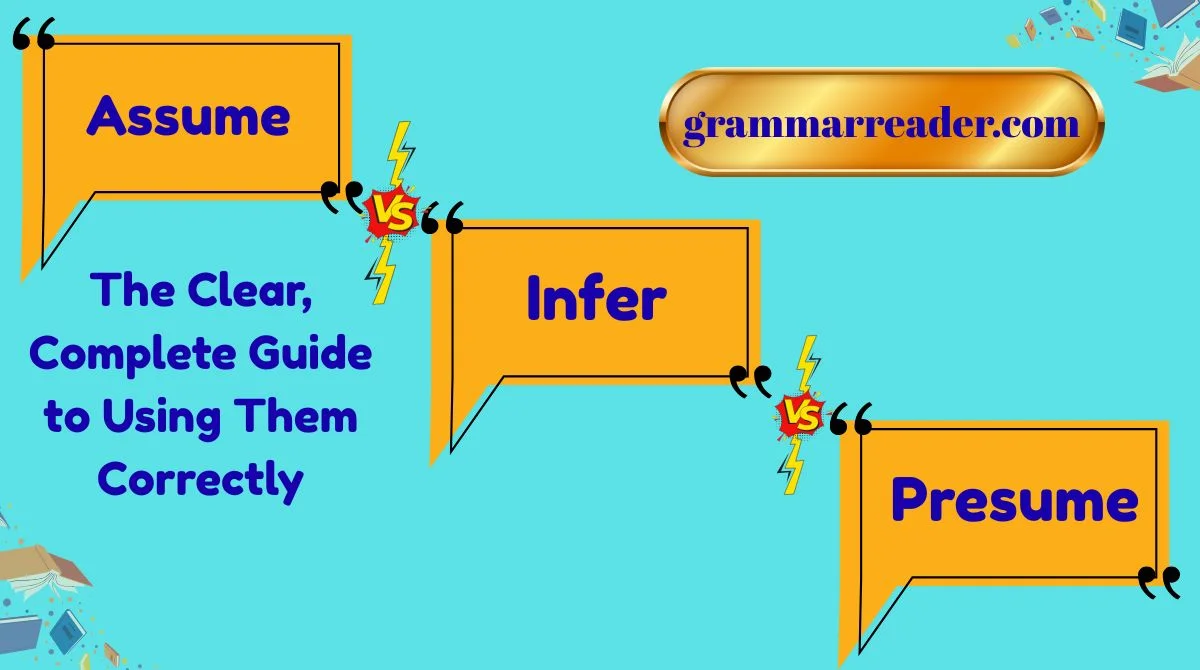
English has many verbs that look similar but behave very differently. Assume, presume, and infer sit at the top of that list.
They appear in daily conversations, academic writing, news reports, and professional emails. Yet people misuse them constantly.
Why?
Because these verbs all deal with belief and understanding, but each one works at a different evidence level.
Use the wrong one, and your sentence sounds careless.
Use the right one, and your writing feels precise, confident, and intelligent.
This in-depth guide breaks down assume vs presume vs infer in simple language. You’ll see clear definitions, real examples, tables, comparisons, and memory tricks. By the end, you won’t hesitate again.
Why Assume, Presume, and Infer Are So Confusing
All three verbs describe what happens in the mind. None of them describe physical action. That overlap creates confusion.
But here’s the key idea:
These verbs are not about what you think.
They’re about why you think it.
The difference lies in evidence.
- Assume → little or no evidence
- Presume → some evidence or probability
- Infer → clear evidence and logical reasoning
Once you understand that ladder, everything else falls into place.
How These Verbs Function in English
Before defining each word, it helps to see how they behave as verbs.
Shared features
- All express mental processes
- All involve belief or conclusion
- All depend heavily on context
Critical difference
- They signal different levels of certainty
That certainty level affects tone, credibility, and clarity.
In formal writing, choosing the wrong verb can weaken an argument. In conversation, it can make you sound rude or careless.
What Assume Really Means
Assume means to accept something as true without proof.
It often reflects:
- Guesswork
- Personal belief
- Lack of verification
When you assume, you skip the evidence step.
Core meaning of assume
To believe something is true without checking or confirming it.
Key characteristics of assume
- No solid evidence
- Often subjective
- Can be risky or misleading
- Common in casual speech
Real examples of assume in context
- I assumed the meeting was canceled.
- She assumed he knew the rules.
- Don’t assume everyone agrees with you.
In each case, the belief may turn out wrong. That’s the danger of assuming.
When assume sounds weak or careless
In professional or academic writing, assume can signal poor reasoning.
Compare these:
- Weak: I assume the results are accurate.
- Stronger: The data suggests the results are accurate.
Assume tells readers you didn’t verify.
What Presume Actually Implies
Presume sits one level above assume.
It means to believe something is true based on probability, experience, or partial evidence.
You’re not guessing blindly. You’re making an educated expectation.
Core meaning of presume
To believe something is likely true based on available information.
Key characteristics of presume
- Some evidence exists
- Sounds more formal than assume
- Often used in legal or professional contexts
- Suggests reasonable expectation
Real examples of presume in context
- I presume the train is late due to weather.
- We presume consent unless stated otherwise.
- The court presumes innocence.
Here, the belief isn’t random. It’s grounded in logic or rules.
Presume in legal and formal language
Presume often appears in laws and policies because it balances belief and caution.
Example:
A person is presumed innocent until proven guilty.
That sentence would sound reckless with assumed.
What Infer Means (And Why It’s Different)
Infer operates at the highest evidence level.
It means to reach a conclusion by analyzing facts, clues, or data.
Inference requires thinking. You connect dots.
Core meaning of infer
To draw a logical conclusion from evidence.
Key characteristics of infer
- Requires evidence
- Involves reasoning
- Stronger and more precise
- Common in analysis and education
Real examples of infer in context
- From his silence, she inferred disapproval.
- Scientists infer patterns from data.
- Readers infer meaning from context.
Inference is not guessing. It’s logical deduction.
Evidence Ladder: Choosing the Right Verb
The easiest way to choose between assume vs presume vs infer is to ask one question:
How much evidence do I have?
Evidence-based decision table
| Verb | Evidence Level | Certainty | Mental Action |
|---|---|---|---|
| Assume | None or very little | Low | Guessing |
| Presume | Some or probable | Medium | Expecting |
| Infer | Clear and logical | High | Concluding |
This table alone can guide most writing decisions.
How Evidence Changes the Verb You Should Use
Let’s see how the same situation changes with each verb.
Scenario: A colleague hasn’t replied to an email.
- Assume: I assume she’s busy.
No proof. Just a guess. - Presume: I presume she’s in meetings today.
Based on her schedule. - Infer: I infer she’s unavailable because her calendar is full.
Based on clear evidence.
Each sentence signals a different level of thinking.
Common Mistakes and Why They’re Wrong
Even advanced speakers make these errors.
Treating assume and presume as interchangeable
They overlap, but tone changes.
- Assume sounds casual or careless
- Presume sounds reasoned and formal
Using assume in formal writing can weaken authority.
Confusing infer with imply
This mistake is everywhere.
Imply is done by the speaker or writer.
Infer is done by the listener or reader.
Example:
- He implied dissatisfaction.
- I inferred dissatisfaction.
They describe opposite sides of communication.
Using assume when inference is required
Bad:
- I assume the conclusion from the data.
Better:
- I infer the conclusion from the data.
Data demands reasoning, not guessing.
Infer vs Imply: A Critical Distinction
This deserves special attention.
Simple rule
- Speakers imply
- Listeners infer
Example dialogue
Speaker: “It’s getting late.”
Speaker implies they want to leave.
Listener infers the intention.
Switching these verbs reverses meaning.
Real-Life Scenarios: Choosing the Correct Verb
Workplace communication
- Assume sounds unprofessional
- Presume fits emails and reports
- Infer fits analysis and strategy
Academic writing
- Assume weakens arguments
- Presume signals cautious belief
- Infer strengthens conclusions
News and reporting
- Reporters avoid assume
- They rely on infer and presume
Casual conversation
- Assume is common and acceptable
- Precision still improves clarity
Are Assume and Presume Ever Interchangeable?
Sometimes. But context matters.
When they overlap
- Casual speech
- Low-stakes statements
When they don’t
- Legal writing
- Academic arguments
- Professional communication
Presume almost always sounds safer and more thoughtful.
Practical Memory Tricks That Actually Work
The Evidence Ladder Trick
No evidence → assume
Some evidence → presume
Clear evidence → infer
One-sentence rule
- Assume guesses
- Presume expects
- Infer concludes
Say that three times. It sticks.
Case Study: One Sentence, Three Meanings
Sentence base:
She didn’t respond to the message.
- I assumed she was ignoring me.
Emotional guess. - I presumed she was busy.
Reasonable expectation. - I inferred she was offline because her phone was off.
Evidence-based conclusion.
Same facts. Different thinking quality.
Why Word Choice Affects Credibility
Strong writing reflects strong thinking.
Readers trust writers who:
- Signal evidence clearly
- Avoid careless assumptions
- Draw logical conclusions
As philosopher Bertrand Russell once noted:
“The trouble with the world is that the stupid are cocksure and the intelligent are full of doubt.”
Choosing infer instead of assume often shows intelligence, not arrogance.
FAQs About Assume, Presume, and Infer
What does assume mean in simple terms?
Assume means to believe something without checking or proof.
How is presume different from assume?
Presume is based on likelihood or partial evidence. Assume is not.
What does infer mean in English?
Infer means to reach a conclusion using evidence and reasoning.
Can infer and imply be used interchangeably?
No. Speakers imply. Listeners infer.
Which verb is best for formal writing?
Presume and infer are safer and more professional than assume.
Final Summary
If you remember only one thing, remember this:
Assume guesses.
Presume expects.
Infer concludes.
That single framework removes confusion.
When you choose the right verb, your writing becomes sharper, clearer, and more credible. You stop sounding unsure. You start sounding intentional.
That’s the real power of mastering assume vs presume vs infer.

Aiden Brooks is an educational writer dedicated to simplifying grammar for learners of all levels. He creates clear, practical explanations that help students read, write, and understand English with confidence.