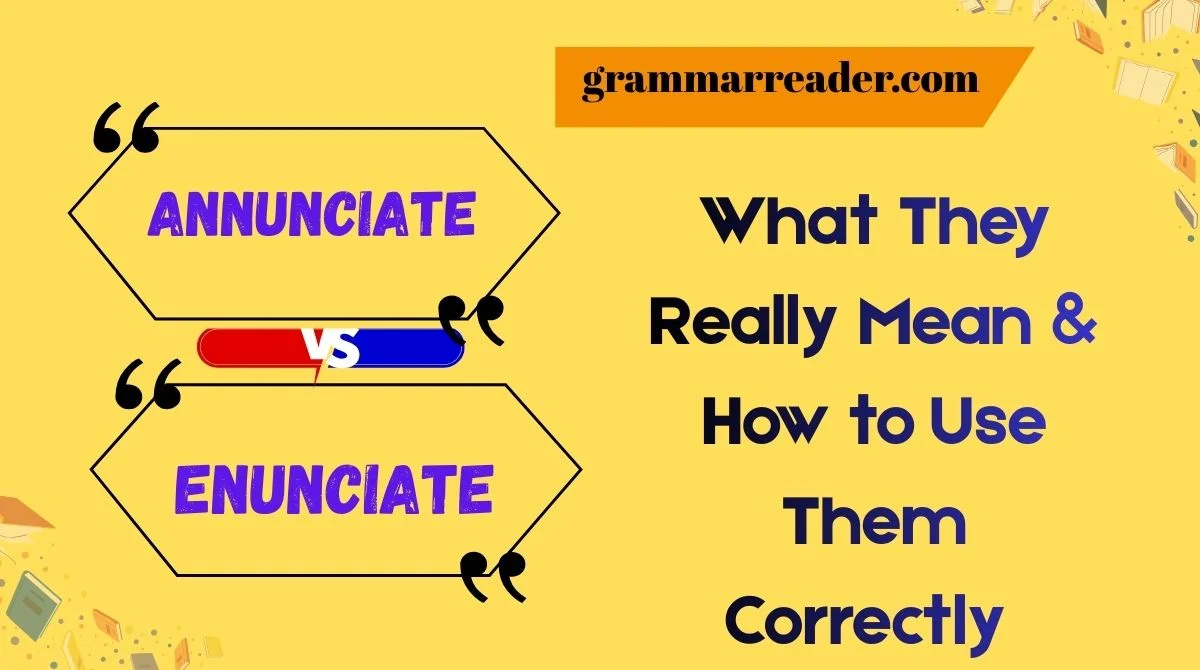
Understanding the difference between annunciate and enunciate sounds simple, but these two look-alike verbs often trip people up.
One deals with declaring information, while the other deals with pronouncing it. Once you get the distinction, you’ll never mix them up again—and your communication will instantly feel sharper.
This guide breaks everything down in a clear, friendly way using examples, tables, analogies, case studies, and bite-sized explanations. Let’s dive in.
Annunciate vs. Enunciate: Why People Mix Them Up
Both words sound similar, both come from Latin, and both involve expressing something. That’s why writers, students, and even professionals accidentally swap them.
But here’s the real difference:
- Annunciate means to announce or proclaim something formally.
- Enunciate means to pronounce words clearly.
They don’t overlap. One is about the message, and the other is about the sound.
A simple memory trick:
Annunciate = Announcement
Enunciate = Enunciation (clear speech)
This alone helps most people keep them straight.
The Origins Behind Annunciate and Enunciate
Both words traveled a long linguistic road, but their paths split clearly.
Etymology & Historical Roots
| Word | Origin | Original Meaning | Modern Evolution |
|---|---|---|---|
| Annunciate | Latin annuntiare | to announce | tied to formal or religious announcements |
| Enunciate | Latin enuntiare | to speak out, articulate | connected to pronunciation and speech clarity |
Even though both came from similar Latin roots, they matured into two very different verbs.
How Each Word Evolved
Annunciate
Historically used in religious and ceremonial contexts. The term often appears in theological writings referring to formal declarations. Over centuries, the word became more niche and rare outside formal writing.
Enunciate
This term quickly attached itself to speech, especially clear articulation. Today, you’ll hear teachers, coaches, parents, and public speaking trainers use it frequently.
What “Annunciate” Means (and When to Use It)
Core Definition of Annunciate
Annunciate means to announce, proclaim, or declare something, usually in a formal tone.
While the word isn’t as common today, you’ll still see it in ceremonial language, literature, and official announcements.
When Should You Use Annunciate?
Use annunciate when:
- The declaration is formal
- The announcement has ceremonial or official weight
- You want a literary tone
- Referring to religious proclamations (e.g., “The Annunciation”)
Examples of Annunciate Used Correctly
- “The priest will annunciate the start of the ceremony.”
- “She rose to annunciate the kingdom’s new laws.”
- “The ambassador will annunciate the final agreement.”
Key Characteristics of “Annunciate”
- Formal
- Rare in casual conversation
- Tone: official, ceremonial, elevated
- Focused on the message being announced
What “Enunciate” Means (and Why It’s Common Today)
Core Definition of Enunciate
Enunciate means to pronounce words clearly and distinctly.
This word focuses on speech clarity, diction, and pronunciation.
When Should You Use Enunciate?
Use enunciate when speaking about:
- Public speaking
- Communication
- Speech therapy
- Acting
- Customer service
- Presentations
- Language learning
Examples of Enunciate Used in Context
- “Please enunciate so the audience can understand you.”
- “He tends to mumble, so his coach asked him to enunciate every consonant.”
- “The teacher encouraged students to enunciate their answers.”
Key Characteristics of “Enunciate”
- Very common
- Used in teaching and communication
- Practical, simple, everyday
- Focused on clarity of sound
Annunciate vs. Enunciate: The Core Comparison
Here’s the simplest way to see the difference:
| Feature | Annunciate | Enunciate |
|---|---|---|
| Meaning | Announce or proclaim | Pronounce clearly |
| Tone | Formal, ceremonial | Everyday, instructional |
| Field | Religious, official, literary | Communication, speech |
| Frequency | Rare | Very common |
| Example | “He annunciated the decree.” | “Please enunciate each word.” |
A Quick Analogy
Think of it like this:
- Annunciate is what someone does when standing at a podium announcing a major event.
- Enunciate is what someone does to make sure the people hearing them understand every word.
Why Speech Clarity Matters: Enunciation in Real Life
Enunciation affects credibility, professionalism, and connection with listeners.
Why Enunciation Matters
- Reduces misunderstandings
- Makes the speaker sound confident
- Helps with accent clarity
- Supports effective teaching and presentations
- Enhances customer or client communication
- Prevents frustration for the listener
Where Enunciation Is Especially Important
- Call centers
- Public speaking
- Broadcasting and acting
- Teaching
- Voice-over work
- Courtrooms
- Leadership roles
Practical Tips to Improve Your Enunciation
Slow Down
Rushed speech leads to swallowed syllables.
Open Your Mouth More
Clear articulation requires space.
Record Yourself
You’ll instantly hear where words get blurred.
Practice Tongue and Lip Exercises
Try:
- Saying tongue twisters slowly
- Exaggerating vowel sounds
- Touching lips while saying “p,” “b,” “m” to feel clarity
Use Controlled Breathing
Better breath = stronger voice.
Speak With Intention
Think about each word before speaking it.
Sentence Examples: Annunciate vs. Enunciate
Examples Using Annunciate
- “The general stepped forward to annunciate the terms of surrender.”
- “During the ceremony, the elder annunciated the crew new tradition.”
- “The oracle annunciated the prophecy before the crowd.”
Examples Using Enunciate
- “If you don’t enunciate, your listeners may miss important details.”
- “She practiced daily so she could enunciate every syllable on stage.”
- “The instructor asked him to enunciate the vowels more clearly.”
Case Study: How Enunciation Changed a Career
Background:
Maria, a customer support representative, consistently received customer complaints that she spoke too fast and wasn’t clear.
Problem:
Her unclear speech caused misunderstandings and longer call times.
Action Taken:
She worked with a communication coach who trained her to enunciate, slow down, and breathe between phrases.
Results:
- Call clarity improved by 40%
- Customer satisfaction increased
- She was promoted to team lead in six months
Lesson:
Clear enunciation doesn’t just help people understand you—it can change your professional trajectory.
Case Study: A Writer’s Confusion Between Annunciate and Enunciate
Background:
A new blogger used annunciate in place of enunciate while writing about public speaking skills.
Problem:
Readers left comments pointing out the misuse, damaging credibility.
Fix:
The blogger rewrote the article using the precise definitions and added examples.
Outcome:
The corrected article gained traction, with many readers praising the clarity.
Lesson:
Knowing the difference between annunciate and enunciate isn’t just academic—it protects your authority as a writer.
FAQs
What is the difference between “annunciate” and “enunciate”?
Annunciate means to announce or proclaim, while enunciate means to pronounce words clearly.
Can I use “annunciate” in everyday speech?
You can, but most people use simpler words like “announce.” Annunciate sounds formal or ceremonial.
Why is enunciation important in communication?
Clear enunciation prevents misunderstandings, improves professionalism, and strengthens your voice.
How can I improve my enunciation quickly?
Slow down, open your mouth more, use tongue exercises, and record yourself for self-feedback.
Can I use both words in the same sentence?
Yes—example: “He annunciated the rules, but he didn’t enunciate them clearly.”
Conclusion
The difference between annunciate and enunciate becomes obvious once you connect each word to its purpose. One is about declaring, the other about pronouncing.
Using them correctly strengthens your writing, sharpens your communication, and prevents embarrassing mix-ups.
Whenever you write or speak, remember:
- Annunciate = Announce
- Enunciate = Speak clearly
Simple, memorable, and accurate.

Aiden Brooks is an educational writer dedicated to simplifying grammar for learners of all levels. He creates clear, practical explanations that help students read, write, and understand English with confidence.