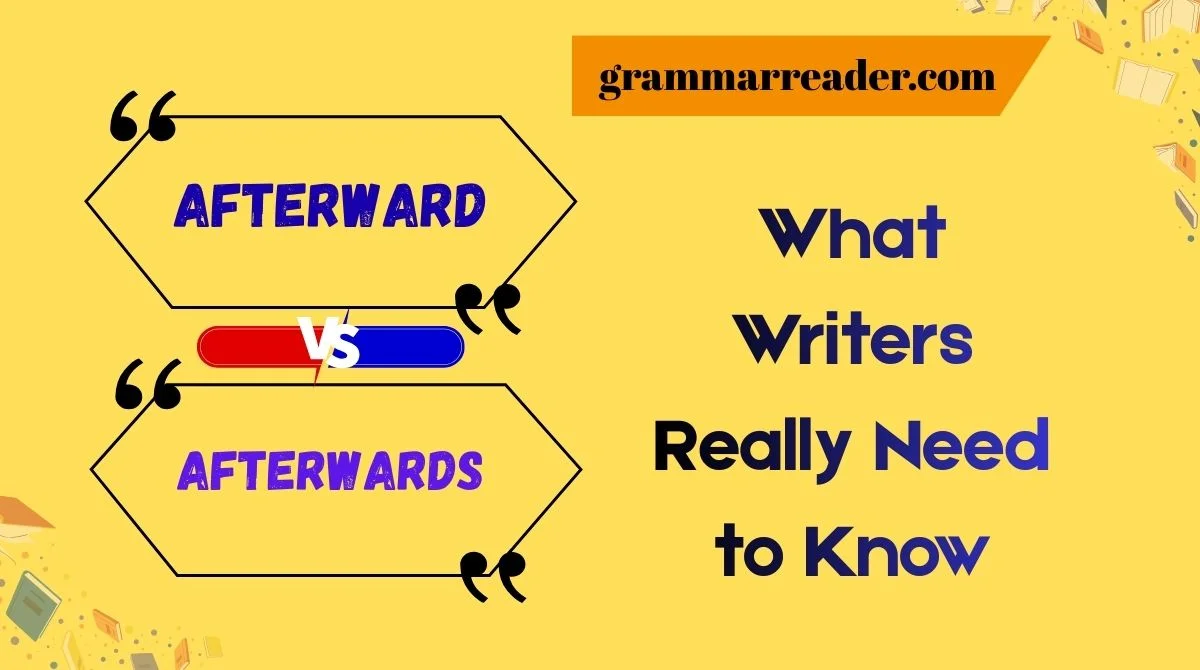
Understanding the difference between afterward and afterwards seems simple at first, yet writers often hesitate before choosing one.
Both words look alike, sound alike, and share nearly identical meanings — so why do they cause so much confusion?
In this in-depth guide, you’ll learn exactly how these words work, where they come from, and how to pick the right one without second-guessing yourself.
We’ll explore grammar, history, usage differences, common mistakes, and practical tips. By the end, you’ll know exactly when to use afterward and afterwards, and you’ll never confuse them with afterword again.
Let’s begin.
Afterward vs. Afterwards: The Complete Guide for Writers
Introduction: Why These Two Words Confuse So Many Writers
Writers run into this problem all the time. You’re typing fast, trying to keep your flow going, and suddenly your brain stops working:
“Should I write afterward… or afterwards?”
Both look correct. Both “feel” right. But most writers still ask:
- Is one American and the other British?
- Is one more formal?
- Do style guides care which one I use?
- Is one outdated?
This guide clears up every one of those questions. We’ll walk through real examples, grammar rules, regional differences, and the small nuances writers often miss.
The Core Difference Between Afterward and Afterwards
Let’s start with the simplest, most important fact:
Both words mean the exact same thing.
They both mean “at a later time” or “after something else happens.”
Examples:
- We went to dinner and afterward watched a movie.
- We went to dinner and afterwards watched a movie.
Both are correct. Both express the same idea.
So why do we have two versions?
Because English inherited two different suffix styles:
- –ward
- –wards
This variation shows up in other word pairs too:
| American Style | British/Commonwealth Style |
|---|---|
| forward | forwards |
| toward | towards |
| upward | upwards |
| afterward | afterwards |
Both forms are grammatically correct. The difference is preference, not meaning.
Origins of the Words
To understand why these forms exist, we need to look at Old English.
Where the –ward and –wards suffixes came from
The suffix –weard in Old English meant “direction toward something.”
Over time:
- “–weard” became –ward
- adding –s created –wards, meaning “in the direction of”
Originally, the –s form was used more often in everyday speech.
As English evolved:
- British English kept both forms but leaned toward –wards.
- American English dropped the –s in most cases.
This explains why “afterward” and “afterwards” still coexist today.
Regional Usage Patterns: Who Uses Which?
Here’s the simplest explanation:
American English prefers “afterward.”
British English prefers “afterwards.”
This doesn’t mean the other form is wrong — only less common.
Regional Usage Table
| Region | Most Common Form | Notes |
|---|---|---|
| United States | afterward | “afterwards” is still understood but rarely used in formal writing |
| United Kingdom | afterwards | considered the default spelling |
| Canada | both | though “afterward” is slightly more common in publishing |
| Australia | afterwards | follows British patterns |
| India, Pakistan, South Africa | afterwards | British influence dominates |
Why the difference?
Because Noah Webster — the man who shaped American spelling — purposely simplified and standardized U.S. English. Removing the –s was part of this movement.
Real-World Usage Examples
Examples from American Writing
American publications lean toward afterward:
- “He spoke to reporters afterward.” — The New York Times
- “We met for coffee afterward.” — Washington Post
- “The meeting ended, and afterward the team regrouped.” — Chicago Tribune
Examples from British Writing
British writers prefer afterwards:
- “We met afterwards to discuss the change.” — The Guardian
- “The team celebrated afterwards.” — BBC
- “The matter was resolved afterwards.” — The Telegraph
Tone and Formality
Both words work in formal and informal writing. The choice is mainly regional and stylistic — not based on tone.
Grammar and Part of Speech: How the Words Function
Both afterward and afterwards function as adverbs.
They answer the question:
“When did the action happen?”
They do not function as:
- nouns
- adjectives
- verbs
Correct grammatical placement
You can place them:
- at the end of a sentence
- after the verb
- after a clause
Examples:
- We talked afterward.
- She left the room and afterwards apologized.
- Afterward, they went home.
Incorrect usage:
❌ The afterward of the event was exciting.
(“Afterward” cannot be a noun.)
Common Confusion: Afterward vs. Afterword
This is the part that trips up most writers.
Afterword is NOT the same as “afterward/afterwards.”
Afterword (with –word) means:
A short concluding section in a book, often written by the author.
Example:
- The author included an afterword explaining the story’s inspiration.
Why people confuse them
They look similar, only one letter apart. But the meanings are completely different.
Here’s a quick comparison:
| Word | Meaning | Type |
|---|---|---|
| afterwards / afterward | later, at a later time | adverb |
| afterword | a concluding note in a book | noun |
Side-by-side examples
- The book included an afterword, and afterward we discussed it in class.
- She read the afterword afterwards.
Once you know the difference, you’ll never mix them up again.
How to Choose the Right Word
Choosing between afterward and afterwards is easy when you know your audience.
Use afterward if:
- you’re writing for American readers
- you follow AP or Chicago style
- your company uses American spelling
Use afterwards if:
- your audience is British, Australian, or international
- you want a slightly more conversational, British tone
- you follow Oxford or Cambridge style guides
Style Guide Notes
Different style guides handle the choice differently:
- AP Style: prefers afterward
- Chicago Manual of Style: prefers afterward
- Oxford English Dictionary: recognizes afterwards as standard
- Cambridge Dictionary: lists both but shows afterwards as more common in British English
Professional Writing Recommendation
If your writing needs to appear polished, consistent, and region-appropriate:
- U.S. → “afterward”
- U.K. and Commonwealth → “afterwards”
Memory Tricks to Avoid Confusion
1. The “S for UK” Trick
“Afterwards” has an S.
“Britain” also starts with B, but “British English” ends with an S sound.
This helps you remember afterwards = British.
2. The “Shorter for America” Trick
American English likes shorter spellings:
- color (vs. colour)
- center (vs. centre)
- analyze (vs. analyse)
So:
afterward = American
3. The “Word vs. Time” Trick
To remember afterword:
An afterword has the word word inside it → it belongs to books.
4. The Movie Timeline Trick
Imagine watching a movie:
- Credits → afterword
- Walking out of theater → afterward/afterwards
5. The Sound Trick
Say them aloud:
- afterwards (longer, flows more)
- afterward (shorter, snappier)
British writers prefer longer, rounded sounds. Americans prefer clipped endings.
Case Study: How One Company Standardized Usage
A global tech company noticed inconsistent spellings in its blog posts. Some writers used afterward, some used afterwards, and others mixed both in a single article.
The content team reviewed analytics and readership:
- 75% of readers were American
- 15% were from Commonwealth countries
- 10% from other regions
To maintain consistency, they created a simple rule:
Use “afterward” in all external communication unless quoting a source.
The result?
- Fewer editing issues
- Higher reader clarity
- A cleaner, more consistent brand voice
Sometimes the right choice isn’t about grammar — it’s about consistency.
Short Quotes Writers Love
“Clarity is the writer’s first responsibility.” — Unknown
“Consistency makes writing feel intentional.”
“English gives you choices; good writers choose with purpose.”
These principles apply perfectly to afterward vs. afterwards.
FAQs
What is the difference between afterward and afterwards?
Both mean the same thing. The difference is regional: Americans prefer afterward, while British speakers prefer afterwards.
Is it wrong to use “afterwards” in American English?
It’s not wrong — just less common. Most American editors prefer afterward.
Which should I use in professional writing?
Use the version that matches your audience. For U.S. readers, choose afterward.
Are afterward and afterword the same?
No. Afterword is a noun meaning “a concluding section in a book.”
Can afterward or afterwards be used as a noun?
No. Both are adverbs. They cannot function as nouns.
Conclusion
Choosing between afterward and afterwards doesn’t have to be confusing. They share the same meaning, but regional preference shapes which one is more common.
American writers usually pick afterward, while British and Commonwealth writers lean toward afterwards. Once you understand the grammar, history, and context behind these words, the choice becomes effortless.
Both forms are correct — what matters is consistency, clarity, and knowing your audience.

Aiden Brooks is an educational writer dedicated to simplifying grammar for learners of all levels. He creates clear, practical explanations that help students read, write, and understand English with confidence.